You are currently browsing the monthly archive for November 2010.
I’ve always had a love-hate relationship with my hair. I’m a sproingy girl, so my wild curls kind of mesh with my personality. In middle school, my straight-haired friends would marvel at my effortlessly formed curly-Q’s; some would even stick their fingers inside the corkscrews and squeal with delight. (Seriously, they did.) And all the while, I coveted their straight, blunt cuts. I watched them brush and comb their hair, stared as they absently dragged their fingers through their locks. Après shower, I slathered my hands with V-05, a thick petroleum-like product, rubbed it all over my hair, and never touched my hair again for the entire day. If I dared to twirl or twist a dry tendril, it was over: frizz city.
About a year ago, I went to a fancy-schmancy event where I was the only woman in attendance with seriously curly hair. Everyone else had perfectly smooth, pin-straight, flat hair. It was confirmed. Clearly, G-d hated me. As we posed for a photograph, I sighed and commented how unfair it was that everyone else had such perfect hair while mine was so unruly.
“Honey,” said one of the women, “You need to meet Shawna.”
It took a while, but eventually, I found myself in Salon LuSandra, not my regular salon, thinking about my husband’s words that morning before I left.
“I will miss your curls,” he said.
“It’s an experiment!” I said.
“I love your curls,” Hubby said again with emphasis adding, “Your curls are one of the things that most attracted me to you…”
“You’ll learn to love other things…” I told Hubby, smooching him on the cheek. “And it’s only semi-permanent. In four months, the wild woman shall return.”
I sat on the wooden chair in the salon for about 35 seconds before an extremely adorable blonde materialized and introduced herself as Shawna: the woman who was going to make my curls go away.
There was no time for nerves. Shawna wrapped my neck in a black towel and had my head tipped back in the sink before I could ask but-what-if-my-husband-doesn’t-love-me-after-we-do-this. She washed my hair three times. She scrubbed and scoured my hair as if I were a nasty little street urchin who hadn’t washed in weeks, maybe months.
Once in her chair, Shawna applied a chemical mixture to every strand of my hair from root to tip. She explained that once she was finished, I would have to wait for 15-20 minutes to let the product saturate each follicle. She told me that if I did everything properly, the process would reduce 50% of the curl and 100% of the frizz.
Truth be told, I could not imagine what that even meant. I’ve always had frizz. I have always been the girl with crazy hair. In the decades before there were long aisles devoted to hair care products, if I attempted to use a blow dryer, I emerged a wild lioness – and I don’t mean in a sultry, beautiful way. I mean I had a mane that was enormous, fluffy and uncontrollable.
As she stood behind me in her black and white polka-dotted smock with skinny red trim, Shawna applied the chemicals. Wearing short black gloves that stopped just above her wrists, she painted and combed, making sure to coat every single strand, fussing over my tresses the way no-one has ever fussed before. She was serious about this procedure.
That’s when Shawna reviewed The Rules associated with Smooth Keratin Treatment. She told me that for the next four days I could not get my hair wet. No shampoo. No conditioner. I promised:
On my honor, I do swear, not wear my hair in a ponytail. Or use barrettes. Or clips or hats or headbands or any other fashion accessory that might leave a crease in my hair. I promise not to tuck my hair behind my ears. I promise to sleep carefully and, upon waking, I promise to touch up any bumps or lumps with a blow dryer and/or flatiron. I promise to wear a shower-cap while washing. I promise not to venture outside if there is any sign of precipitation.
But I was worried. I knew I had to teach over the next four days. What if I had to get to school while my hair was “curing” – and it just so happened to be raining? How would I get inside the building without getting my hair wet? I started making elaborate plans, involving umbrellas and shower caps and running shoes. I considered which colleague would not think less of me if I needed to leave a flat-iron in her office. In case of a hair emergency. In the end, I decided it would just be easier to cancel classes in the unfortunate case of poor weather.
Three hours into the procedure, I was amazingly relaxed. Maybe it was the cyclopentasiloxane (one of the ingredients in the Simply Smooth product). Maybe it was the prospect of no frizzies or the idea of not having to devote so many hours to hair care. Maybe it was just that Shawna knew what she was doing. Because she knew what she was doing.
Meanwhile, people wandered in and out and bubbled over with testimonials. They used words like “life-altering”: clearly, everyone loves this keratin treatment.
Eventually, Shawna removed my plastic hat, which was good because my eyes had started to tear up a little bit under there. She grabbed a dryer and started blowing-out my newly chemically treated hair. I was confused. My hair was still huge.
“Now we flat-iron every teeny-tiny section about five times,” Shawna explained.
For over an hour, Shawna tugged at my head.
And then it happened.
Someone walked by and said, “Oooh. Gorgeous hair.”
And I realized (or I thought that maybe, possibly) they could have been talking about my mop, except it wasn’t not a mop anymore. It was a head of flat, shiny hair that looked healthy and vibrant and felt really soft.
“Try not to touch it too much,” Shawna said.
The following four days were all about the hair. About not touching it and avoiding water.
Here are the results:
On this morning, I showered (with a shower cap) and used a flat-iron to dry any wet areas. See that one little “dip”? I got rid of that!
This is where things got tough. I had to conference with students, and I felt like my scalp may have smelled more than a little funky. I asked a good friend to give a sniff (good friends do things like this), and she said, “Not so bad.” I pressed on, impressed that my hair on day 3 looked even better than day 1!
I can’t lie. Day 4 was rough. Our family went to a football game, and I was terrified that I would see people I knew because – even though I had been showering my body, my head was stinky. Or, at least, I felt like it was. It was. I’m just putting it out there. I mean, I was coming up on 96 hours without shampoo.
So, this curly-haired girl now has straight hair. What used to take hours to try to accomplish can now be easily achieved in under 25 minutes. Do I miss my curls? Kinda, but this is a fun little hair vacation because I know they’ll be back. They always come back. And besides, if I don’t want to blow dry, I can wear my hair like this:
So it’s a win-win. I can wear my hair straight or wavy. And the biggest surprise of all? Hubby likes it! Only down note, I never realized how many products I would need to buy to have this hair. I had to buy a blow-dryer (never had one before), a flat-iron (never had that either), and I had to buy a boat load of products (shampoos, conditioner, serums, oils) that are specifically formulated to extend the life of the procedure; otherwise, the curls will return more quickly!
The procedure has confirmed it for me: curls or no curls, I’m still a wild woman. And while I am enjoying the change, I kinda like knowing my inner wild woman and my outer wild woman will be reunited in full force around March.
Has anyone else had a “hair experience”? Do tell!
So it’s Thanksgiving. I’ll tell you what I’m grateful for: My son, who decided to take over as today’s guest blogger and gave me a little extra vacation time. I was going to add more, but I think he’s about covered it.
Stuff I’m Thankful for at Eleven Years Old
1. Thanks for my family. They love and support me when I’m in a tough situation.
2. Thanks for life. It keeps me alive.
3. Thanks for friends. Those guys sometimes piss me off, but they are still awesome.
4. Thanks for entertainment. It makes us say: “ooh,” “aah,” and “oh no!”
5. Thanks for books. They help us learn and are great on car rides when you don’t want to get out of the car to do errands. You can say, “Do I have to go in? I’m reading.” That usually works.
6. Thanks for my Dad’s job. Without it we wouldn’t have enough money for everything we have today. Because everyone knows my mom’s job as a teacher doesn’t really pay very much.
7. Thanks for technology. Especially when it works.
8. Thank goodness for a little vacation. No school!
9. Thanks for blankets: Warmness!
10. Thanks for everything. Except the bad stuff. And luckily, we don’t have too much of that.
What are you thankful for?
I have a friend who, after two years as a full professor, is back down to adjuncting part-time due to budget cuts. A former student of mine earned his degree in math and special education and has been subbing for two years in an outstanding district, but he simply can’t seem to get his own classroom. And even though I am (currently) employed by a local community college, I recently decided to conduct an experiment to see if I, with my soon-to-be twenty years of classroom experience, could land even a part-time position in any school district within a desirable radius. I updated my resume and cover letter and applied to four local school districts.
Did I get a bite?
Not one!
At first I was bitter, but now I understand. There are too many teachers and not enough jobs.
What does this mean? Well, theoretically, it could be a good thing for our children. If the pool of applicants is supersaturated, then – hopefully – the weakest candidates will be tossed away quickly making way for the cream of the crop to land in our nation’s classrooms which, as we all know, are badly in need of help. Alas, I suspect it means that many positions will be “excessed” causing more teachers to scramble for fewer positions. It means greater numbers of students will be squished into classrooms, which will make it harder for them to learn. It means less adult supervision in the place where we really need them to receive specialized, individualized attention.
Meanwhile, I know plenty of people who have given up. Though stellar students themselves, each having received outstanding reviews during all phases of their student teaching experience, each has decided to leave the dream behind. One former student of mine just took an entry level position at an editing/publishing company last fall, after three years of looking for an elementary school position. She sent out hundreds of résumés, attended dozens of encouraging interviews, but just never could seal the deal. For years, she worked as a substitute teacher, earning $75-85 a day (with no benefits). I think she files and makes people coffee now. Seriously. I’m not kidding. To do these things, one does not necessarily need to attend college.
“It’s ridiculous,” my former student says, “Spending all that money for an education I can’t use has been beyond frustrating. But really I had no choice. I needed benefits. And I needed to make money.”
How can we continue to allow good students to go through graduate school to become educators if the jobs are not there for them when they come out the other side?
So, my little experiment, though simultaneously interesting and humbling, meant little for me. I am one of the lucky ones: I have a job that I love.
For now, anyways.
Today is my birthday. I’m um… a year older than I was last year.
Every year, for as long as I can remember, my parents have sent me a birthday card. Generally, my card arrives about two weeks early. This year’s card arrived on November 11th, so they are getting closer.
Inside the card, my mom always tells me that I am beautiful, that she remembers my birth as if it were yesterday, (I’ll bet she does), and she wishes me happiness, good health and good luck.
My father always writes me a poem. Well, technically, they are written an anonymous poet, whose handwriting just so happens to look exactly like my father’s script. Since nobody writes anymore, I have come to cherish these little ditties that my father (I mean, “anonymous”) pens for me.
This year’s poem reads:
There once was a girl named Schuls
Who didn’t care much for jewels
Her greatest wish
Was for people to be good in English
And follow the grammar rules.
And it’s true: I don’t care much for diamonds or pearls or rubies or emeralds or gold. And I do wish everyone would walk around with his or her grammar style-book at all times (just in case of an “affect/effect” emergency). But my greatest wish is that my parents stick around for a really long time – at least another hundred years – and that they keep sending me their fabulously goofy cards once a year. At least two weeks early. Their continued wackiness makes getting older a little easier.
Do you have a favorite birthday ritual?
Whenever I take on a project, where I am in a leadership role, where there are deadlines, where visible, public failure is possible – I get positively crazed. The desire for perfection makes me hustle to work, work, work – and in striving for perfection, the craziness kicks in.
This weekend I was grading essays. The. Entire. Weekend. You could not get me to stop. My husband came in at 2 pm and begged me to stop. My son came in at 3 pm and begged me to stop. They tried to stop me. They offered food. “I’ll eat when I am finished,” I said. I couldn’t be stopped. I was . . . driven.
Thankfully, I don’t have this problem with shopping (or sex) because it is powerful and unstoppable, and it would likely land me in the poorhouse or, in the case of the latter, in a starring role in an episode of Californication.
Hours later, after I’d completed all the grading, I felt miserable that I’d neglected my family all day. That isn’t right. I will try to be more mindful about this in the future. For once, I’d like to be in the club, rather than always being the “leader of the band.”
Related Articles
- Biting off More Than I Can Chew… (weddingbee.com)
Not too long ago, my 6th grade Monkey had to sign several contracts – various agreements between himself and sundry teachers and coaches.
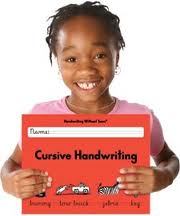
“Do I have to write in cursive?” 11 year-old Monkey asks.
“It’s probably a good idea,” I reply.
There is a pause. Silence during which time I assume he is signing his name on the assorted colored sheets of papers. But after a while, I glance over and notice he has written only the first three letters of his first name. He is looking off into space, clearly stuck.
“Mom,” he says eventually.
“Mmmmm?” I ask, pretending to be oblivious but definitely aware of his dramatic pause. But I’m thinking to myself, maybe boy has some deep moral, ethical or philosophical opposition to being asked to sign a particular contract. I’m thinking maybe he is hung up on one of the terms. Maybe something seems unreasonable to him, and he is not willing to just sign on the dotted line. For a moment, I’m actually proud. I figure he’s read the contracts and internalized the content, and now he has questions, reservations. He’s thinking critically about his commitments and if he can take on more responsibility. . .
“I can’t remember how to make a “v” in cursive,” boy announces. “I kinda forgot how.”
My child is in 6th grade. He is a stellar student. How could it be that he has forgotten how to make his “v’s” in cursive? I wonder. But I am patient. The school year is just kicking off, and he has been away for three weeks at overnight camp, playing in the dirt with friends, enjoying the heat of summer, so maybe he needs a quick mini-lesson.
“Sure, honey,” I say and prepare to give him a quick tutorial in cursive – which morphs into an elongated lesson because, as it turns out, Boy doesn’t remember how to make a capital “J” (which, for the record, is the first letter in his last name); neither does he recall how to make a lower case “b” (also a letter represented in his last name!)
At this point, I hear the ocean in my ears.
This is never a good thing as it generally means a giant wave is rising up from the deepest, angriest depths of me, and it generally culminates in a boatload of phone-calls.
“Buddy.” I ask Mr. Calm, Cool and I’m-Not–Worried-At-All-That-I Don’t-Know-My-Alphabet-In-Cursive, “How is it that you do not know all your cursive letters?”
My son proceeds to explain to me that, while cursive letters were taught in 3rd grade, his teachers didn’t really require that he (or any of his classmates) write in cursive.
“Writing in cursive was pretty much optional,” Boy tells me.
Optional?
Optional!
(Can you hear the Atlantic, the Pacific, the Antarctic and Indian Oceans rolling around inside my head?)
I couldn’t help myself. I made a few phone-calls to a few principals (who shall remain nameless) in a few local public schools (which shall remain nameless) in a few nearby districts (which shall also remain nameless). Most principals agreed that there is just so much material to cover to prepare students for standardized tests, that many things have had to go. (Damn you, No Child Left Behind!) One administrator told me that decisions had been made (note the passive voice) to focus less on cursive writing but that students could select cursive as “a font option” when printing from their computers.
Cursive? As a font option?
Really?
Hold on folks. I’m going back for a nostalgia moment.
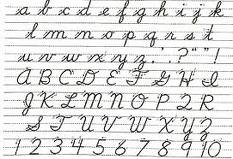
I remember a time when we kids couldn’t wait to move from our world of block letters to the world of cursive which was infinitely more adult. (And I’m not the only one who felt this way! Read Kathy English’s awesome essay on the death of cursive!) My babysitters used cursive to write notes to each other, but I could never read their words as they were like some crazy, secret code I couldn’t decipher no matter how hard I tried. But I knew that one day I would eventually be deemed mature enough to learn “The Code,” that I would figure out how to connect letters by one single, continuous stroke. I knew I would learn to create words in loopy cursive letters and that, ultimately, I would be able to read my grandmother’s shaky script, my mother’s slanted hand, as well as my my teacher’s perfect penmanship.
In the 18th and 19th centuries, cursive was one’s special signature. It distinguished one individual from another. The most elite received special training, and possessing a “fair hand” was considered a desirable trait for both men and women.
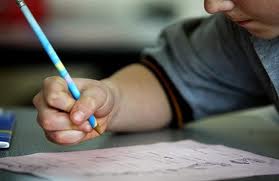
By the 1960s, a standardized method for teaching penmanship called D’Nealian Script had been introduced into schools all over the United States, and handwriting became more homogenized. I didn’t know any of this, of course, as I sat in class in 3rd grade in the mid-1970s. All I knew was that during “cursive time,” each of us learned to write the same way: on thin, oatmeal-colored paper that consisted of two straight continuous horizontal lines with one dashed line in the middle. We students sat with our pencils poised “at the basement” of the line ready to “go all the way up to the attic” or to stop “at the first floor.”
I remember being totally geeked up about learning cursive, but apparently, not everyone was as psyched about switching to cursive as this twit. And while I might have considered learning cursive a bit like taking a second art class, apparently, it wasn’t that way for everyone. For some kids, learning cursive was really difficult. I remember “the lefties” really struggled as did a bunch of kids who probably would have been diagnosed with some kind of fine-motor skill problem if they were going through the ranks today. But they didn’t test kids for things like that back in the 1970s. Instead, our teachers encouraged us (or goaded us, or punished us) until we learned our letters. And while we weren’t necessarily good at it right away, with daily practice, our shaky letters improved.
I wrote all my papers in cursive until my senior year in high school in the mid-1980s when my father brought home an enormous TRS-80 around the same time teachers were setting up the first “computer lab” at my high school.
So much has changed in twenty-five years! With the advent of word-processing and PDA’s and all things electronic, cursive has completely fallen out of favor. In fact, it has almost gone the way of the dinosaur. Without a doubt, typing is infinitely faster and easier to read than handwritten papers – but, now that I hear that cursive is not being reinforced, I wonder, is something being lost in making cursive optional?
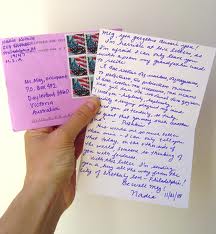
First, there is the obvious, esoteric stuff. When written properly, cursive is beautiful. Reading a handwritten note from a friend or lover is actually a completely different experience than reading the same content typed. Don’t believe me? Go back and look at some old photo album that belonged to somebody’s great grandmother. Look at the handwriting. You can actually feel something of the person in the handwriting. It is so much more intimate than reading something on a piece of paper that looks like it came from a school or the mortgage company. Have you ever received a thank-you note via email? Ewwwww. What about a thank-you via text? Double ewwwwww! There is nothing more lovely than holding a card in your hands where someone took the time to write a nice note thanking you for something that you did for them. I swear, you can feel the gratitude in the loops.
But “pretty” probably isn’t a good enough reason to keep cursive in the curriculum, right?
Ever the pragmatist, my husband says cursive will likely eventually disappear along with so many other “quaint niceties” like handwritten thank-you notes. He says the convenience of email and text will drive us away from handwriting altogether and computerized voice recognition and grammar programs will continue to improve. Hubby points out his signature is barely legible. It is his mark. “Well,” I countered, “At least you have a mark. Soon an entire generation of kids will be making X’s as they won’t be able to put their John Hancock on anything.” Hubby says I’m being overly dramatic, that I should calm down.
But I can’t calm down when I feel desperate inside. I’m the girl who still writes in journals and keeps yellow pads of paper filled with notes – all in cursive. My lesson plans are drawn up in cursive. My first draft of anything is always done in long-hand. I wonder what this means: if people cannot decipher their grandparents’ letters, how can they ever read important documents like our nation’s Constitution, Lincoln’s “Gettysburg Address” or our Declaration of Independence?
They’ll read those documents in textbooks,” Hubby responds. “Or online. More likely, they won’t read them at all.”
(I am pretty sure Hubby was just trying to pick a fight there.)
I shudder because as an educator I know things: the focus on cursive around third grade serves a larger purpose; it reflects the developmental connection between writing and thinking. Children who excel in handwriting skills tend also to excel in other academic pursuits. Cursive writing assists in the development of fine motor skills and muscle control, and it’s an introduction to self-expression. To abandon handwriting lessons could potentially interfere with the learning process as a whole.
I wish I could make some powerful claim that indicates students who are unable to read and write in cursive are guaranteed to score at least 100 points lower on their SATs than their cohorts who read and write in cursive. That would probably catch someone’s attention.
Doesn’t that look impressive?
Alas, I don’t have anything like that.
Sigh.
Americans are tired. We have been told that the sky is falling, the glaciers melting; the earth quaking; that strangers want to abduct our children, that neither government nor lawyers nor doctors can be trusted; the rain-forests are being destroyed; that – in fact – the entire cosmos is running out of time. So who can bother to get upset over my li’l ole lament over the loss of cursive handwriting?
I think I’ll go write-up a nice long grocery list – in cursive.
Just because I can.
Related Articles
- Handwriting skills waning, mother laments (cbc.ca)
- Mourning the Death of Handwriting (time.com)
- “Everybody Else Is Crazy” (andrewsullivan.theatlantic.com)
Scenario: You have been notified that your child has been arrested for doing something illegal. Your child has privately admitted to both you and your spouse that he did, in fact, do this thing.
Okay, it’s ethical question moment.
Would you make him accept the consequences, or would you hire the best lawyer you could afford and try to keep him out of trouble? Or is there some kind of middle ground?