Category Archives: Education

‘Sup With Grammar in America

Google Images

The other day I was in the grocery store when I distinctly heard a woman declare, “I should (pause) of gotten a salad.”

Should of?

What?

Should of is the equivalent of fingernails on the chalkboard for English teachers.

I believe the person meant to say, “I should’ve made a better lunch choice instead of opting for these nasty, greasy chicken wings.”

There is no such thing as should of.

And believe me, it took all of my self-restraint from correcting Mrs. Disgruntled Chicken Wing Eater.

Sigh.

Anyway, I am in love with this video. There must be something wrong with me.

Hubby walked out of the room as I tried to show it to him.

Am i the only person who cares that folks dont seem 2 no how 2 rite or speak proper any moor?

Do you have a grammar pet peeve? What is it?

School Is Not the Time To Make Friends

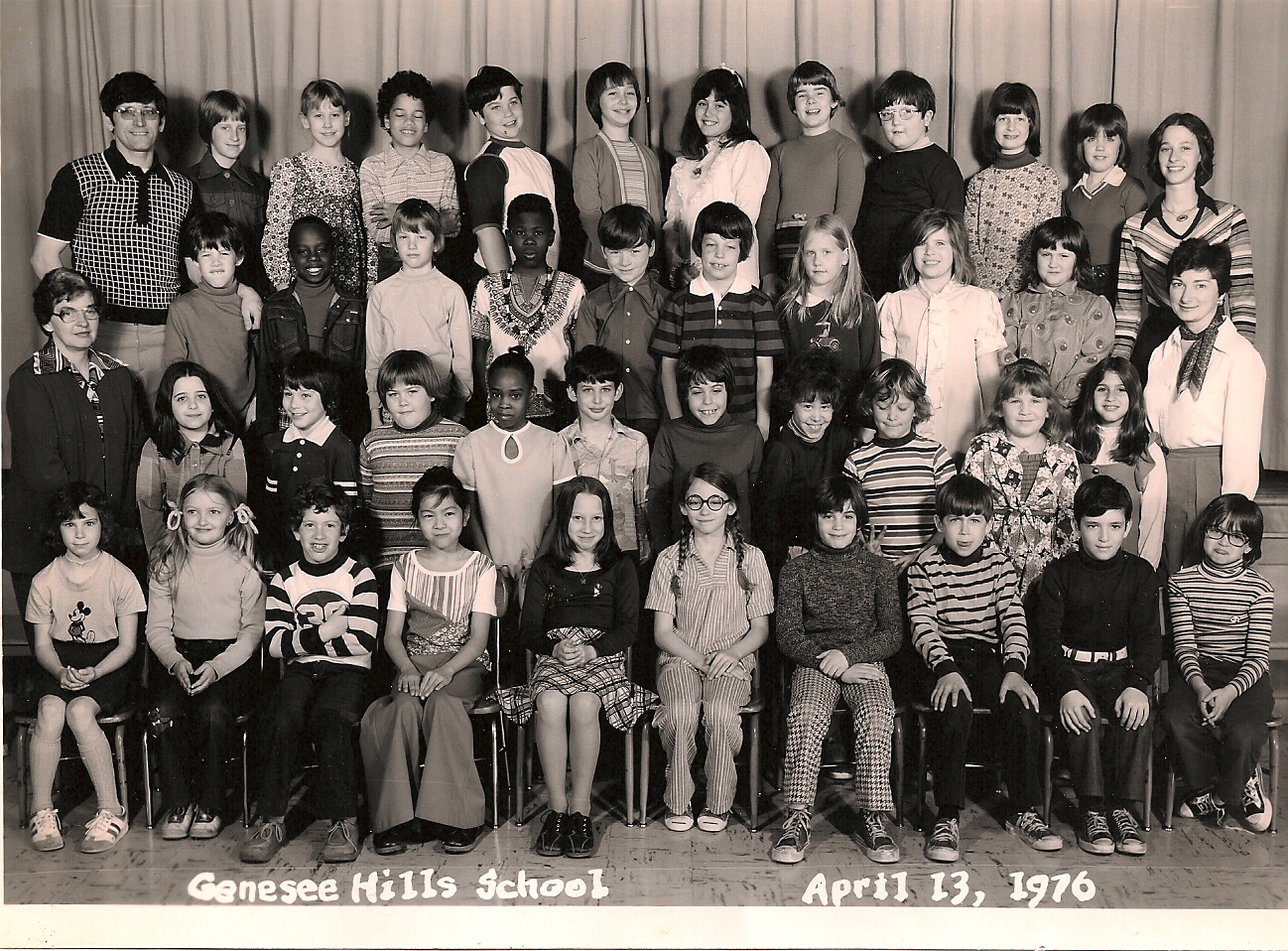
When I was a student at Genesee Hills Elementary School in the 1970s, we had quite a bit of free time during which we actually interacted with our peers: during lunch, recess, specials, sure. But also during class. In 3rd grade with Mrs. Marmillo and Mr. Barnello, we enjoyed an amazing invention called “Boy, Girl and Group of the Week.” A concept that would never fly now, I feel fortunate to have been part of this fabulous, classroom environment, and I know dozens of people who likely feel the same way.

Before I tell you about Boy, Girl & Group of the Week, keep in mind, this classroom phenomenon happened in 1976 — more than 30 years ago — so I could be wrong on some of the basics (so for those who may remember, feel free to chime in).

I want to say that on Friday afternoons, students from our two 3rd grade classrooms gathered together to nominate students as Boy and Girl of the Week. Students who went out of their way to do something nice for their peers were considered, so we said things like:

I want to nominate Jeff F. as Boy of the Week because he lent me a pencil when I didn’t have one.

or

I want to nominate Siobhan E. because she got me a tissue when I had a bloody nose, and then she helped me to the nurse’s office.

Meanwhile, our teachers sat quietly and made hash marks (or something) on a clipboard. Unless, we gave too many nominations to the same kid — in which case they would encourage us to look around the room and notice people who had possibly never been nominated, they were pretty silent.

When we finished, our teachers determined and announced the Boy, Girl and Group of the Week. (Maybe it was predetermined. It probably was.) The prize? Winners got the privilege of walking from our elementary school to Burger King, a little less than a mile away, sometime the following week along with our teachers. To get to BK, we walked on roads – not sidewalks. Yes, there were a few cars, but we walked – single-file in sun and in slush – to get to a hamburger, small fries and a soft-drink. It was heaven.

Imagine teachers pulling off this weekly field trip in 2010. It’s practically impossible.

First off, I have a feeling 90% of today’s parents would say they don’t like the idea because Burger King is fattening, and (in case you hadn’t heard), we have an obesity epidemic in our country. Okay, this may be the case when you are eating BK every day. But we weren’t back then. And we used our lunch and recess periods (both of which were longer than they are now) to walk to and from Burger King. The trek was just under 1.5 miles, but we walked briskly, so it was a good healthy walk.

We used our best manners while waiting in line. I remember standing in the BK queue, preparing to place my order — using my own voice to speak to an adult, “One hamburger, please,” I would say, careful to add, “Thank you.” Eating with my teachers and friends was a most amazing reward! We learned so much about each other during our walks to and from school and while sitting in the big booths together. We learned about our teachers’ families, their children. We learned if our classmates had siblings, what color our classmates’ rooms were painted, and if we liked to play the same games. We learned whose parents were divorced. Hell, we learned what the word divorce meant! We learned to speak, and we learned to listen.

I imagine, these days, most parents wouldn’t like the idea of children walking on main roads with traffic. Because people worry about things like that these days. Because someone could get hit by a car! Or get abducted! Or fall into a ditch and twist an ankle! (The last scenario was probably the most likely.)

As far as I know, my parents signed one skinny permission slip to allow me to go on the aforementioned trip off campus to BK and provided me with the requisite dollar or so to purchase my meal. These days, I imagine there would be a 12-page document that would have to be signed by parents, promising to waive their rights to this, that and the other thing. Back then, nobody worried that we were going to get hit by cars or fall in gulches or get kidnapped. Everyone just kind of assumed giving children additional privileges came with giving us additional responsibilities. People sought to broaden our world experience rather than limit our boundaries.

We had so many opportunities to practice civility in elementary school. It was okay to have a little idle chatter time built into our day. The classroom was the place where we learned our academics, but we also practiced our social skills. Today, I would imagine that most administrators would tell parents that there is simply not time for idle chitter-chatter. A few years ago a school administrator told me that “school is not the place for children to make friends.” She argued that kids needed to get involved in extra-curricular activities if they were interested in making friendships. She explained teachers needed to make the most of classroom time to prepare students for standardized tests, that teachers have more to teach than ever.

In 2010, I would argue “the civility piece” has fallen out of the curriculum — along with the belief that there are benefits to idle time. In 1976, it seemed like there was an emphasis on these things, as well as the other things we learned as by-products: patience (eventually everyone got to be Boy or Girl of the Week), paying attention to the little things, actually making an effort to help out a fellow student in need, being a good citizen (not just because it could get you a trip to Burger King but because it felt good). And a million other things, too.

And in this age of technology, a little more emphasis on these seemingly insignificant niceties could go far to help kids plug into each other and their behaviors. I mean, a student might not bully the kid upon whose vote he depends to get some kind of special reward.

And I would argue that sometimes the greatest life-lessons occur when it doesn’t appear that one is learning at all.

But that’s probably a hard sell these days.

I Hit a Wall


Google Images

Okay, I admit it. I’m being a little lazy.

First off, the whole plagiarism thing has left me exhausted.

Second, I fell down an entire flight of cement stairs, hit my head really hard, and I think I actually suffered a slight concussion. I’m okay now, but I don’t want to do that again. Picture me in my sassy, short skirt and tall boots with black stockings. I’m looking very professional and confident and competent when, suddenly, I miss a step and am rolling head over heels down down down about 12 steps where I proceed to slam into the wall (somehow) face-first.

Amazingly, I never let go of my unattractive wheelie bag that holds all my papers and my grade book. I hit my head really hard, and I think I actually suffered a slight concussion. I’m okay now. (What do you mean I am repeating myself?) Plus the plagiarism stuff has left me exhausted. (Did I say that already? I think I might have said that.)

Third, this brilliant blog entry was written by a former student of mine, Zach Sparer. His content is made to be inserted in a place where education and parenting collide, so I can’t not post it. (Was that a double negative? It was. It was a double negative. I’m really sorry. I hit my head earlier this week.) I mean, I have to post-it. Wait, not like Post-It, the company. I have to post it, without the hyphen.

Wow, so this is what happens when I hit a wall.

What I mean to say is that Zach’s stuff is good. Like I-wish-I-had-written-it-good. And this is the place where education and parenthood collide, right? (At least, that’s what is says up there at the top of the page.)

California and New Jersey are currently considering putting ads on school buses. So now I’m wondering: what is this Minneapolis school district thinking? You should click on this link and read the article now. (I know I usually summarize things more clearly, but I hit my head earlier this week, and I think I have a slight concussion, so I just feel like you should read the source material yourselves because there are a lot of big numbers in it.)

We all know times are tough, and schools are having to get creative about how they generate revenue to support certain programs. If they don’t get the dollars, they may have to cut valuable programs. But do we really want to turn locker space into advertising space? Will savvy advertisers start using students’ Facebook information to target individual locker users? You know personalized ads bombarding kids with images from their favorite stores, their favorite eateries, and coffee shops? Oh, and when the students start drawing all over the walls, that Minneapolis superintendent better not whine about it because nothing says, “Go ahead and write on the lockers, kids!” quite like these graffiti-ed up lockers. (Graffiti-ed?I just turned a noun into a verb. Yikes.)

Did I mention that I hit my head?

Nabbed a Cheater!

My cyber-friend, fellow blogger and educator, Clay Morgan, recently wrote a very funny blog about how we teachers notice when our students cheat. And I laughed because it was true: There are “peekers” and “sneakers” and “giraffers” and folks who try to write everything they can on their pencils and their shoes and their arms.

And then yesterday, I busted one of my students for some crazy, overt plagiarism, and suddenly it isn’t so very funny anymore. Well, it’s a little funny because the person copied from Wikipedia and left in the hyperlinks. But still, when you get down to it, it’s not that funny.

I hate this part. I hate this part. I hate this part. I hate this part of being an educator.

Let’s assume for the sake of ease that the cheater is male. Then I can avoid all the he/she stuff.

My thought is to have The Despicable One take a look at his paper along with a copy of the Plagiarism Contract which he signed earlier in the semester and ask him to respond in writing to three questions: 1) Why did he choose to copy directly from the source rather than paraphrase or summarize it? 2) Why didn’t he use in-text citation and include a Works Cited page at the end of his paper? 3) What does he think the most appropriate course of action would be in this situation?

When he is done writing (read: documenting the offense in his own handwriting), I will listen to what he has to say, explain to him how serious an offense this is, (because it is serious), and then I will think about it for a while.

So today I’m feeling a little snarky. A little annoyed, even.

Why? I guess because I feel plagiarism is just so dang silly. It is the laziest of all academic infractions. I can predict The Plagiarizer will say something like: “I didn’t know how do to it the right way, so I just didn’t do it.” That is what lazy people say. I guess I’m noting something of a character flaw in plagiarizers (as if other flaws aren’t obvious enough). I keep thinking, if I didn’t know how to do something, I would do my damndest to figure it out.

In this specific instance, for example, if I didn’t know how to cite properly, I would have called a classmate for assistance. I would have stopped playing BeJewelled on Facebook and looked online for tips of how to cite a paper. (There are a zillion free websites offering advice.) I might have looked in the style book which I was assigned to purchase at the beginning of the semester. If all that failed, I would have tried to indicate that I knew I was taking information from an outside source. I could have written:

Dear Professor-In-Charge-Of-My-Grade:

I am getting this information from reallycoolandfakewebsite.com, but I’m not sure how to cite it properly. (*hangs head in shame*)

When you get a chance, can you show me? I hope you won’t deduct too many points. (*lame attempt at humor*)

So so so sincerely,

Ashamed One

If I knew in advance that I were going to be in trouble with citation, I would have made at least one appointment with the folks at the college’s Writing Center (where one can schedule a free 30-minute tutoring session to really get some help on a paper). I might have even asked my teacher to meet with me. Because teachers want to help their students. Some will even skip lunch or blow off grocery shopping to help their students.

So I can tell this student started really, really late on this paper.

Like eleven o’clock at night: too late for phone calls or in-person tutoring sessions.

And, frankly, because of his procrastination and poor decision-making, I now have to make difficult moral decisions. And now, depending on how far I want to go with this, I will have a boatload of extra paperwork to handle. And copies to be made in triplicate. Because my Department Chair will need a copy. And so will Student Services. And I’ll probably have to hold on to this paper for the rest of my life. (Hubby, I have another important document for the fire safe…)

I guess you can tell that I have strong beliefs about integrity and honor and honesty. Basic values which everyone agrees seem to be on the decline. Interestingly enough, judging from the reaction that I’m getting from some of my students, they don’t see plagiarism as a big deal. I’ve tried to explain that it is a big deal. A very big deal. Because when you turn in something with your name on it, you are claiming to have authored those words and, when you haven’t, it is a lie.

In my eyes, The Despicable One is a liar and a cheater. Does he understand that I think of him as a person who steals ideas? That I can’t trust him or anything that he says? Ever? That I would never vouch for him for anything? How could I? He signed a banana-yellow piece of paper promising not to plagiarize, but he did.

I’m worried about this generation. So maybe my tone is annoyance with a side order of panic.

There have to be consequences for this transgression. This is not kindergarten, folks. I teach at the college level. This is where people learn life lessons. And sometimes people have to learn the hard way; after all, you don’t always get a second chance when you screw up.

So I have options.

Put on your thinking caps for a moment and consider this.

If you were me, would you:

a) Allow the aforementioned student to write a new paper with proper citation by a certain date for a maximum grade of D. (If the paper doesn’t come in, or there is evidence of future plagiarism, the student would be failed.)

b) Not allow the student to rewrite the paper. Give him a zero, but allow him to stay in the class with the warning that if this happens again, he will be failed.

c) Tell the student that he has done irreparable damage to the student-teacher relationship and fail him from the course as well as report him to Student Services. (This could impact his entire financial aid package, but he might learn a lesson.)

d) Make him babysit my child every Saturday for free from now until the end of the semester.

e) Ask him what he thinks should happen.

I’m definitely leaning in a particular direction, but I’m open to suggestions.

What would you do if you were in my shoes? Can anyone think of other options?

10/17/2010: ***Note: Read the  interesting, varied and intelligent comments to learn the difficult decision that I had to make, and the thought processes that teachers have to have to consider every day above and beyond our course material!***

Stuck Behind a Bus

photo by Thomas Hawk @ flickr.com

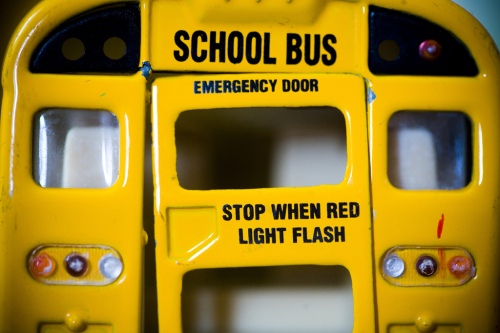
Ever been stuck at a red light behind a school bus? Of course you have. You know that moment when the kids suddenly realize, Hey! We’re not moving! And there’s a car back there with a person in it! And then they all start frantically waving?

It’s definitely a decision moment.

There are non-wavers who live among us.

I just don’t happen to be one of them.

Recently I found myself stuck behind a school bus, facing The Rowdy Boys, and I had one of those flashback moments a la Wayne’s World when I remembered my time spent at the back of the bus. These days, most school buses (in these parts anyway) have two parallel rows and an aisle with an emergency safety exit in the back; in the 1970s-80s, on the buses at my district’s alma mater, the back seat of the bus was one long row that extended from one side of the bus to the other. (If there were ever an emergency, I think we were supposed to kick out the rear window with our feet and jump out.) Or something.

A “walker” from kindergarten until fifth grade, I wasn’t introduced to school bus culture until middle school. In sixth grade, I made sure to sit in the front of the bus — close to the driver, but by eighth grade, I was definitely back seat material. I was soooo cool, wearing my cool jeans that pressed against the aged, red cushion where generations of cool kids sat before me. I sat with the smokers and the naughty girls and the angry boys. I read graffiti scribbled on the walls, watched people carve their initials into the metal bus walls, felt the bus move and sway beneath me. We tried to figure out the lyrics to The Sugar Hill Gang‘s “Rappers Delight.” We exchanged dirty jokes. We made plans to hang-out out after school.

But the bus I trailed the other day was peopled with elementary school aged innocents who smiled and laughed  and acted like goofballs, making faces and sticking out tongues. Separated by a little metal, glass, and asphalt, they probably felt like I did in eighth grade: Cool. Maybe a little bit naughty. Waving to a stranger in her car? What would their mommies say?

I made them work for it a little bit. They flapped their arms furiously, and I smiled. Eventually, just before the light turned green, I waved. Because I always wave back. And, of course, they loved it. I saw them whooping it up, high-fiving each other, as if they’d placed bets on whether or not I’d return their advances. (Maybe I am underestimating those elementary schoolers. Maybe they did place bets! Maybe that kid in the red Old Navy shirt won a lot of money because I actually waved.)

For kids, the bus is a buffer, a zone between the world of school and home, and the ride serves a dual purpose. It is a convenience (read: Mom doesn’t always have to be the chauffeur), but the bus-ride also provides time for kids to mentally shift gears from school — the land of increasing independence and increasing work and increasing expectations — and home, the land of dependence, where they are not the boss and there is homework to be done and sports to prepare for and instruments to practice and parents who still want to hear about every detail of the day, even if the kids themselves aren’t interested in sharing.

When you see kids on a bus, know they are between worlds. Time-traveling, if you will. And, if you are stuck behind a bus and the kids actually recognize your acknowledge in a positive manner, be glad. Just like adults, some of them have had fabulous days filled with glitter-glue and rainbows. But some of them have had lousy days. Dark days. Days where they have been mistreated and misunderstood. Maybe they have been bullied or made to feel small.

I say everyone should wave to kids on school buses; it’s such a little gesture, a little reaching out. It doesn’t cost anything, and it can bring so much joy.  Oh, but here’s a quick tip; only do the waving thing if the kids initiate it first. Otherwise, you’re just a creepy dork in the car behind the bus.

What do you remember from your school bus days?

The Teenage Years: It’s All in the Brain

photo by c.a. muller @ flickr.com

My son just started middle school after Labor Day, and everything seems to be going really well. So why am I already battening down the hatches? Because I remember how I was in middle school. I was evil. Just impossible. Everything my parents did was horrifyingly embarrassing. My friends were my world. I wanted the blue Fair Isles sweater that Jodi wore, the Bermuda bag that Marla carried, the clogs that Melissa had on her feet. I wanted to hang out with Dina and Noelle and Todd and Adam as much as humanly possible. We lived to torture our poor, pathetic French teacher. Every moment was filled with emotion and drama. I look back sometimes and wonder: Seriously, what was I thinking?

Apparently in the last decade,  a fair bit of research has been conducted to gather biological evidence as to why teenagers go a little bit haywire. Apparently, the teenage brain begins a massive shift around the prefrontal cortex around 12-13 years of age. The pre-frontal cortex is the thinking part of the brain that allows us to consider the consequences of our actions, and that part of the brain kind of stops working as well as it had before. Parents don’t always understand the neurological changes that their children’s brains are undergoing: changes that can cause their once docile children to take big risks and make big mistakes. The following article is an excerpt from a fabulous piece of reporting by Patti Neighmond for npr.org. You can read it, or you can listen to it here.

Laura Kastner, who along with Jennifer Wyatt has written a new book, Getting to Calm: Cool-headed Strategies for Parenting Tweens and Teens. For more than 30 years, Kastner has helped parents and children work toward greater calm in the home. In the book, Kastner presents a typical scenario:

Your child goes to a sleepover. The kids sneak out, go to someone’s house, and spray shaving cream all over the house and cars. The police come, give them a tongue lashing and send them back to the host family, who promptly delivers them home to you in the middle of the night.

“Sometimes, parents say, ‘What were you thinking?'” says Kastner. “And the joke’s on us. They weren’t thinking. They were running like wildebeests in the canyon. Just go, go, go. You know, they were flooded and excited and not really thinking through the consequences of their actions.”

In situations like this, Kastner says the first line of defense for parents is to stay calm. Tell the teen to just go to bed and that you will deal with consequences tomorrow. Ask them to write a note of self-reflection — about their regrets, why they went off track, what they would do differently if given another chance, and what skills they might need to avoid the situation in the first place.

Kastner suggests even writing a letter of apology to the host family, the family that got shaving-creamed, and maybe even the police officer who wasted his time responding to the incident. Based on the quality of this self-critique, Kastner says, parents can then determine discipline or consequences.

“It will be small, medium or large, based on the quality” of the self-critique and how much the parents believe their children learned from the mistake, she says. Parents might even have the teenager suggest their own discipline. And there’s an added benefit to the teens’ writing. It engages the “thinking” part of the brain, and gets the teenager away from the emotional frenzy of the night.

I, of course, love the idea of integrating writing as a way of getting kids to connect with thoughts to their actions. This is a strategy I have used in my classroom when students have been misbehaving. I simply hand the offending student a pre-written sticky note which instructs that student to sit out in the hall and write a full-page explanation as to why he/she has been asked to leave my class.

The exercise works for several reasons: First, it immediately eliminates the distraction from the classroom. Second, the student has to go outside and really think about what he/she was doing. Sometimes it is the first time the student has ever had the opportunity to even consider that what he/she has been doing might be considered annoying/bothersome, anti-intellectual, etc. Third, once the student is done, he/she returns to the class where we calmly conference. There has been time to cool down. I get to read the student’s words. The student generally recognizes his/her behavior as problematic to the larger group dynamic and we come to some kind of understanding. Sometimes, adjustments need to be made: maybe we decide to move the student’s seat so he/she is closer to me and further away from a friend or a loud hallway. Always, we have a clearer understanding of the other. And last, I have a piece of paper documenting the student’s infraction so if the behavior recurs, well . . . I have proof from the student’s own hand that establishes there has been an ongoing problem.

I have done all this for years, however, until I heard this report on NPR, it had never occurred to me to use this same kind of writing technique as a kind of disciplinary technique with my own child. (Not that I have had to. Yet.) But I love the idea of it.

So guess who has a blank composition notebook in the kitchen cupboard ready to go, should that moment of crisis arise. (Note: if you act fast, those notebooks are twenty-five cents at Target. If your peeps are just entering middle school, I suggest you pick up a few!)

And while we’re on the subject, anyone brave enough to share an example of a “wild and crazy thing” you did when you were between the ages of 13 and 17 years old? Anyone? Anyone?

Turn Down The Noise

I am reposting an article that was published on August 17, 2010 by Carla K. Johnson, a medical writer. I cannot tell you how many times I have sat in the halls at the community college where I work, and have heard students approach before I have ever seen them coming. So many of them wear their ear buds between classes, to get from point A to point B, I have often thought the constant noise has to be having some kind of impact on their hearing.

Turns out, it is.

Study: 1 in 5 US teenagers has slight hearing loss

CHICAGO — A stunning one in five teens has lost a little bit of hearing, and the problem has increased substantially in recent years, a new national study has found. Some experts are urging teenagers to turn down the volume on their digital music players, suggesting loud music through earbuds may be to blame – although hard evidence is lacking. They warn that slight hearing loss can cause problems in school and set the stage for hearing aids in later life.

“Our hope is we can encourage people to be careful,” said the study’s senior author, Dr. Gary Curhan of Harvard-affiliated Brigham and Women’s Hospital in Boston.

The researchers analyzed data on 12- to 19-year-olds from a nationwide health survey. They compared hearing loss in nearly 3,000 kids tested from 1988-94 to nearly 1,800 kids tested over 2005-06.

While the researchers didn’t single out iPods or any other device for blame, they found a significant increase in high-frequency hearing loss, which they said may indicate that noise caused the problems. And they cited a 2010 Australian study that linked use of personal listening devices with a 70 percent increased risk of hearing loss in children.

“I think the evidence is out there that prolonged exposure to loud noise is likely to be harmful to hearing, but that doesn’t mean kids can’t listen to MP3 players,” Curhan said.

Loud music isn’t new, of course. Each new generation of teenagers has found a new technology to blast music _ from the bulky headphones of the 1960s to the handheld Sony Walkmans of the 1980s. [But] today’s young people are listening longer, more than twice as long as previous generations, said Brian Fligor, an audiologist at Children’s Hospital Boston. The older technologies had limited battery life and limited music storage, he said.

[And] some young people turn their digital players up to levels that would exceed federal workplace exposure limits, said Fligor. In Fligor’s own study of about 200 New York college students, more than half listened to music at 85 decibels or louder. That’s about as loud as a hair dryer or a vacuum cleaner.

Bottom line, if you can hear someone’s music playing while their earbuds are in, they are probably listening to their music at too loud of a decibel. And while they may hate you, you would be doing them a big favor in asking them to dial down the noise.

Do you let your kids use ear buds? Do you feel they use them at a reasonable listening level? Would you feel comfortable asking a stranger to turn down his/her music?

The Empty Blue Desk

photo from Google images

Fall Semester 2009. Last year. He sat in the back row. In the only blue desk in a room filled with brown desks. He wore a button up shirt every day. He was quiet. Kept to himself. Initially, he was studious and handed in each assignment. His grammar was impeccable, his writing strong. He had a wry sense of humor and wrote about a time when he had worked in a Styrofoam factory. How the white stuff stuck to him, went up his nose, in his mouth, made him sneeze and sputter. He learned quickly he didn’t want to ever work in a Styrofoam factory. We all laughed when he read his piece aloud. Not at him: at his material. He was funny.

I expected great things. In fact, I was so sure he was going to produce great things, he kind of fell off my radar.

About six weeks into the semester, we hit the argumentative research paper unit, and he started to fall apart. He didn’t hand in his intentions for his topic, thus he never had a topic approved. I worried because he didn’t seem to be moving forward. While other students worked on paraphrasing and interview questions for their “experts,” he sat still in his blue chair, looking stiff and uncomfortable.

Finally, I asked him to stay after class. I went to his desk. I asked him if he had started the research paper. No. Did he have a topic? No. Did he need help selecting one, I implored. It was not too late. No. Could I help him? No. Would he let me know if I could help him? No. That was the one that stopped me. Chilled me, actually. No? I tried to look into his face, his eyes for something, but he was looking down, angry at being detained, at the questioning.

“You won’t contact me if you need help?” I asked.

“No,” he said.

I tried to explain to him that up until the research paper, he had an A — the only A grade in the class! He shrugged, underwhelmed. I told him he could still save his grade, the semester, but without the research paper, it would be impossible to pass, especially since he had not met any of the deadlines during the process. I told him I was worried about him.

“Thank you,” he said quietly. “I understand what I’m doing.”

The next day I received an email from Records and Registration that read:

We regret to inform you that we have been notified of the death of one of your current students (name here, and student number). We have noted this in the student information system so that all parties reviewing the student’s record will be informed.

Please make the appropriate notation in your records.

I was stunned. The appropriate notation? Was there a code I was supposed to put in my book? “D” for deceased? “S” for suicide? I knew I had to have been among the last to speak with my student. I replayed our conversation in my head endlessly. “I understand what I am doing” suddenly sounded much more ominous. I had missed it. I had missed a strong student’s decline from excellence into despair. Something was going on with him, and I had missed it. Maybe the better notation was “IF”: I. Failed. Or IF I had only known.

Later, I learned that my former student’s chosen method was to wrap his car around a telephone pole. He had been driving very fast. Very intentionally. He understood what he was doing.

Meanwhile, I was devastated. None of my students noticed the sudden absence of their classmate because students come and go all the time at community college. People drop out for many reasons: job or family obligations, financial issues, poor grades, poor attendance.  I spent the remaining weeks of the semester staring at that lone blue desk amidst the sea of brown desks and felt desperate.

I have had former students die – through illnesses, accidents, even at their own hand — just not during the semesters I taught them. Last year’s experience was a first for me. I have long known that I cannot transform them all into English teachers (nor would I want to), but I guess I always thought out of all their teachers, I would be the one they might come to if they needed help. I would be the one they would choose.

Last year, I learned that was a ridiculous idea, and that I cannot save them all.

What Our Actions Teach Our Kids About The Earth

image by D. Sharon Pruitt @ flickr.com

Monroe Community College has a new greenhouse on campus and this past school year, more than 850 students enrolled in 11 courses — from botany to business management — with an agricultural component. Some of these classes made use of the greenhouse, where — with state-of-the-art heating and cooling systems — tomatoes potted in soil thrive near micro-greens cultivated hydroponically in nutrient-enriched water.

This summer MCC launched a week-long Agriculture Summer Camp for Kids. And this semester, MCC students — for the first time — are able to take an introduction to agriculture course. Much of the push for MCC’s closer ties to the agricultural community comes from Bob King, who is the founding director of the Agriculture and Life Sciences Institute at MCC, established in January 2007. “People are more and more concerned about sustainability and how to account for their carbon footprint. And what better way to do (that) than through agriculture?” King is quoted as saying.

I try to remain optimistic, but I find myself wondering if our efforts are merely an exercise in too little, too late? As thousands of gallons of oil oozed into the Gulf just off the coast of my beloved former home of Louisiana, I found myself thinking about how the more we try to fix things, the more we muck things up.

We teach our children they can be anything, that they can do anything. Do we teach them to sit quietly and listen to the earth? To appreciate a blade of grass? To understand how we are dependent on the oxygen produced by the plants and trees around us? Are we willing to spend the extra time to tend our own lawns rather than dump funky chemicals onto our properties to make our lawns look like golf-course greens?

My friend, Jennifer Hess, is working to make change in our local school district lunch program: To integrate healthier choices into the kids’ daily fare; after all, that is what the district health curriculum preaches. She has written an amazing blog on the topic of school nutrition. I am behind her 100%. How far are people willing to go to learn about the effects of hormones in meat and milk? About high fructose corn syrup and its relationship to the obesity epidemic? What do you do when you learn that supposedly vitamin packed soft-drinks turn out to be no healthier than sodas? And once you know, how willing are you to change your purchasing and eating habits?

Pep Talk For New Teachers

As the new school year approaches, it occurs to me that there are a lot of new teachers heading out there.  This is my twentieth year in the classroom. It hardly feels possible, but if you were to check my Facebook page, it is peopled by former students from five different schools. Most of these folks now have children of their own!  I figured I’d share some things with new teachers that I’ve learned over the years. And I hope that parents will consider these things, too – especially if you hear your child has a new teacher. Before you start wringing your hands in despair, understand that new teachers bring enthusiasm to the classroom. They are eager to work, eager to get to the business of teaching. Help them; encourage them. They have to figure things out very quickly.

August. A new class arrives. Wide-eyed, unformed, brimming with enthusiasm, the youngest ones tinged with trepidation. They find their rooms, sit in desks which have held many before them, smile brightly, secretly thrilled, eager to ponder great books, study unfathomed formulas, devour complex theories, dream noble dreams. This is the ritual of August, right?

Sort of. I mean, maybe for the first week or two. But by the end of the first month, when that ho-hum routine is kicking in, and summer feels like past tense, students may become hauntingly silent, or worse, horribly restless. This is when a new teacher may begin to panic. Because  there are papers to be graded, charts to be updated, forms to be completed and returned to somebody’s office: It’s grueling and even more difficult when you are still trying to figure out whose office is where and which key opens what door.

When I was a teacher at Metairie Park Country Day School in New Orleans, Louisiana, I was on a Committee that helped to create a new faculty handbook filled with enough information to get a new teacher started, but not so much as to overwhelm.

New Teachers, see if any of these things help:

photo by Eric James Sarmiento @ flickr.com

1. Don’t take things too personally. You have to know this up front. Your students are going to talk about. If you are lucky, they will say nice things like, “I like Mr. X’s hair,” or “Ms. Q. is kinda cool.” More likely, you will overhear them in the halls: “(Insert your name here) is unfair. Not flexible. Boring. Biased. Unqualified.” Let’s face it. Not every student is going to die for your class. Not every student is going to find the Quadratic equation fascinating. Not every student is going to care about conjugating verbs. They won’t all be interested in Mendelian genetics. Some of them won’t like your unit on Lord of the Flies, or insects, or rain forests. Listen to their comments, glean from them what you will, and then let them go. This is especially true for teachers of older students when you receive your first batch of student evaluations.

2. Don’t be afraid to ask for help. Usually teachers are the nicest bunch of folks you can ever meet. (Except when there are budget cuts. When there are budget cuts, hide your construction paper and bolt down your stapler.) But generally speaking, if you need support, a new teacher can ask just about any other faculty member to explain how to un-jam the copier or for directions to the nearest bathroom. No matter what your problems might be, if you are in need, there is someone who can help you. Teachers like to be helpful.

3. Don’t forget to forgive yourself. One of the greatest advantages to teaching is the forgiving nature of children. That same characteristic which makes your students forget the complex theory which you masterfully presented to them just yesterday allows them to completely forget your prior day’s blunder. Even older students will be tolerant of your errors if you are honest about them and don’t try to pretend they didn’t happen. You should apply this same forgiveness to yourself. Some of your lessons are going to suck. But some will be brilliant.

photo by Nick J. Webb @ flickr.com

4. Don’t forget to take care of yourself. This is not in any  handbooks I’ve ever read on teaching, but it’s actually really important. If your new teaching experience is anything like mine was, in addition to your teaching responsibilities, you’ve probably already taken on extracurricular responsibilities. Whether you’ re working on a yearbook, organizing a dance or proctoring for SATs, helping to make costumes for the play or coaching a sport, no doubt you’ve got your new teacher hands full. And just as you are getting a grip, someone pops his head in and offers you another great “opportunity for growth.” Don’t be afraid to say no. It isn’t always easy, but you don’t have to take on additional responsibilities you don’t feel ready to handle. Because if you take on too many activities, you’ll get sick. This is because new teachers spend late nights planning, and grading, trying to stay one day ahead of their students. So while it sounds obvious, don’t forget to get enough sleep, eat right, and take lots of vitamins.

5. Don’t forget to laugh. If necessary, look for something funny! Just watching a group of kids at work or coming down the hallway is usually sufficient. There’s usually someone picking his nose, someone with an unzipped fly, someone with pants down around the knees, some girl wearing waaaay too much make-up — (and I’m pretty sure this applies from kindergarten all the way up to college level, folks!) And don’t take yourself so seriously that you can’t appreciate the hilarity of the moment when you learn that you have chalk on your butt. It’s funny!

6. Don’t feel like you have to have all the answers. The most seasoned teachers will tell you that even fifteen or twenty years from now, you still won’t know everything – especially these days with the technology changing so quickly, the kids will, no doubt, be teaching you many things. Let them. If you don’t know something, don’t make something up. Tell the student you don’t know the answer to the question. Write. It. Down. Do some research, and get back to the student with the answer. That student will know that you care.

In May, when you feel more relaxed, more comfortable, more competent, you will walk from one end of the campus/quad/building to the other and each time experience something different — a burst of magnolias on the east side of the auditorium; on the terrace, a gathering of students, intense in their chatter; the sturdy dark wood of the dining room, inviting and scented with red sauce; in the middle school wing, you might see mouths devouring a snack. If it is a Thursday, maybe they might be eating donuts (*she said nostalgically*); outside, during recess, the littlest ones will swing and climb, jump and shout; and everywhere fluffy squirrels will scratch up the nearest trees. You will smile at a colleague while passing her and return a wave to a student who enjoys your class. You will remind someone to throw his plastic something-or-other in the garbage can. You will begin making plans for next year’s classes. You will feel calm. You will feel you belong. You will have survived your first year, the gauntlet.

I promise you, the following year will be a lot easier!

Seasoned teachers, how did I do? What did I forget?