Category Archives: Education

Lessons on an Elevator

Aufzugsschiebetür

Image via Wikipedia

In my last hour on campus during the fall-winter 2010 semester, during my last elevator ride down from the English/Philosophy Department, I experienced the most interesting confrontation/ conversation. Ever.

When the elevator “landed” at the 5th floor, several people got out and four faculty members — including myself — got in.

One woman was already on the elevator; her dark skin stood in sharp contrast to the knee-length, bright yellow coat she wore. She had long, false eyelashes and long, sparkly fingernails. It was pretty obvious that she was a student as most educators simply don’t have enough hours in the day to worry about simple hygiene let alone more advanced techniques like applying fingernails or eyelashes. She also carried a cute little backpack while we all had little, unattractive wheelie bags laden with books and papers.  She must have accidentally gone up when she meant to go down. Whatever. The five of us crammed into the teeny-tiny elevator.

The door closed.

Suddenly a loud, distorted male voice came from Ms. Yellow Puffy Coat’s hand, “Girl, you better fucking get back on them pills. I don’t want to be nobody’s baby-daddy.”

All of us “newcomers” noticed at the same moment that Puffy Coat was now holding a telephone in front of her mouth, that it was on speaker mode, and its volume was on full blast.

“Dashan,” Puffy Coat said, “Don’t fucking be telling me fucking nothing about what I need to do with my body. You so worried about getting me pregnant again, go buy some fucking condoms.”

We faculty members were silenced.

It was incredibly uncomfortable.
I looked around the elevator as Puffy Coat’s increasingly intimate conversation filled with obscenities continued. I caught one professor’s eye. He shrugged, then looked down. The filthy elevator floor was apparently very interesting as everyone else was looking down, too. The doors stopped at the 4th floor where another professor got in. I recognized her immediately as Professor Sanity.

Puffy Coat kept going.

“I’m not having another abortion…” said Puffy Coat.

“Bitch,” shouted the faceless Dashan, “don’t play fuckin’ games with me.”

I couldn’t take it. If no one was going to say anything, I would be that girl.

“Excuse me,” I said as politely as I could, “that sounds like a very personal conversation. Do you think you could wait to continue until we are off the elevator?”

Polite wasn’t going to work.

“Hold up, Dashan,” Puffy Coat declared. “Bitch in the elevator trying to tell me what to do.” She continued, “Fucking bitch. I don’t know who she is. Just ignore her. Go on.”

Suddenly, the elevator stopped moving. Professor Sanity had hit the kill switch.

“Excuse me,” said Professor Sanity to Puffy Coat. “That is a completely inappropriate way to speak to another person. Please apologize right now.”

Puffy Coat didn’t know what to do.

It was excellent.

“Dashan,” Puffy Coat said, “I got a situation in the elevator. I’m gonna have to call you back.” And with that she silenced her phone.

(Hello, that’s all I was asking for!)
Professor Sanity did not stop. She pointed over toward my way. “When that professor suggested you turn off your phone, she was speaking for all of us. Because when you are in an elevator, you are in a public space. This is a public space.” Professor Sanity gestured a tiny circle above her head. “It’s a really tight public space, so people need to be especially mindful of each other. The conversation that you were having was beyond personal. No one wants to hear about your sex life. No one wants to hear the language you were using. The swearing was inappropriate, and it made us all uncomfortable. This is a place of higher learning. This is your moment to learn something.”

“Is everything okay in there?” A voice from campus security interjected through the intercom.

“We’re fine,” said Professor Sanity with authority. “Just give us a few minutes.”

Gawd, I love Professor Sanity. I soooo want to be her when I grow up.

Puffy Coat was relentless. She would not back down.

“I have every right to talk on my phone whenever and wherever I want to,” she insisted. “I pay my bills. You can’t tell me what to do. This is racism. You all are just picking on me because I’m black.”

Professor Sanity kept her cool, “You know very well that this has absolutely nothing to do with the color of your skin. This has to do with your behavior. You were not acting respectfully toward the people around you. When someone asks you to do something, your first response should not be to call that person a ‘Bitch’ — but that was your very first response. You need to think about that.”

Feeling bolder now that we weren’t going anywhere, another professor weighed in. Skinny, bald, and sporting double-hearing aids, this man looked to be about 80 years old. “Your argument isn’t logical.” (He must have been a Philosophy Professor.) He continued, “Why do you think that because you pay your bills you have the right to do ‘whatever you want whenever you want’? Paying your bills merely gives you the service. This conversation has nothing to do with race. This conversation has everything to do with your attitude of entitlement.”

Puffy Coat was silent. I couldn’t tell if she understood one word that Elder Prof had just said. Or maybe she realized that she was like a punchline in a bad joke: Five tired professors are on an elevator at the end of the semester. A student walks in.

Maybe she figured if she was quiet, things would end more quickly.

And things did end. Puffy Coat did, in fact, apologize. When five educators are staring at you in a stopped elevator, what choice does a person have? I mean, her apology was totally coerced. Puffy mumbled something to the effect that she was sorry for cursing, adding that she had never considered that being on a speaker phone in public could be perceived as rude. It was Guantanamo Bay in there. And that poor girl was being detained by brutally civilized, intellectual savages.

Professor Sanity told campus security to start us back up again, and we silently rode down to the first floor.

What stuck with me after I made it outside was Puffy’s defensiveness and her utter lack of understanding with regard to how to communicate with people. I considered how Puffy spoke to her boyfriend, to me, to the others: I supposed “combative” was her default setting. I imagined a whole heckuva lot of people must have spoken to Puffy with that same hostile tone over her lifetime, so that is the way she approaches the world. Pissed off is a pretty good defense-mechanism, but it doesn’t serve a person well in college, in the working world, or in life.

I wondered how a person could get to be college-aged and not understand how to behave in a socially appropriate manner.

It’s a sad social comment.

I’d like to believe — given the season — that like the Grinch, maybe …

Puffy puzzled three hours, `till her puzzler was sore

and eventually she realized she could be so much more.

“Maybe,” she thought, “I don’t have to be rotten to the core”

“Maybe it’s good those professors blocked the door.”

Maybe Puffy’s small brain grew three sizes that day!

Do you think that it could?

That maybe Puffy actually “got it” — maybe she understood?

Wouldn’t that be amazing? Wouldn’t that be good?

It would be wonderful.

If that’s what she got.

Do you think that she got it?

Alas, probably not.

What have you witnessed recently that caused you to think: “What has happened to civility?”

End of Semester Gratitude

thank you note for every language

Image by woodleywonderworks via Flickr

The Fall-Winter 2010 semester is over for me. My grades have been reported. The contents of my unattractive yet functional wheelie bag have been dumped and placed with the rest of the luggage — in the nether regions of the basement. Today, I am getting my hair highlighted. It’s been fifteen weeks since my last highlight or cut. (The straightening thing doesn’t count.) Don’t even ask about the state of my fingernails at the moment. I have a way of letting certain things go during the semester. But now it is time to catch up.

This morning, I popped onto my faculty email account to make sure everything was in order, and I found two pieces of email waiting for me. The first indicated that my grades may have been inaccurately reported (are you $%#@! kidding me?) so I had to check another link to a list upon which — thankfully — my name did not appear. And then there was a second piece of mail. Here it is:

Dear Mrs. RASJ,

I would just like to say thank you for everything, Mrs. Renee Jacobson. I learned so much in your class and I am so glad I received an A! I know you’re probably going to write back, “You worked hard for that A and you deserve it,” but there is no way in hell I would have done it without you.

You just did so much to help, and you ARE a good teacher. You have amazing patience with students; you’re fair, and you’re always willing to help. You are very thoughtful and you really put your time in to teaching your students, and you do it all without babying us. That’s the way a teacher should be, and it is really hard to come by these days.

Thank you for putting up with my short temper at times, for sitting down with me to talk almost everyday, and for the donuts and wisdom pendant. You are very thoughtful.

It was nice to be educated by you. I wish you the bast (sic) of luck and times.

With love and sincerity.

Your favorite student ever,
Student X 🙂

This student knows me. Because I would absolutely have said that he earned his “A,” that it had little to do with me. An “A” in my class means he did his work and he did it well. It means he showed up and participated. It means he took advantage of extra credit opportunities. It means he was a good peer editor and gave solid feedback. It means he was respectful. It meant he asserted himself. If he didn’t understand how to do something, he made an appointment to meet with me to figure it out. It means he came prepared with all his materials: all his books, handouts, and writing utensils. Every day. He was on-time. When he contributed to the conversation, his comments were meaningful — and when he received criticism, he was not defensive. His writing often showed great depth, and he taught me something on more than one occasion. He was honest (in his writing) and open (as a human being).

I don’t give A’s. To me, an “A” means something akin to “amazing,” and very few people are. So I will share this letter with all the teachers out there who understand how much letters like these really mean. People so rarely write letters these days, typed or otherwise, it is always a bit of a thrill for me when I receive one. For an educator, a letter from a former student is a shot of fuel that helps fill up a near empty tank. Those little gestures keep us keepin’ on.

So thank you, Student X. You put a little bounce in my step today.

What put a bounce in your step today?

Contemplating Quitting The Classroom

A black and white icon of a teacher in front o...

Image via Wikipedia

I have been thinking that this will be my last semester in the classroom. It’s been a hard year for a variety of reasons, but I have been thinking I just am not connecting with my students the way I used to. Part of it may be that I am getting older. I have somehow become an “old-fashioned teacher” who doesn’t show movies, rely on Smart Boards or Power Point presentations. In other words, I have always been able to “be my own show,” create my own bells and whistles, and that was enough. I was enough.

This year is different. I don’t like how my students seem less prepared each year. I don’t like having to repeatedly tell adults to put away their technology/toys. It’s exhausting. I haven’t lowered my expectations with regard to their assignments or how I grade them, but I have a lot of students with D’s and F’s. That doesn’t feel good to me. Part of it is the 15-week gig: It doesn’t feel long enough to get my students where they need to be. I don’t understand why some of my students come to class without full drafts of their papers when I tell them they need to come to class with completed papers. I don’t understand why they leave their books in their cars. I don’t understand why they come to English class without pens or paper, even though it is clearly stated as a basic expectation on my Course Information Sheet. I don’t understand their lateness, why they don’t recognize walking in late as a terrible act of rudeness and incivility. I don’t understand why they struggle so much with citation. Except I do: it requires meticulous attention to detail  – and, based on this last essay I collected – about 7 students out of about every 22 possess the ability to attend to detail. Here’s a newsflash: some students don’t attempt to write papers at all. They take zeros, and they seem fine with this.

Me? I’m not fine with any of this, so I’ve been feeling run-down.

There is a bit of ego in teaching, maybe more than teachers might care to admit. I can’t speak for all teachers, but I think it is fair to say we are willing to take the ridiculously low pay, work the long hours, plan our lessons, grade the papers into the wee morning hours – as long as we see progress. Positive change. Forward movement. Progression. I need to feel as though I am helping my students move from point A to point B: even better if I can take them from point A to point Z! That said, it’s been a little light on that this semester. So I’ve been thinking about jumping ship and hopping onto a different boat.

And then I received a poem from Niquette Kearney.

Niquette in 2010

I taught Niquette in New Orleans back in the mid-1990s at Metairie Park Country Day School, nearly twenty years ago. When I first met Niquette, she was in 10th grade Honors English while struggling with some big life stuff. Big. Life. Stuff. And she was floundering. Because it is hard to focus on writing papers when you are dealing with Big Life Stuff. I suggested Niquette drop out of her high-pressure Honors section (with me as her teacher) and pop into another section of Regular English, (also with me as her teacher.) Poor Niquette. There was no escaping me that year as I taught the entire 10th grade! Boy, was she pissed off! I’m pretty sure she wanted to kill me; instead, she agreed. (Really, though, what was the alternative?) And the Regular section was easier for her. She got her work done, earned stellar grades, and she was able to focus on herself.

From the beginning, I adored Niquette. Teachers aren’t supposed to have favorites, but Nikit (the nickname I began to scribble on her papers) was beautiful and smart and funny and strong. How can you not love that? She was the whole package. She just didn’t seem to realize she was the whole package. But then, honestly, in high school, who feels they are “all that”? Nikit and I spent lots of time on a beat-up old couch in the English Department. Sometimes we talked about papers, but lots of times, we didn’t. Sometimes I just listened to her talk about her life, her experiences. Sometimes she cried, but mostly she didn’t. Her voice always quavered a little, as if she lived right on the verge of tears. That year, Nikit found herself at a crossroads. Without sharing her secrets, let’s just say, because she is beautiful and smart and funny and strong, she has managed to survive this very difficult year – maybe even thrive despite the adversity.

So here I am thinking of leaving the teaching biz, and I get this piece of correspondence.

Niquette’s message read simply: “Here’s a poem I wrote recently and thought I’d share with you, as you were in my thoughts.”

In a moment bigger than I knew,
At a time which could have been many,
I glanced at myself

In the mirror of my own eyes,
As if greeting a stranger for the first time,
I introduced myself with wonder
At the amazing sight of me

After so long without looking,
I finally saw
What I thought they’d lied about
Suddenly, it covered my reflection, overcoming me
So bright, I shuddered, reaching out my hand,
Welcoming the newcomer,
The one I thought I’d seen before

It was then, that I saw myself
And what I’d never even looked for,
And I blushed when I knew
That it was there the whole time

What a rare sight,
To view myself that way,
As a stranger meets another pleasantly, then parts
This moment passed but was mine
I saw what I did, and it was precious; beautiful

It was me.

Niquette Kearney, 2010

I am pretty sure I am one of the ones who tried to convince Nikit about her strength, her smarts, her internal and external beauty. I’m pretty sure I’m one of the one’s she assumed lied to her about all her fabulousness. I’m just so happy to know that she saw it, felt it, if only for a moment. And I’m even happier to know that she sat down and recorded it – as if it had been an assignment for English class – so she can have it to hold on to. I love that, after all these years, she is still writing poetry.

And then, thanks to Nikit, I remember this is the reality for teachers, especially college educators. We do our stuff. We try to shimmer and shine and get our junk into our students’ heads in 15 short weeks – and then, if we are lucky — maybe — 10, 15, 20 years later, someone reminds us that we helped them along the way. Someone might send us a poem, or a card, or run into us in the grocery store and give us a giant hug and tell us how much we helped. Teaching is like parenting; it involves a lot of delayed gratification. Folks shuffle in; they shuffle out, sometimes without so much as a smile. Sometimes it’s really hard to wait for gratitude.

I am happy for my sweet Nikit. She is going places, that one.

Me? I’m not so sure if I’m jumping ship. Time will tell.

For now, my course is set, and I will continue to power ahead through these choppy waters, full throttle.

End of the Semester Blues

Students taking a test at the University of Vi...

Image via Wikipedia

I have one section of students that  hasn’t mastered the necessary skills to show they understand how to properly write a college essay, complete with proper citation. Their last batch of essays was pretty bad. With the exception of a few papers, most students bombed their Works Cited pages and their writing felt unpolished.

I asked a few other professors what to do.

“Tell them to suck it,” one said. “If they don’t have it by now, it’s not because you haven’t shown them; it’s because they haven’t taken the initiative to learn the material.

The other professors agreed.

But I didn’t want them to “suck it.” Why am I hesitating? I wondered. What has happened to me? As always, I want my students to master the material, so regardless of what my colleagues said, I decided to give them an option: I returned ungraded essays to them with extensive feedback and told them they could ask me for the grade they received on the essay and forfeit the right to revise, or they could revise their essays (with rough drafts attached) by Wednesday at the beginning of class. And by Wednesday, I mean tomorrow.

No one asked for his or her grade.

Now, I’m not crazy enough to believe that everyone will actually revise, but I am hopeful that some will. I am hoping that they will use their style books, the extra time along with my feedback, and give it one more try. Because after this, that’s it. There are only a few tiny assignments, 7-minute oral presentations, and self-evaluations.

I know students have other classes, but mine is required. English Composition-101 is required. Required. So if a student fails, he or she will have to take it again. It’s expensive to fail classes, but some students don’t seem concerned about the debt they are piling up.

At this point of the semester (with 6 classes remaining before the end of the term), certain students wake up and realize they have been doing poorly (for most of the semester), and act shocked by this revelation. They ask about extra credit and want to be passed because they need to keep an athletic scholarship, and/or avoid parental wrath. Requests for points for nothing or for passing grades are easy to handle. I offer a “no” along with my sympathy, plus advice about how to retake the class.

Today, as we began week 14 of 15, I had a student with an overall average of 54.4% ask me what he could do to bring up his grade. I shrugged. He shrugged. Later, I saw this video. I’d send him the link, but I don’t think he’d get it.

*Note: This little ditty was made by Clay Morgan at Educlaytion.com*

In reality, it is kind of hard to fail my class. I offer a lot of help to students to want it. I make myself available to conference. I allow students who show initiative to revise their papers. I offer extra credit opportunities throughout the semester – just not as an “emergency out” at the end.

I hate watching students unravel at the end of the semester but – the reality is – there are always some who come unstitched.

It’s reality, but I don’t have to like it.

Seriously though, why am I more upset about my students’ failing grades than they are?

Functional Illiteracy: The Repost

People who know me know I’m struggling this semester. I try to explain how a larger number of my college students seem to have weaker skills this year; how I can’t get them to use capital letters (or, in some cases, how I can’t get them to stop randomly capitalizing words that don’t need to be capitalized); how they won’t stop writing “im” instead of “I’m”; how I can’t get them to stop using the letter “u” when they mean the word “you.”

“They don’t know how to outline!” I exclaim. “Or write in five paragraph essay format!”

People think I’m exaggerating. “Things can’t be that bad,” folks say.

Finally, here is a perfect example of why my panties are in a bunch this year.

This post called “Functional Illiteracy” from Just Sayin’ addresses some of the very real struggles that educators are facing today, even at the college level.

Do you have discussions with your kids regarding their use of language? Are they writing as well as you would like? Do error-filled papers (with high marks) come home from your children’s schools? Do you think their grades are inflated? Because, I am here to tell you, graduating high school students are not using capitalization or punctuation.  Many high school graduates have not figured out basic written communication skills which my peers and I had mastered in the 6th grade and spent the following years perfecting.

Many of this generation’s students are essentially unemployable, and if you don’t believe me, read this post from my friend, Michael Hess, of Skooba Design. Because as a business owner, he cares about the way people write.

Do you care about how you write?

Or r u 2 busy txtin 2 care?

Mamas, Don’t Let Your Babies Grow Up To Be Teachers

image from google.com

I have a friend who, after two years as a full professor, is back down to adjuncting part-time due to budget cuts. A former student of mine earned his degree in math and special education and has been subbing for two years in an outstanding district, but he simply can’t seem to get his own classroom. And even though I am (currently) employed by a local community college, I recently decided to conduct an experiment to see if I, with my soon-to-be twenty years of classroom experience, could land even a part-time position in any school district within a desirable radius. I updated my resumé and cover letter and applied to four local school districts.

Did I get a bite?

Not one!

At first I was bitter, but now I understand. There are too many teachers and not enough jobs.

What does this mean? Well, theoretically, it could be a good thing for our children. If the pool of applicants is supersaturated, then – hopefully – the weakest candidates will be tossed away quickly, making way for the cream of the crop to land in our nation’s classrooms which, as we all know, are badly in need of help. Alas, I suspect it means that many positions will be “excessed” causing more teachers to scramble for fewer positions. It means greater numbers of students will be squished into classrooms, which will make it harder for them to learn. It means less adult supervision in the place where we really need them to receive specialized, individualized attention.

Meanwhile, I know plenty of people who have given up. Though stellar students themselves, each having received outstanding reviews during all phases of their student teaching experience, each has decided to leave the dream behind. One former student of mine just took an entry-level position at an editing/publishing company last fall, after three years of looking for an elementary school position. She sent out hundreds of resumés, attended dozens of encouraging interviews, but just never could seal the deal. For years, she worked as a substitute teacher, earning $75-85 a day (with no benefits). I think she files and makes people coffee now. Seriously. I’m not kidding. To do these things, one does not necessarily need to attend college.

“It’s ridiculous,” my former student says, “Spending all that money for an education I can’t use has been beyond frustrating. But really I had no choice. I needed benefits. And I needed to make money.”

How can we continue to allow good students to go through graduate school to become educators if the jobs are not there for them when they come out the other side?

So, my little experiment, though simultaneously interesting and humbling, meant little for me. I am one of the lucky ones: I have a job that I love.

For now, anyway.

tweet me @rasjacobson

Lessons From A Boy In a Skirt

photo from MC Quinn @ flickr.com

Several years back, on the first day of the semester, a student walked into my classroom. A boy, clearly, a male — wearing a long pink skirt, his hair tied in a low pony-tail. When I read the roster and got to his name, he corrected me and told me that his name was Sophia.

I quickly noted the change.

When I met Sophia, she wanted gender reassignment surgery. She wished for it, but knew it would be a long road. As gender reassignment is an irreversible procedure, two letters of therapy clearance would be required. She explained one therapist (psychologist, psychiatrist, social worker, sexologist) would be required to have a doctoral degree, and one of the two therapists would have to know her for an extended period of time. When I met Sophia, she was simply trying to change the name on her birth certificate and running into all kinds of roadblocks. A ward of the State from age 15, if memory serves, Sophia was an emancipated minor living with distant relatives. She had no car, took the bus to campus, and had no expendable money for one therapist, let alone two with the kind of credentials that she would need to put her on the path towards gender reassignment.

That semester, Sophia was distracted. It was hard for her to get to class on-time. Hard for her to make deadlines. Hard for her to deal with the stares and (I imagine) comments in the hallways. A talented writer, Sophia was exhausted at age 19. And I wanted to help her. Eventually, Sophia stopped coming to class. I had lost her.

In June 2009, I read that the person once known as Chastity Bono, the precious little blond-haired daughter of Sonny and Cher who often made appearances at the end of their shows, would henceforth be referred to as Chaz Bono. At age 40, Chaz Bono went public that he was undergoing gender reassignment surgery, and I read the surgery had been completed in May 2010. Of course, I thought of Sophia.

I cannot imagine what it must feel like to be a person stuck in the wrong-gender body.

I am English teacher. I am supposed to teach my students how to improve their writing skills; how to properly use their commas; how to understand and compose for different audiences and recognize the varying modes of discourse. But writing teachers also get to read their students’ words. And I got to read hers.

So while I don’t know where Sophia landed, I still hope she is okay. That she feels good about herself. That she saw the article about Chaz Bono and feels hopeful about her future. And I hope she doesn’t have to wait until her 40th birthday to get the surgery she wants.

tweet me @rasjacobson

Biting Off More Than I Can Chew

Photo by Dionne Hartnett @ flickr.com

Whenever I take on a project, where I am in a leadership role, where there are deadlines, where visible, public failure is possible – I get positively crazed. The desire for perfection makes me hustle to work, work, work – and in striving for perfection, the craziness kicks in.

This weekend I was grading essays. The. Entire. Weekend. You could not get me to stop. My husband came in at 2 pm and begged me to stop. My son came in at 3 pm and begged me to stop. They tried to stop me. They offered food. “I’ll eat when I am finished,” I said.  I couldn’t be stopped. I was . . . driven.

Thankfully, I don’t have this problem with shopping (or sex) because it is powerful and unstoppable, and it would likely land me in the poorhouse or, in the case of the latter, in a starring role in an episode of Californication.

Hours later, after I’d completed all the grading, I felt miserable that I’d neglected my family all day. That isn’t right. I will try to be more mindful about this in the future. For once, I’d like to be in the club, rather than always being the “leader of the band.”

Cursive as a Font Option?

image from Wikipedia

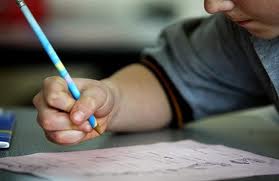
Not too long ago, my 6th grade Monkey had to sign several contracts – various agreements between himself and sundry teachers and coaches.

“Do I have to write in cursive?” 11 year old Monkey asks.

“It’s probably a good idea,” I reply.

There is a pause. Silence during which time I assume he is signing his name on the assorted colored sheets of papers. But after a while, I glance over and notice he has written only the first three letters of his first name. He is looking off into space, clearly stuck.

“Mom,” he says eventually.

“Mmmmm?” I ask, pretending to be oblivious but definitely aware of his dramatic pause. But I’m thinking to myself, maybe boy has some deep moral, ethical or philosophical opposition to being asked to sign a particular contract. I’m thinking maybe he is hung up on one of the terms. Maybe something seems unreasonable to him, and he is not willing to just sign on the dotted line. For a moment, I’m actually proud. I figure he’s read the contracts and internalized the content, and now he has questions, reservations. He’s thinking critically about his commitments and if he can take on more responsibility. . .

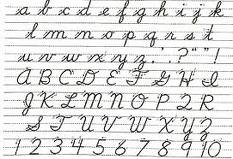
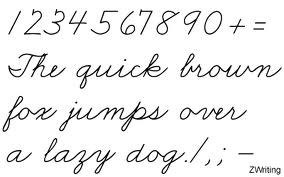
“I can’t remember how to make a “v” in cursive,” Boy announces. “I kinda forgot how.”

image from Wikipedia

My child is in 6th grade. He is a stellar student. How could it be that he has forgotten how to make his “v’s” in cursive? I wonder. But I am patient. The school year is just kicking off, and he has been away for three weeks at overnight camp, playing in the dirt with friends, enjoying the heat of summer, so maybe he needs a quick mini-lesson.

“Sure, honey,” I say and prepare to give him a quick tutorial in cursive – which morphs into an elongated lesson because, as it turns out, Boy doesn’t remember how to make a capital “J” (which, for the record, is the first letter in his last name); neither does he recall how to make a lower case “b” (also a letter in his last name!).

At this point, I hear the ocean in my ears.

This is never a good thing as it generally means a giant wave is rising up from the deepest, angriest depths of me, and it generally culminates in a boatload of phone calls.

“Buddy.” I ask Mr. Calm, Cool and I’m-Not–Worried-At-All-That-I Don’t-Know-My-Alphabet-In-Cursive, “How is it that you do not know all your cursive letters?”

My son proceeds to explain to me that, while cursive letters were taught in 3rd grade, his teachers didn’t really require that he (or any of his classmates) write in cursive.

“Writing in cursive was pretty much optional,” Boy tells me.

Optional?

Optional!

(Can you hear the Atlantic, the Pacific, the Antarctic and Indian Oceans rolling around inside my head?)

picture from Google Images

I couldn’t help myself. I made a few calls to a few principals (who shall remain nameless) in a few local public schools (which shall remain nameless) in a few nearby districts (which shall also remain nameless). Most principals agreed that there is just so much material to cover to prepare students for standardized tests, that many things have had to go. (Damn you, No Child Left Behind!)  One administrator told me that decisions had been made (note the passive voice) to focus less on cursive writing but that students could select cursive as “a font option” when printing from their computers.

Cursive? As a font option?

Really?

Hold on folks. I’m going back for a nostalgia moment.

I remember a time when we kids couldn’t wait to move from our world of block letters to the world of cursive which was infinitely more adult. (And I’m not the only one who felt this way! Read Kathy English’s awesome essay on the death of cursive!) My babysitters used cursive to write notes to each other, but I could never read their words as they were like some crazy, secret code I couldn’t decipher no matter how hard I tried. But I knew that one day I would eventually be deemed mature enough to learn “The Code,” that I would figure out how to connect letters by one single, continuous stroke. I knew I would learn to create words in loopy cursive letters and that, ultimately, I would be able to read my grandmother’s shaky script, my mother’s slanted hand, as well as my teacher’s perfect penmanship.

from Google Images

In the 18th and 19th centuries, cursive was one’s special signature. It distinguished one individual from another. The most elite received special training, and possessing a “fair hand” was considered a desirable trait for both men and women.

By the 1960s, a standardized method for teaching penmanship called D’Nealian Script had been introduced into schools all over the United States, and handwriting became more homogenized. I didn’t know any of this, of course, as I sat in class in 3rd grade in the mid-1970s. All I knew was that during “cursive time,” each of us learned to write the same way: on thin, oatmeal-colored paper that consisted of a series of two straight continuous horizontal lines with one broken line between them. We students sat with our pencils poised “at the basement” of the line ready to “go all the way up to the attic” or to stop “at the first floor.”

I remember being totally geeked up about learning cursive, but apparently, not everyone was as psyched about switching to cursive as this twit. And while I might have considered learning cursive a bit like taking a second art class, apparently, it wasn’t that way for everyone. For some kids, learning cursive was really difficult. I remember “the lefties” really struggled as did a bunch of kids who probably would have been diagnosed with some kind of fine-motor skill problem if they were going through the ranks today. But they didn’t test kids for things like that back in the 1970s. Instead, our teachers encouraged us (or goaded us, or punished us) until we learned our letters. And while we weren’t necessarily good at it right away, with daily practice, our shaky letters improved.

I wrote all my papers in cursive until my senior year in high school in the mid-1980s when my father brought home an enormous TRS-80 around the same time teachers were setting up the first “computer lab” at my high school.

So much has changed in twenty-five years! With the advent of word-processing and PDA’s and all things electronic, cursive has completely fallen out of favor. In fact, it has almost gone the way of the dinosaur. Without a doubt, typing is infinitely faster and easier to read than handwritten papers – but, now that I hear that cursive is not being reinforced, I wonder, is something being lost in making cursive optional?

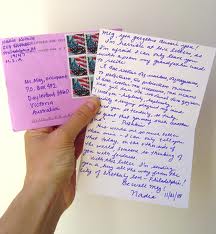
First, there is the obvious, esoteric stuff. When written properly, cursive is beautiful. Reading a handwritten note from a friend or lover is actually a completely different experience than reading the same content typed. Don’t believe me? Go back and look at some old photo album that belonged to somebody’s great grandmother. Look at the handwriting. You can actually feel something of the person in the handwriting. It is so much more intimate than reading something on a piece of paper that looks like it came from a school or the mortgage company. Have you ever received a thank-you note via email? Ewwwww. What about a thank-you via text? Double ewwwwww! There is nothing more lovely than holding a card in your hands on which someone took the time to write a nice note thanking you for something that you did for them. I swear, you can feel the gratitude in the loops.

But “pretty” probably isn’t a good enough reason to keep cursive in the curriculum, right?

Ever the pragmatist, my husband says cursive will likely eventually disappear along with so many other “quaint niceties” like handwritten thank-you notes. He says the convenience of email and text will drive us away from handwriting altogether and computerized voice recognition and grammar programs will continue to improve. Hubby points out his signature is barely legible. It is his mark. “Well,” I countered, “At least you have a mark. Soon an entire generation of kids will be making X’s as they won’t be able to put their John Hancock on anything.” Hubby says I’m being overly dramatic, that I should calm down.

from Google Images

But I can’t calm down when I feel desperate inside. I’m the girl who still writes in journals and keeps yellow pads of paper filled with notes – all in cursive. My lesson plans are drawn up in cursive. My first draft of anything is always done in long-hand. I wonder what this means: if people cannot decipher their grandparents’ letters, how can they ever read important documents like our nation’s Constitution, Lincoln’s “Gettysburg Address” or our Declaration of Independence?

They’ll read those documents in textbooks,” Hubby responds. “Or online. More likely, they won’t read them at all.”

(I am pretty sure Hubby was just trying to pick a fight there.)

I shudder because as an educator I know things: the focus on cursive around third grade serves a larger purpose; it reflects the developmental connection between writing and thinking. Children who excel in handwriting skills tend also to excel in other academic pursuits. Cursive writing assists in the development of fine motor skills and muscle control, and it’s an introduction to self-expression. To abandon handwriting lessons could potentially interfere with the learning process as a whole.

I wish I could make some powerful claim that indicates students who are unable to read and write in cursive are guaranteed to score at least 100 points lower on their SATs than their cohorts who read and write in cursive. That would probably catch someone’s attention.

Doesn’t that look impressive?

Alas,  I don’t have anything like that.

Sigh.

Americans are tired. We have been told that the sky is falling, the glaciers melting; the earth quaking; that strangers want to abduct our children, that neither government nor lawyers nor doctors can be trusted; the rainforests are being destroyed; that – in fact – the entire cosmos is running out of time. So who can bother to get upset over my li’l ole lament over the loss of cursive handwriting?

I think I’ll go write up a nice long grocery list – in cursive.

Just because I can.

My Brain is About To Explode

Do You Remember?......Call

Image by rogilde – roberto la forgia via Flickr

For real.

It’s happening.

I’m. Having. A. Total. Meltdown.

I’ve been trying to figure out this anti-plagiarism program called turnitin.com, and while the program appears easy enough to use, well, it isn’t working for me. And I seem to have found the ugly truth: apparently no one works at this company. There is no technical support. No phone number provided at which to reach a human.

After a major Internet investigation, I found a phone number. Elated, I dialed. And then I got that automated voice that tells you to please wait. Please wait. Please. Wait. (I watched an entire DVR’ed episode of Survivor while the music played in the background.)

Before I ever reached for the phone, I tried email. I explained my situation in detail, and somebody (a monkey?) sent me an email ticket indicating somebody (in India? in Texas? from Mars?) had received my angst-filled note(s) and promised I would be contacted within 24 hours.

I’ve been waiting for help since Monday.

I can’t get a human.

I can’t even get the sales rep.

So here’s a little video for your enjoyment.

You know, while I wait.

What makes your brain explode?