Tag Archives: New Orleans

Guest Post by Abby Fendler: In Memory of Ronnie

Today’s guest post is by Abby Fendler, a former student at Metairie Park Country Day School. Earlier this week, Ronnie Frazier, Buildings and Grounds Supervisor, unexpectedly passed away, shocking the entire MPCDS community. While Ronnie wasn’t officially a teacher, he sure did mentor a lot of people. That man touched lives. My condolences to Ronnie’s wife, Rubie – whom Ronnie adored.
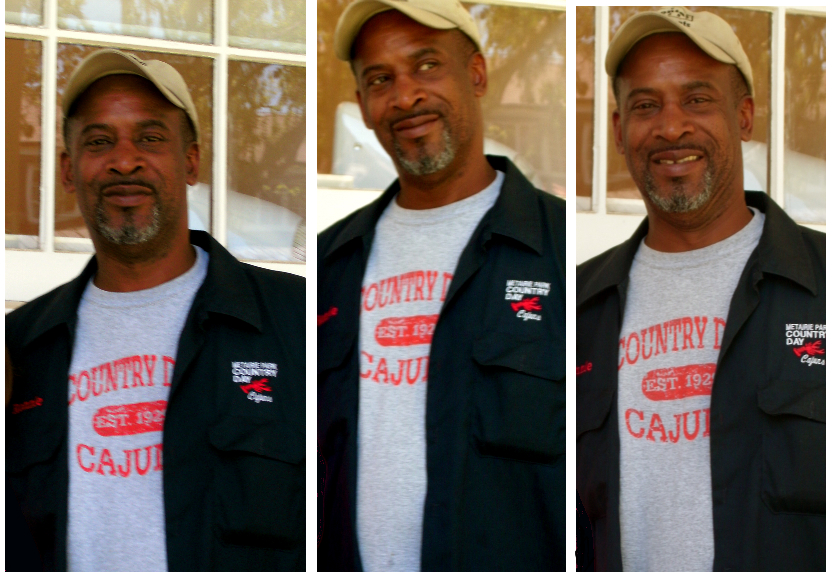
Photos courtesy of Sarah Choquette

How many people can say that their school janitor was – without a doubt – one of their best friends, heroes, and idols of all time? Rest assured, thousands of students, graduates, faculty and parents of Metairie Park Country Day School in Louisiana, can.

Born in Ferriday, Louisiana in 1957, in a town of 5,000 people, Ronnie had an English teacher aunt who stressed the importance of reading. As a result, Ronnie grew up articulate, politically acute, and knowledgeable. The day after he graduated from high school, he joined the army and, after his stint, he came to New Orleans looking for work.

“There weren’t many jobs available,” he said, “so I took a part-time job working in a grocery store warehouse, but I wanted to get into management training.” Although there were many stumbling blocks to his being admitted into the program, he persevered and eventually became assistant manager. Only then did he discover that the job did not pay a livable wage. Through a friend, Ronnie heard about a position with benefits and the possibility for career advancement at a well-known private school in the city, Metairie Park Country Day. “I felt that I’d found what I was looking for. In the past, I had only held jobs for short stretches of time, but at MPCDS, I felt like I could be happy,” Ronnie said.

Ronnie’s official job title was “Building and Grounds Supervisor” of the Metairie Park Country Day School in Louisiana, but Ronnie was also the head of maintenance, a bus driver, a woodworker, and a do-anything-and-everything-man-for-anyone-and-everyone on campus guy; in actuality, he was every student’s greatest hero – a real life “Superman.”

Graduate Traci Berger said, “Not one student at Country Day thought of Ronnie as ‘just the janitor’; he was like every student’s unofficial psychiatrist, funny uncle, favorite teacher, and best friend all wrapped up in one enormous, smiling package.” To the people who knew Ronnie, he was not merely a maintenance man; he was a fixture of the community, the real heart and soul of Metairie Park Country Day School.

An imposing figure at six feet five inches tall, dark, muscular and two hundred twenty-five pounds, Ronnie was a commanding presence at the school. Mallory Bohn, a thirteen year veteran of Country Day, remembers her first encounter with Ronnie Frazier as a kindergartener and new student:

I remember carrying my new “Barbie and Ken” lunchbox and an empty “My Little Pony” book bag, and from what I remember there was no one around to help me, but just as that first tear rolled down my cheek, Ronnie appeared from out of nowhere with this gigantic, welcoming smile. He’s was always around, to high-five when you were up and to commiserate and help when you were down.

Every faculty member and student has a fond memory of Ronnie Frazier. In 2004, graduating class president, Ben Fendler read these words in his speech. “I learned many things at my school – Math, Science and English – but the real lessons of life were those that I learned from watching Ronnie Frazier. He works hard without whining or complaining; he never quits. He’s a confidant, but not a snitch. He shines at a job that many would consider beneath them, and makes it all worthwhile and even enviable. Ronnie says that to succeed in his job requires diplomacy, flexibility and level-headedness, and that the kids make this easy for him because of all of their energy and inherent goodness. Although I think all of you would agree with me that it is not the children but Ronnie’s own character that accounts for his success.”

Ronnie worked at Country Day for 20 years. He once said being a member of the Country Day community was “like a vacation” because he was able to make a good living and get to watch wonderful kids grow up. “I get to drive them around, watch them play their [sports] and get paid for it. And, at the end of the day, I get to go home and know that I may have helped a student… That makes me so thankful.” Ronnie said. “I may not have the highest paying job in the world, but nothing is as rewarding as knowing that a child looks up to me and that, in his or her eyes, what I have to say really does make a difference.”

Does anyone recall having a bond with a person who worked at a school? Not a teacher but someone else who made a difference in your life? I’d love to hear your story.

Tweet this Twit @rasjacobson

Lessons From 6th Grade Health Class

The Red ribbon is a symbol for solidarity with...

Image via Wikipedia

The other day Monkey came home wanting to know how old I was when I learned about HIV/AIDS.  (He’s learning a lot in his 6th grade Health class.)

I told him I learned about HIV/AIDS at the end of high school, that I vividly remembered the Surgeon General at the time, the white-bearded C. Everett Koop, coming on television in 1985 to talk to the American people and explain how scientists believed the disease was being transmitted.

“It was a scary time,” I said. “People were getting AIDS from blood transfusions and worrying you could get if from kissing.”

Monkey started schooling me about how HIV/AIDS was a virus that attacked the immune system, that it was not passed via “kiss-spit,” but by blood and urine and other bodily fluids, like sperm. Frankly, I was pretty impressed by what he had learned in school.

“You know,” I said, “HIV/AIDS is still a huge problem in Africa and in other communities. It hasn’t been cured.”

But Monkey didn’t want to talk about the world’s AIDS crisis. He had other designs. Squinting at me from the opposite side of our kitchen island, he turned on me.

Monkey: So when you met daddy you both knew about AIDS?

Me: Yeah, it was pretty big news back then.

Monkey: And you met in what year?

Me: We met in 1990 and started dating in 1993.

Monkey: And when did you get married?

Me: In 1997.

Monkey? So you were together for 4 years before you got married?

Me: Yup.

I could feel his wheels turning. He was going to ask me something big. I held onto to kitchen counter trying to steady myself. Was I going to have to confess that his father and I lived together in New Orleans, that we shared an apartment before we married? And where would that take us? Would he assume we had separate bedrooms? The questioning continued.

Monkey: Did you get AIDS tested?

Me: Can we talk about this when daddy gets home?

Monkey: Answer zee kveschun!

(Actually, he didn’t say it like that. It only felt like I was being interrogated by the Gestapo.)

Me: Yes, we both got tested.

Monkey: Before you got married.

This came out of his mouth as a statement, not as a question, so I didn’t feel the need to tell him that his father and I were AIDS tested about 3 months after we started dating –  waaaaay back in 1993.

But Monkey was satisfied and announced we had acted responsibly and added he planned to wait to have sex until he’d married, too.

I smiled at my 11 year-old son who had grabbed a plum and wandered off to do his science homework. Here, I thought he was about to grill me about safe sex practices and demand to know if his father and I had remained chaste until our wedding night.

I am not ready for that talk.

That same night, I saw an episode of Glee where the father, Burt Hummel talks to his gay son, Kurt, about sex. His monologue was short and sweet and brilliant.

Frankly, I think all parents should be required to memorize this speech before leaving the hospital on the day their child is born so they can use it later.

Here is what Burt Hummel said to his son (with a few gender changes):

For many people, sex is a thing we want to do because it’s fun and it feels good, but we’re not thinking about how it feels on the inside or how the other person feels about it. But it’s more than just the physical. When you’re intimate with someone in that way, you gotta know that you’re exposing yourself … You gotta know that it means something. It’s doing something to you, to your heart, to your self-esteem, even though it feels like you’re just having fun.

When you’re ready, I want you to be able to do everything. But when you’re ready, I want you to use it as a way to connect to another person. Don’t throw yourself around like you don’t matter, because you matter.

Here’s a link to the whole video, if you care to see it.

Watch: Kurt and His Dad Have a Gay Sex Talk on ‘Glee’ Video.

At some point, probably sooner than I think, Monkey might ask me to clarify the status of my virginity prior to marriage. Lord knows, that boy can ask me answer any question that might be roiling around in his brain.

I think I just bought myself a little time.

And next time, we are definitely waiting until his father gets home.

Lessons From The Dance Floor

Outside of Taylor's Nightclub & Bistro

Last Thursday afternoon, my husband took Monkey to a fencing tournament in Arlington, Virginia. While they were at The Capitol Clash, I spent hours working on my book. I didn’t eat or watch television; I simply wrote. And it was fabulous.

But by Friday late afternoon, I got antsy and started thinking it would be kind of a good idea to get out of bed and move my body a little bit, maybe go dancing. For the record, the last time I went clubbing was when I lived in New Orleans back in the 1990’s, so you can imagine my surprise when I learned that there is, in fact, a joint less than five miles from my home where I could actually get down and get funky.

So I started asking (and by asking, I mean begging) friends to go dancing with me that night. After hours of foolishness spent on Facebook (and the phone), I realized that there was simply no one willing or able to go with me. My first rejection came when my bestie sighed and said that, while she loved me, she was going to have to let me down. This was followed by a handful of other friends who felt compelled to tell me everything they were doing with their children that night that prevented them from going dancing with me. As the hours passed, my beloved neighbor emailed to let me know she was already in her jammies while another buddy reminded me of her back injury. Finally, at 9pm my pal Lisa said if she hadn’t blown out her knee she would have totally gone with me.

“Really? I asked.

“No, not really,” she giggled, “That place is gross.”

Even my gay friends declined.

Dejected, I crawled back into bed and wrote prolifically until just after midnight, at which point I flipped off my light. As I lay there in bed, I thought to myself: Why didn’t I just go alone? What was there to be afraid of? I didn’t need an entourage. I wasn’t going out to get laid. I just wanted to shake my groove thing a little. Snuggling into my comforter, I decided that I would go the next night.

At 9:30pm Saturday night, I gussied myself up (and by “gussying myself up,” I mean I put on a pair of clean jeans and a black short-sleeve t-shirt) and headed over to Taylor’s Nightclub and Bistro – which, by the way, is a total misnomer. Taylor’s is no “bistro.” When I think “bistro,” I conjure up a small, informal restaurant that serves wine – usually found in France. Let’s be clear: Taylor’s is a dive. No one is serving bread or wine or olives at Taylor’s. Which, by the way, was fine. All I wanted to do was shake my groove thing.

A blustery Saturday night with about four inches of fresh, slippery snow on the roads, I was surprised to see that the place was, in fact, packed. One dance floor featured an eclectic (read: skanky) mix of women wearing really short dresses and really tall heels doing a lot of bumping and grinding. Sure, there were men on the prowl, but they were harmless enough. There was even a cluster of older moms, laughing and enjoying a night out together.

I made my way to dance floor number two where a disco ball turned and strobe lights flashed. It was much less crowded. The DJ played hits from the 70s and 80s on a warped turn-table. Much more my speed.

I warmed up to “White Lines” and “Cold Hearted Snake” when (gasp) Janet Jackson’s “Pleasure Principle” came on. Sidebar: You have to understand that in 1989, I memorized every single move in that video and I still remember most of the sequences, so I started going full force. It all came back to me. My God, I thought, I am even wearing the black shirt and jeans. (Note: there were no chairs or microphones to topple or throw, so I had to improvise during those parts, and while it was tempting, I did not tie my shirt into a front knot.)

Anyway, near the end of the song, Janet starts throwing her head around and striking these tight popping poses, so I dug deep into my old repertoire and tried to recreate my old moves.

Keep in mind that I had not had one single drink.

Not even a gingle ale.

But suddenly the room started to tip, and I started to topple. You know when you have put too many towels in your washing machine and it starts making that kachung-kachung-kachung sound and you know things are unbalanced, and then you have to go in the laundry room and move things around so that things run smoothly again? Well, it was like that.

Except I was alone in a bar, so when I grabbed the wall for support, I am sure I looked mad drunk.

And the sensation  wouldn’t go away.

The DJ actually announced something like: “If you’ve been drinking, for everyone’s safety, please stay off the dance floor.”

I am pretty sure he was talking to me.

And then, I felt a vibration in my back pocket. Retrieving my phone, I saw that it was my husband, texting to say the airplane had landed. I had to get them at the airport, but I was in no condition to drive. I grabbed my coat, prayed the cold night air would make me feel better, and staggered out into the snow (and by staggered, I mean I zigzagged across the parking lot). If a police office saw me, he would definitely have demanded I take a Breathalyzer. It was embarrassing.

Once in my car, I waited for the weird swirling feeling to stop completely (which it did, thank goodness), and, as I drove to the airport to pick up my family, this twit had a sad epiphany: At forty-sumthin-sunthin years old, I can no longer channel my inner Janet Jackson.

From here on out, as Billy Idol once sang, I’ll be “Dancin’ With Myself.”

Probably in my own living room.

Anybody else miss being in their 20s, even once in a while?

(If you’ve never seen “The Pleasure Principle,” please enjoy Janet’s moves from 1989. Just imagine my face on her body.) 😉

Contemplating Quitting The Classroom

A black and white icon of a teacher in front o...

Image via Wikipedia

I have been thinking that this will be my last semester in the classroom. It’s been a hard year for a variety of reasons, but I have been thinking I just am not connecting with my students the way I used to. Part of it may be that I am getting older. I have somehow become an “old-fashioned teacher” who doesn’t show movies, rely on Smart Boards or Power Point presentations. In other words, I have always been able to “be my own show,” create my own bells and whistles, and that was enough. I was enough.

This year is different. I don’t like how my students seem less prepared each year. I don’t like having to repeatedly tell adults to put away their technology/toys. It’s exhausting. I haven’t lowered my expectations with regard to their assignments or how I grade them, but I have a lot of students with D’s and F’s. That doesn’t feel good to me. Part of it is the 15-week gig: It doesn’t feel long enough to get my students where they need to be. I don’t understand why some of my students come to class without full drafts of their papers when I tell them they need to come to class with completed papers. I don’t understand why they leave their books in their cars. I don’t understand why they come to English class without pens or paper, even though it is clearly stated as a basic expectation on my Course Information Sheet. I don’t understand their lateness, why they don’t recognize walking in late as a terrible act of rudeness and incivility. I don’t understand why they struggle so much with citation. Except I do: it requires meticulous attention to detail  – and, based on this last essay I collected – about 7 students out of about every 22 possess the ability to attend to detail. Here’s a newsflash: some students don’t attempt to write papers at all. They take zeros, and they seem fine with this.

Me? I’m not fine with any of this, so I’ve been feeling run-down.

There is a bit of ego in teaching, maybe more than teachers might care to admit. I can’t speak for all teachers, but I think it is fair to say we are willing to take the ridiculously low pay, work the long hours, plan our lessons, grade the papers into the wee morning hours – as long as we see progress. Positive change. Forward movement. Progression. I need to feel as though I am helping my students move from point A to point B: even better if I can take them from point A to point Z! That said, it’s been a little light on that this semester. So I’ve been thinking about jumping ship and hopping onto a different boat.

And then I received a poem from Niquette Kearney.

Niquette in 2010

I taught Niquette in New Orleans back in the mid-1990s at Metairie Park Country Day School, nearly twenty years ago. When I first met Niquette, she was in 10th grade Honors English while struggling with some big life stuff. Big. Life. Stuff. And she was floundering. Because it is hard to focus on writing papers when you are dealing with Big Life Stuff. I suggested Niquette drop out of her high-pressure Honors section (with me as her teacher) and pop into another section of Regular English, (also with me as her teacher.) Poor Niquette. There was no escaping me that year as I taught the entire 10th grade! Boy, was she pissed off! I’m pretty sure she wanted to kill me; instead, she agreed. (Really, though, what was the alternative?) And the Regular section was easier for her. She got her work done, earned stellar grades, and she was able to focus on herself.

From the beginning, I adored Niquette. Teachers aren’t supposed to have favorites, but Nikit (the nickname I began to scribble on her papers) was beautiful and smart and funny and strong. How can you not love that? She was the whole package. She just didn’t seem to realize she was the whole package. But then, honestly, in high school, who feels they are “all that”? Nikit and I spent lots of time on a beat-up old couch in the English Department. Sometimes we talked about papers, but lots of times, we didn’t. Sometimes I just listened to her talk about her life, her experiences. Sometimes she cried, but mostly she didn’t. Her voice always quavered a little, as if she lived right on the verge of tears. That year, Nikit found herself at a crossroads. Without sharing her secrets, let’s just say, because she is beautiful and smart and funny and strong, she has managed to survive this very difficult year – maybe even thrive despite the adversity.

So here I am thinking of leaving the teaching biz, and I get this piece of correspondence.

Niquette’s message read simply: “Here’s a poem I wrote recently and thought I’d share with you, as you were in my thoughts.”

In a moment bigger than I knew,
At a time which could have been many,
I glanced at myself

In the mirror of my own eyes,
As if greeting a stranger for the first time,
I introduced myself with wonder
At the amazing sight of me

After so long without looking,
I finally saw
What I thought they’d lied about
Suddenly, it covered my reflection, overcoming me
So bright, I shuddered, reaching out my hand,
Welcoming the newcomer,
The one I thought I’d seen before

It was then, that I saw myself
And what I’d never even looked for,
And I blushed when I knew
That it was there the whole time

What a rare sight,
To view myself that way,
As a stranger meets another pleasantly, then parts
This moment passed but was mine
I saw what I did, and it was precious; beautiful

It was me.

Niquette Kearney, 2010

I am pretty sure I am one of the ones who tried to convince Nikit about her strength, her smarts, her internal and external beauty. I’m pretty sure I’m one of the one’s she assumed lied to her about all her fabulousness. I’m just so happy to know that she saw it, felt it, if only for a moment. And I’m even happier to know that she sat down and recorded it – as if it had been an assignment for English class – so she can have it to hold on to. I love that, after all these years, she is still writing poetry.

And then, thanks to Nikit, I remember this is the reality for teachers, especially college educators. We do our stuff. We try to shimmer and shine and get our junk into our students’ heads in 15 short weeks – and then, if we are lucky — maybe — 10, 15, 20 years later, someone reminds us that we helped them along the way. Someone might send us a poem, or a card, or run into us in the grocery store and give us a giant hug and tell us how much we helped. Teaching is like parenting; it involves a lot of delayed gratification. Folks shuffle in; they shuffle out, sometimes without so much as a smile. Sometimes it’s really hard to wait for gratitude.

I am happy for my sweet Nikit. She is going places, that one.

Me? I’m not so sure if I’m jumping ship. Time will tell.

For now, my course is set, and I will continue to power ahead through these choppy waters, full throttle.

The Problem With Mirows

Photo by Joseph Rodriguez

When hubby and I lived in New Orleans, we kind of came to accept that conventional spelling and pronunciation were often disregarded.

When it came time for us to move north of the Mason-Dixon Line, we hired a few packers to help us with the job. They were nice gentlemen. Plump and toothless, Juno and Orly toiled tirelessly in the June heat to help us prepare for our move, and we appreciated their assistance.

When our moving van arrived in New York State, we were excited to unpack. Eventually came across one strangely enormous bundle labeled “mirows,” that had us stumped.

What the hell is a “mirows?” I wondered.

“I don’t remember buying a ‘meer-rows,'” hubby said as we unwrapped and unwrapped and unwrapped the mounds of bubble-wrap that Juno and Orly had painstakingly taped together in our old apartment several weeks prior.

Bubble-wrap followed by puffy, white foam and packaging tape followed by another layer of bubble-wrap, puffy foam and more tape. It was like peeling an onion. Juno and Orly had put a lot of care into wrapping up the mee-rows (?), but the tape had melted and fused with the plastic bubble-wrap, so we had to be careful because we really didn’t want to hurt our my-rose (?). We plowed away, but the bundle of mire-ohs (?) never seemed to get smaller.

“How many licks does it take to get to the center of a Tootsie Roll Pop?” Hubby joked, referring to a commercial from our youth in which a child questions a turtle and an owl about how long it would take to get to the Tootsie Roll Pop hidden inside the hard candy shell, if one could restrain oneself from biting.

“The world may never know,” I mimicked my best impression of the commercial’s deep voiced omniscient narrator.

Finally, we figured out what was in the package when we heard the pitiful sound of glass shattering: our two, formerly fabulous, incredibly ornate, big-ass mirrors were history.

I wish I had asked Juno and Orly about dem mirows.

Cuz they is gone.

I sho’ do miss N’awlins.

Where have you traveled where you’ve loved the dialect?

Pep Talk For New Teachers

As the new school year approaches, it occurs to me that there are a lot of new teachers heading out there.  This is my twentieth year in the classroom. It hardly feels possible, but if you were to check my Facebook page, it is peopled by former students from five different schools. Most of these folks now have children of their own!  I figured I’d share some things with new teachers that I’ve learned over the years. And I hope that parents will consider these things, too – especially if you hear your child has a new teacher. Before you start wringing your hands in despair, understand that new teachers bring enthusiasm to the classroom. They are eager to work, eager to get to the business of teaching. Help them; encourage them. They have to figure things out very quickly.

August. A new class arrives. Wide-eyed, unformed, brimming with enthusiasm, the youngest ones tinged with trepidation. They find their rooms, sit in desks which have held many before them, smile brightly, secretly thrilled, eager to ponder great books, study unfathomed formulas, devour complex theories, dream noble dreams. This is the ritual of August, right?

Sort of. I mean, maybe for the first week or two. But by the end of the first month, when that ho-hum routine is kicking in, and summer feels like past tense, students may become hauntingly silent, or worse, horribly restless. This is when a new teacher may begin to panic. Because  there are papers to be graded, charts to be updated, forms to be completed and returned to somebody’s office: It’s grueling and even more difficult when you are still trying to figure out whose office is where and which key opens what door.

When I was a teacher at Metairie Park Country Day School in New Orleans, Louisiana, I was on a Committee that helped to create a new faculty handbook filled with enough information to get a new teacher started, but not so much as to overwhelm.

New Teachers, see if any of these things help:

photo by Eric James Sarmiento @ flickr.com

1. Don’t take things too personally. You have to know this up front. Your students are going to talk about. If you are lucky, they will say nice things like, “I like Mr. X’s hair,” or “Ms. Q. is kinda cool.” More likely, you will overhear them in the halls: “(Insert your name here) is unfair. Not flexible. Boring. Biased. Unqualified.” Let’s face it. Not every student is going to die for your class. Not every student is going to find the Quadratic equation fascinating. Not every student is going to care about conjugating verbs. They won’t all be interested in Mendelian genetics. Some of them won’t like your unit on Lord of the Flies, or insects, or rain forests. Listen to their comments, glean from them what you will, and then let them go. This is especially true for teachers of older students when you receive your first batch of student evaluations.

2. Don’t be afraid to ask for help. Usually teachers are the nicest bunch of folks you can ever meet. (Except when there are budget cuts. When there are budget cuts, hide your construction paper and bolt down your stapler.) But generally speaking, if you need support, a new teacher can ask just about any other faculty member to explain how to un-jam the copier or for directions to the nearest bathroom. No matter what your problems might be, if you are in need, there is someone who can help you. Teachers like to be helpful.

3. Don’t forget to forgive yourself. One of the greatest advantages to teaching is the forgiving nature of children. That same characteristic which makes your students forget the complex theory which you masterfully presented to them just yesterday allows them to completely forget your prior day’s blunder. Even older students will be tolerant of your errors if you are honest about them and don’t try to pretend they didn’t happen. You should apply this same forgiveness to yourself. Some of your lessons are going to suck. But some will be brilliant.

photo by Nick J. Webb @ flickr.com

4. Don’t forget to take care of yourself. This is not in any  handbooks I’ve ever read on teaching, but it’s actually really important. If your new teaching experience is anything like mine was, in addition to your teaching responsibilities, you’ve probably already taken on extracurricular responsibilities. Whether you’ re working on a yearbook, organizing a dance or proctoring for SATs, helping to make costumes for the play or coaching a sport, no doubt you’ve got your new teacher hands full. And just as you are getting a grip, someone pops his head in and offers you another great “opportunity for growth.” Don’t be afraid to say no. It isn’t always easy, but you don’t have to take on additional responsibilities you don’t feel ready to handle. Because if you take on too many activities, you’ll get sick. This is because new teachers spend late nights planning, and grading, trying to stay one day ahead of their students. So while it sounds obvious, don’t forget to get enough sleep, eat right, and take lots of vitamins.

5. Don’t forget to laugh. If necessary, look for something funny! Just watching a group of kids at work or coming down the hallway is usually sufficient. There’s usually someone picking his nose, someone with an unzipped fly, someone with pants down around the knees, some girl wearing waaaay too much make-up — (and I’m pretty sure this applies from kindergarten all the way up to college level, folks!) And don’t take yourself so seriously that you can’t appreciate the hilarity of the moment when you learn that you have chalk on your butt. It’s funny!

6. Don’t feel like you have to have all the answers. The most seasoned teachers will tell you that even fifteen or twenty years from now, you still won’t know everything – especially these days with the technology changing so quickly, the kids will, no doubt, be teaching you many things. Let them. If you don’t know something, don’t make something up. Tell the student you don’t know the answer to the question. Write. It. Down. Do some research, and get back to the student with the answer. That student will know that you care.

In May, when you feel more relaxed, more comfortable, more competent, you will walk from one end of the campus/quad/building to the other and each time experience something different — a burst of magnolias on the east side of the auditorium; on the terrace, a gathering of students, intense in their chatter; the sturdy dark wood of the dining room, inviting and scented with red sauce; in the middle school wing, you might see mouths devouring a snack. If it is a Thursday, maybe they might be eating donuts (*she said nostalgically*); outside, during recess, the littlest ones will swing and climb, jump and shout; and everywhere fluffy squirrels will scratch up the nearest trees. You will smile at a colleague while passing her and return a wave to a student who enjoys your class. You will remind someone to throw his plastic something-or-other in the garbage can. You will begin making plans for next year’s classes. You will feel calm. You will feel you belong. You will have survived your first year, the gauntlet.

I promise you, the following year will be a lot easier!

Seasoned teachers, how did I do? What did I forget?