Tag Archives: Parenting

Lessons on Slowing Down

Nearly every parent I know has wrestled with deciding how important it is to have their children take Advanced Placement (AP) courses. Parents want their children to have all the opportunities they can get so that they can succeed and be happy in life. (If only happiness could be achieved that easily!) Meanwhile, kids feel the pressure and report feeling exhausted, unhappy and anxious.

People often ask me, as a person who has spent nearly twenty years in the classroom, what I think about AP classes. Should their child take this AP or that AP. And they are often surprised when I respond with a question: “Does your child love French? Because if he doesn’t love it, why would you want him to take the AP which is going to require so much of his time and energy?”

What people (and by people, I mean parents) do not seem to understand is that the demand of an AP class is designed to be similar to a 100-level college class. The difference is that, in high school, that class will likely meet every day – while in college, there is usually an “off-day” where students have time to read and generally better manage coursework.

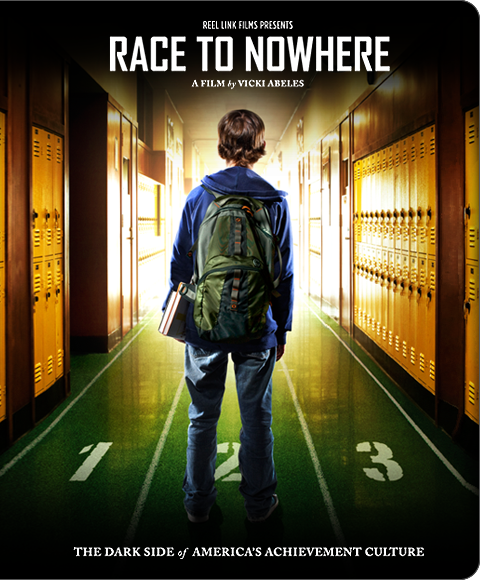
In RACE TO NOWHERE, filmmakers Vicki Abeles and Jessica Congdon speak to educators, parents, tweens, and teens about the pressures they face academically and emotionally, and the physical toll these expectations exact. What results is a picture of a fractured educational system that pushes kids to become successful — but at a cost.

During the Post World War II Advanced Placement pilot program, AP courses were designed to draw the top students into a small class of other students who LOVED the material. In 1952, AP classes were designed to be small so teachers could move at an accelerated pace because of the students’ voracious love of the subject matter. The idea was excellent.

Of course, what has happened over time, is that parents have demanded that their children be allowed entry into AP classes because, these days, there is a warped race to create the best college application. (Believe me, parents want those AP’s on their college applications.) So AP class sizes have ballooned, and there is less one-on-one with teachers. And kids who had no business being in an AP in the first place struggle. Because AP classes are hard. Really hard. When the idea was created, I don’t think anyone from the Ford Foundation would have recommended that any one student take five AP courses.

I always tell parents that AP courses are not the be all/end all. When I say this, they look at me like I have five heads. Then they ignore me completely. (I’m telling you, parents don’t like to hear this.)

I truly believe that the point of education is for children to love to learn. When students are getting sick, when they arrive at college unprepared and unmotivated, there is a problem. Students who feel too much pressure to perform, burn out. Feeling the pressure to achieve, students self-medicate, turn to drugs and alcohol as an escape, and sometimes cheat to complete the ever mounting pile of assignments which need to finished – now! From my vantage point, I see kids who are over-scheduled and overtired.

School should be the place where our teens learn about balance. Schools that allow students to skip lunch periods so they can take five Advanced Placement courses have bought into the hype (or caved into parental pressure). And that is sad. Lunch should not be optional. Humans need to stop and eat healthy food (not a bag of chips) to provide their bodies with energy. I don’t care how many times a parent calls and says, “I want my son to take 5 APs.” Administrators need to grow a set and say, “I’m sorry, but we just don’t think that is beneficial to your child.” Students need help learning how to make healthy choices. Sometimes that means they need the school to shield them from demanding parents. And anyway, kids don’t have to be enrolled in a course to take AP tests: a really self-motivated kid who loves to learn should be able to access all the material he needs to prepare him/herself for any AP test.

For the love of Pete, I’m a Tiger Momma. I believe our children need to pick the things they do and do them well. But we need to help guide them to understand they cannot do everything. Our kids need to study hard – absolutely – but they also need to eat. They need to be able to go to the bathroom without worrying they are missing crucial information. And they need to be allowed to tune school out for a while so they can exercise and nurture friendships. They should not be running from this practice to that recital just be sitting on their asses in front of their computers every night.

When I was in high school, I had the opportunity to take regular English, AP English, or  Syracuse University Project Advance (SUPA English). At the time, SUPA was a college curriculum class taught by our own high school instructors who had been trained to teach the course. I worked my butt off in that class, and I did not always excel. I remember getting one paper back with a big fat “D” on it. (Maybe it was a “C,” but in my mind, I remember it as a “D.”) I also remember taking that paper to the library and weeping next to a huge potted plant. I had worked so hard on that paper. And English was the subject in which I was supposed to excel. I did not understand how I could have failed. My ego was battered, but my love for the subject matter made me want to figure things out. I busted my hump in that class. It was truly an amazing experience, and I believe it was the course that best prepared me for college.

When I think back on it, I cannot imagine how grueling it must put in that kind of work into every subject, every day. To me, taking all those APs seems utterly unnecessary. No one has ever asked me: “How many AP courses did you take in high school?” (Well, one pretentious fuck did, but it was after he had polished off an entire bottle of red wine himself.) In fact, many colleges don’t even accept AP credit anymore. It’s true.

So, my recommendation is this: If you’ve got a kid who is interested in some accelerated academic experience, have him/her enroll in a summer course at a real college. That looks good on college applications, too. And the credit might actually transfer somewhere, and it might help transition him or her to the realities of actual college life. Help your child live a balanced life. Have your kid go to summer camp, get a job, plant a garden, try something he/she has never done before. Not for the college application, just because.

In the United States, success has long meant making a lot of money. And the way to do this has traditionally meant attending a great college. But we need to redefine success for children. We have gotten caught up in this “race to nowhere,” as described by Abeles and Congdon. We need to teach our kids to do what they love – not pressure them into taking five AP classes because it will make them look good on paper.

In 2010, over 1.8 million students took over 3.2 million AP tests at about $87 bucks a pop. I’m no mathematician, but even I can tell that some people are taking more than one test. And I’d like to know five years down the line, where those kids are, and if they feel all that pain was worth it.

Check out this clip from the film below. Tell me you don’t want to see it!

NYS Grads Ain’t Reddy For College

graduation caps

Image by j.o.h.n. walker via Flickr

In case you have not already seen/heard this by now, I am reposting Sharon Otterman’s article: Most New York Graduates Are Not College Ready – NYTimes.com in its entirety. If you like, you can click on the link above and read it in its original format. Frankly, this is the kind of news story that makes me weep inside.

If you prefer, you can read my repost below and catch all my snarky comments in blue. Red indicates sheer horror. (This is why I cannot loan out my books, people.)

• • • • • • • • • • • • • • • • • • • • • • • • • • • • • • • • • • • • • • • • • • • •

February 7, 2011

Most New York Students Are Not College-Ready

By SHARON OTTERMAN

New York State education officials released a new set of graduation statistics on Monday that show less than half of students in the state are leaving high school prepared for college and well-paying careers. The new statistics, part of a push to realign state standards with college performance, show that only 23 percent of students in New York City graduated ready for college or careers in 2009, not counting special-education students. That is well under half the current graduation rate of 64 percent, a number often promoted by Mayor Michael R. Bloomberg as evidence that his education policies are working.

But New York City is still doing better than the state’s other large urban districts. In Buffalo, Rochester, Syracuse and Yonkers, less than 17 percent of students met the proposed standards, including just 5 percent in Rochester.

The Board of Regents, which sets the state’s education policies, met on Monday to begin discussing what to do with this data, and will most likely issue a decision in March. One option is to make schools and districts place an asterisk next to the current graduation rate, or have them report both the current graduation rate and the college ready rate, said Merryl H. Tisch, the chancellor of the Board of Regents.

The move parallels a decision by the Regents last year to make standardized tests for third through eighth graders more difficult to pass, saying that the old passing rates did not correlate to high school success. (Oh good, let’s make new, harder tests. That should fix everything.What else is going to have to fall out of the curriculum so that our kids can pass these silly tests?)

State and city education officials have known for years that graduating from a public high school does not indicate that a student is ready for college, and have been slowly moving to raise standards. But the political will to acknowledge openly the chasm between graduation requirements and college or job needs is new, Dr. Tisch; David M. Steiner, the state education commissioner; and John King, the deputy state education commissioner, said in interviews last week.

With President Obama making college readiness and international competitiveness a top national goal, and federal and philanthropic money pouring into finding ways to raise national education standards, that equation is changing, they said. “It is a national crisis,” Dr. Steiner said.

Statewide, 77 percent of students graduate from high school. Currently, a student needs to score a 65 on four of the state’s five required Regents exams to graduate, and beginning next year, they will need a 65 on all five.

Using data collected by state and community colleges, testing experts on a state committee determined last year that a 75 on the English Regents and a 80 on the math Regents roughly predicted that students would get at least a C in a college-level course in the same subject. Scores below that meant students had to often take remediation classes before they could do college-level work. Only 41 percent of New York State graduates in 2009 achieved those scores. (No duh! This is what I have been seeing for years: Baffled community college students claiming to be “A students” in high school who have absolutely no idea how to read for meaning or write in complete sentences. No wonder they start freaking out when they suddenly get C’s on their essays!)

In the wealthier districts across the state, the news is better: 72 percent of students in “low need” districts are graduating ready for college or careers. (You get that, right? Over 25% of students in more affluent suburbs aren’t pulling their weight when they get to college.) But even that is well under the 95 percent of students in those districts who are now graduating. (We live in one of these “low need districts.” I have tutored students in grades 6-12 who still have not mastered basic comma rules. I have had to teach them commas, semi-colons and colons. I’ve thrown in a few mini-lesson on thesis statements for good measure. But that’s about all I can do. But seriously, the schools can’t do it all. I know they can’t. Why? Because public schools are so busy being mandated to prepare students for standardized tests that they simply do not have enough time to make sure that students have mastered certain things, so they have had to let some things go. I think folks at The Board of Regents must believe that kids pick up things like grammar by osmosis.)

The data also cast new doubt on the ability of charter schools to outperform their traditional school peers. Statewide, only 10 percent of students at charters graduated in 2009 at college-ready standards, though 49 percent received diplomas. The state has not yet calculated results for every district and school. (So charter school are broken, too? What a surprise!)

State officials have also begun a series of meetings in local districts to introduce this data and ask local officials what they want to do about it. A common reaction, Dr. Tisch said, is shock and hesitancy. There are fears of plummeting real estate values, as well as disagreement, particularly in rural areas, with the idea that all students need to be prepared for college.

Jean-Claude Brizard, the schools superintendent in Rochester for the past three years, said that while he was surprised by the data, he welcomed the effort to move the conversation away from simply graduating. In an effort to improve, Rochester has closed half its high schools and opened new schools, including its first high school that allows students to earn credits at several local colleges. 

In New York City, roughly 75 percent of public high school students who enroll in community colleges need to take remedial math or English courses before they can begin college-level work. (I would argue the same is true here in Rochester. Many of my incoming first year community college students are not anywhere ready for regular Comp-101. They need a more basic English class to prepare them for Comp-101. That is what my community college is grappling with now. This semester faculty in the English Department started developing a new diagnostic tool as the old AccuPlacer was proving ineffectual. Not everyone had to take it and part-time students slipped through the cracks.) City education officials said the 23 percent college-ready rate was not a fair measure of how the city would do if graduation requirements were raised to a higher standard, because students would work harder to meet that new bar.

While it has not gone so far as to calculate an alternative to graduation rates, the city has already begun tracking how each high school’s students fare in college, and in 2012 it will begin holding principals accountable for it. “Last year, well before the state announced this plan, we told schools we would begin including robust college readiness metrics in school progress reports,” said Shael Polakow-Suransky, the chief academic officer.

One thing that is helping districts get over their shock, Dr. Tisch said, is the opening of a discussion about how to improve things. On their tour, which has visited Albany, Buffalo and Rochester and will visit New York City, Westchester County and Long Island in the coming weeks, officials are presenting a menu of options. (Oooh, a menu! Well, I’ll take one helping of smaller class sizes: Eighteen students would be lovely. I’d like two helpings of students with parents who value and support education. I’d like a pile of teachers who are enthusiastic about their subject matter. I’d like intelligent principals who support their teachers and support staff. I’d like a double-helping of students who accept responsibility for their actions. I’d like to see Honor Courts comprised of the most ethical students, as nominated by teachers and peers. I’d like all students to sign an contract stating that they understand no one has the right to interfere with anyone else’s right to learn – because if they do, they will be expelled. And, um, I don’t see this on the menu but if it’s not too much trouble, I’d like to request students who remember to bring the necessary materials to class. Every day. Or at least just a pen.)

One idea is to simply report a college-ready graduation rate as an aspirational standard and leave it at that. (I have no idea what this means. So a principal could report: “We aspire to have 35% of our students graduate by 2015. That is insane! That is called The Anti-Aspirational Initiative.) Another is to impose tougher graduation standards — like requiring that all students in the state take four years of math and science, or permanently raising the passing score on high school Regents exams to 75 in English and 80 in math. (Be still my heart! Could it be that The Board of Regents is starting to realize a 65% is not really a passing grade. It’s a friggin’ low D! Way to go, Board of Regents. For the love of Pete, it’s only taken thirteen years for you to realize that teaching to a low standard is only bound to enforce that standard. Oy!)

But they are also discussing increased flexibility for districts and students, so that they can spend more time on the subjects they are interested in. For example, students might be permitted to choose at least one of the Regents exams they must pass to graduate — currently all students have to pass math, English, science, global history and American history. Students might be able to substitute foreign language, economics or art for one of the five. Or students could replace one Regents with a vocational skills test in an area like carpentry or plumbing. (Non-snarky response: I actually love this idea. Traditional education is not for everyone, and we need to value our vocational students more. Honestly, those middle and high school years are the only times in life where we expect people to be universally excellent at everything from foreign language to math to science to social studies to English to gym to sewing and cooking! People aren’t made that way. It would be great if we could allow students to specialize in their areas of interest. I mean, you could have asked me if 5th grade if I was going to be a nuclear scientist and I would have told you, “Hells bells, no!” and then I would not have had to suffer through calculus. I can honestly tell you that in my career, I have never used calculus. Ever.

Alternatively, the state could grant flexibility to districts to give credits based not on how many hours students sit in a classroom — currently 54 hours per semester per credit — but on whether students show competency, based on examination or online course work. (Really, so a student who can demonstrate that he already knows his shit might not have to sit through a required class. Just because the State says he has to take it? Now that’s somethin’!)

To press their case, state officials said they hoped to get political support from Gov. Andrew M. Cuomo. The political environment was particularly challenging now, because the state will roll out a new system in July to evaluate teachers that has the potential of strong opposition from teachers’ unions. (Oh great. Let’s blame the teachers who can’t “fix” their students in one calendar year, and if their numbers aren’t high enough, let’s put them on probation (or possibly fire them), ‘cuz teaching is not stressful enough without wondering if you are going to have a job the following September. And everyone knows that when students fail, it’s definitely the teachers’ fault.)

“The obligation at the end of the day,” Dr. Tisch added, ” is to make sure that when youngsters graduate, that graduation means something from New York State.” (I think Dr. Tisch meant to say: The obligation is to make sure that graduation from New York State means they have a set of skills which will enable them to succeed in college and in life. Because right now, that is just not the case.)

Lessons on Gray Hair & Karma

It all started when I found a gray hair in my ski helmet.

My response was completely rational.

“Who has been wearing my ski helmet?” I asked my husband who responded by laughing at me and telling me that the one in the helmet had some friends. On my head.

So I made an appointment to get my hair colored. I would have to wait eight weeks for my appointment. Okay, fine. Whatever. Make me suffer. Fine.

Not my child, but doesn't he look sad?

On the day of my appointment, Monkey was barfing. I mean power-puking. It was crazy.

I had a twenty minute drive to make it to the salon on-time. I couldn’t believe it. In the almost twelve years he has lived on this planet, my child has probably missed two days of school due to illness, total.

Monkey laid on the couch with a blue bucket at his side.

I looked at my watch. I thought about what I should do.

I sighed, realizing I had to do it.

I had to go to the salon.

(For God’s sakes, I had eight weeks of roots! Don’t judge me!)

“Monkey, I said. “I have to go out.”

He nodded and gripped the toilet.

“Here’s the phone,” I said, putting the cordless at his feet. “You know my number, right?”

He nodded.

The wintry roads were slippery, but still I zoomed off to Isobel. Pulling into the parking lot, I heard my phone ring. I checked to be sure it wasn’t Monkey. (It wasn’t.) I ran into the salon where Michael, the owner, welcomed me with a firm, “You’re five minutes late. Did you see I called you?”

I explained to Michael that I was the worst mother in the world. That I had left my barfing, sick child at home to get my highlights done. And Michael agreed, I was a pretty bad mom. But seventy-five minutes later, my hair was perfect. I paid for a job well-done and zoomed home.

While sitting at a stoplight approximately one minute from my house, my phone rang. “You left your wallet wide-open on the desk at the salon,” said Stephanie, a stylist at Isobel.

“Are you serious?” I asked, knowing, of course, she was serious.

I turned my car around and headed downtown. Again. Somehow, I got lost. I don’t know how I got lost, but I did. Maybe it’s because the entire city was cloaked in white so I took a wrong exit. Then, there were no discernible signs only lumpy shapes. Whatever. I finally made it to the salon and pulled my car right up to the door. It wasn’t really a parking space, per se – but I figured I was running in for two seconds and running back out. I had to get home to Monkey.

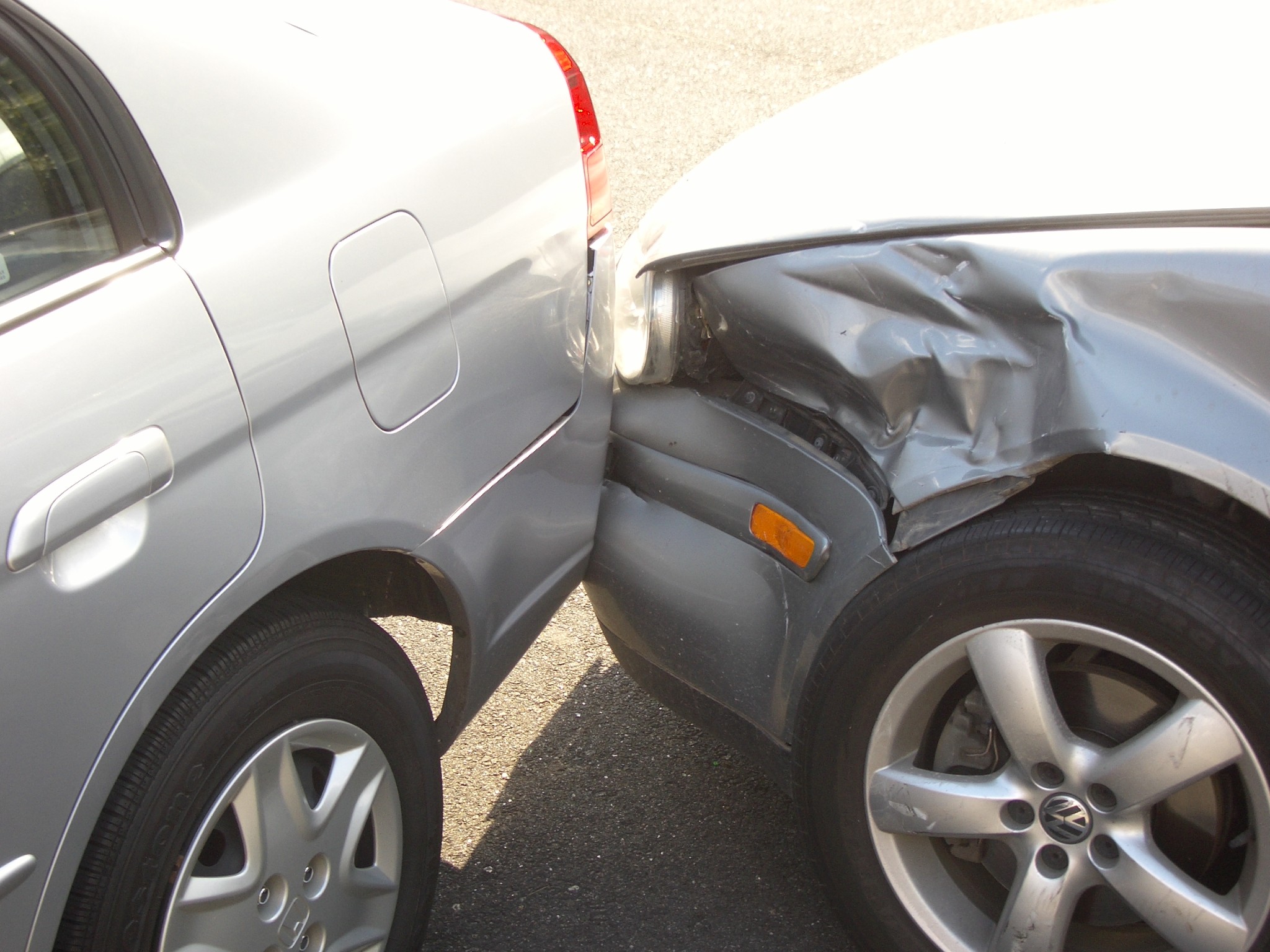
I turned off the ignition, opened my door, swung my clunky boots around, when – suddenly and simultaneously – the entire car shook and I heard a loud thunk-crunch. Turning my head, I saw another vehicle had smashed up against my rear bumper. (This was soooo not my day.)

And that’s when I noticed him. Looking to be about twenty years old, and wearing sagging jeans and a hoodie, he shuffled around to survey the wreck. “Ohhhhh mannnnn.” The guuy who had just plowed into my car spoke very slowly, like the way Spicoli spoke in the movie Fast Times at Ridgemont High. (For you young’uns out there, Spicoli was a major stoner.)

Not the real cars involved.

I drive a Honda Pilot. My vehicle is tall and black (and currently filthy). It’s not fancy, but it is tough. I looked closely at my bumper, which had absolutely no evidence of damage. Spicoli drove a kind of small, purplish (and might I add uber feminine) Hyundai which now had a dimple in it. And by “dimple,” I mean, his car was crushed like a paper fan.

“Thiiiiiis suuuucks,” Spicoli said, pulling the flaps of his Guatemalan hat down over his ears. He looked distressed. “Man,” says Spicoli. “I’ve had like… two other accidents in the last six months… I don’t want my insurance to go up any higher.”

“Well,” I said, trying not to sound too impatient, “there is no damage to my car, so we don’t have to report it.”

Spicoli looked confused.

I told him I was going into the salon for a minute and that when I came out, he could tell me what he wanted to do. At last, I dashed into the salon and grabbed my wallet. Michael made some pithy joke at my expense, but I was already gone.

“So…um…” Spicoli stuttered, “if you are okay with it, can we not report this?” Spicoli asked. “I mean, my car is totally drivable.”

I nodded in agreement. Then Spicoli apologized, shook my hand, and told me I seemed like a nice lady.

Meanwhile I thought guiltily: Nice ladies don’t leave their sick children at home while they have their hair done.

I drove home carefully, certain that every police officer was out, ready to give me a ticket. And when I was pulled over, I would have to confess that my 11 year old was at home, alone and sick. And then Monkey would be hauled off to Child Protective Services. I visualized my husband screaming at me and then getting a really hot divorce lawyer.

Except none of that happened. After the garage door opened, I parked the car and hurried into the house to find Monkey, still resting on the couch. I pulled off my mittens and puffy black coat while I cooed, “Hey, Monkey… how are you feeling?”

“Okay,” he said.

I touched my son’s forehead. Cool as a cucumber. (Thank goodness.)

Tugging the hat from my head, I grabbed an extra blanket and covered Monkey from chin to toe. Then, I sat down beside him on the couch. Glancing at the clock, I saw it had been over three hours since I had left him alone.

“Do you need anything, buddy?” I asked, trying hard to make up for my hours of neglect. “Some tea?”

Monkey shook his head and kind of closed his eyes.

In that moment, I thought about what I had done. I had left my sick child when he needed me. Sure, I wanted my hair highlighted, but clearly some cosmic power seemed to be punishing me in a major way for my actions that morning, and I silently promised that if my li’l dude ever got sick again, I would put him first absolutely. Yes. Because he is that important to me. And I want him to know that he is loved and be the one to comfort him when he is feeling down and out.

“Mom,” Monkey said quietly, interrupting my thoughts. “Your hair looks really pretty.”

And you know what? It did. It really did.

Care to share any low parenting moments? Or just judge me in mine? It’s cool. I can take it.

Lessons From Losing

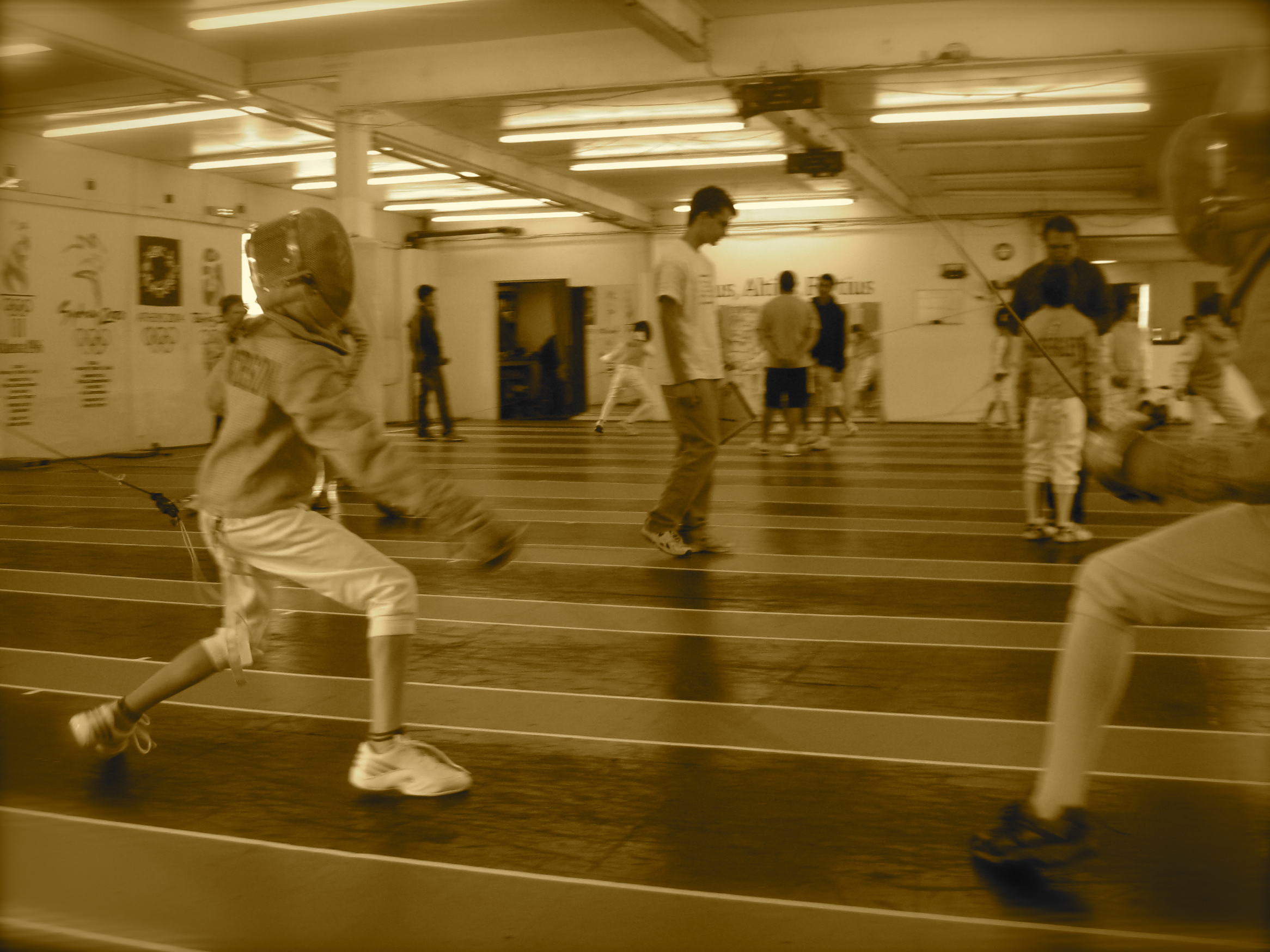
As a self-admitted, ridiculously competitive parent who wants her child to know how good it can feel to work hard and win, it is my duty to report that my son competed in a fencing competition last weekend. On the strip, he fenced his butt off and did not lose a single match. As parents, my husband and I were internally beyond psyched, but externally we tried to contain ourselves.

After two hours, Monkey came over to the area where we were standing and said, “Explain how I have won every bout but I am now ranked #7?” Husband and I looked at each other and said (practically in unison), “Don’t ask us! Ask the guy with the clipboard.” So Monkey did. He marched right up to his coach who is like nine feet tall and tattooed and has a goatee and sometimes yells at kids or bonks them on their helmets for not paying attention. (It should be said, this treatment is always deserved. Elliott is an amazing coach, but he can be intimidating.)

Several adults were standing in a small cluster when Monkey barged in. From my vantage point (wedged against husband and the cola machine), I could see Monkey say something and point at the clipboard. Then I saw everyone look at the clipboard. And then I saw four horrified adult faces. I watched people erasing and nodding. Eventually, words were exchanged and Monkey came back over to us.

Apparently, an error had been made. One of the refs accidentally wrote down the wrong last name in the brackets and so Monkey’s competitor, the kid he had beaten, moved ahead of him.

When the error was brought to his attention, my son was composed. He stayed for the remainder of the competition and watched other fencers compete. He even congratulated the winners afterward.

Later in the car, Monkey was mad. It’s the first time I’d ever seen anything close to a kind of fire in my son. He said he was frustrated – really frustrated. That he had wanted to go as far as he could, and he was mad to have been prematurely stopped in his tracks. He did not have a hissy fit or cry. He understood an error had been made. He knew it was not intentional. He knew that by the time the error had been caught, it was too late, as fencers were already fencing in the semi-finals. He just kind of wished he had known about the mistake earlier.

So there were lots of lessons that day. Lessons we take through life. Monkey kept his head about him and kept his cool, despite the fact that he got a bum rap. He understood his disappointment wasn’t so much about the losing so much as it was losing the opportunity to do his best. That was the frustrating thing for him. (And I’m guessing next time, he’ll be the kid hovering around whomever is holding the clipboard.)

There were lessons for this trophy-seeking momma, too. I have to admit, my first instinct was to feel anger. I felt Monkey had been gypped. Privately, I wanted the coaches to go all the way back in the seeding to where the error was made and start over. I didn’t care if it meant another grueling two hours for the fencers; I wanted justice! I was surprised by how quickly my inner Tiger Momma wanted to pounce: claws bared, teeth clenched. I wanted apologies and a free year of private lessons. I wanted someone to publicly acknowledge my child’s amazing composure. For the love of Pete, I wanted to scream, Someone mention that you guys screwed up and my kid did not really come in 7th place!

Of course, I didn’t.

I squished these urges down, but it wasn’t easy. But I took my cue from Monkey, and I rode the tide. And just so we’re all clear, I’m not a great tide-rider. But on that day, I had to be. We all did. Because sometimes life really does just happen and — even if you have a sword — sometimes you just have to put it away and prepare to battle another day.

The Giver: Thirteen Years Later

The Giver

Image via Wikipedia

It’s happening.

My son is reading a piece of literature that I used to teach.

He is reading Lois Lowry’s The Giver, the story of a young boy named Jonas living in a highly controlled community some time in the future. The novel fits into a larger genre of cautionary tales called “dystopian literature.” If a utopia is a society in which everything is perfect, a dystopia is the opposite: everything has gone wrong. The novel explores Jonas’s encounter with memories of “the past,” a time when people still had the freedom of choice.

When I first taught The Giver, the book had just come out, and it was controversial. In fact, it was banned in many schools for its disturbing content and ambiguous ending, but I taught The Giver to 9th graders in an independent school, so I had a lot of freedom. The Giver explores an age-old debate: Should government let people have freedom or seek to “protect them”? Should we value individuality or the greater good? Are emotional highs and lows better than the steady middle ground?

Fast forward. My son is now in 6th grade. Oh, he can handle the language and the concepts just fine. He is a voracious reader, and he seems to understand the book thus far. I have struggled over the last weeks because, really, I want him to discover the book himself. I want him to be stunned when he learns that the main character’s father has lied to him, that it is his father’s job to kill babies. To nurture them, yes, but also to decide which one’s live and which one’s die. Jonas watches his father administer a lethal injection to an otherwise healthy infant twin because the community has decided there can be no twins. And he learns that his father will have to “release” a baby that has been living with the family because he simply cannot sleep through the night without crying.

So I will be waiting for his response.

Because right now, he thinks The Community is a pretty good place to live.

No one has to worry about money, he insists. The climate is controlled. The birth-rate is controlled. Jobs are determined by Committee Members based on careful scrutiny of children and their personality traits. Kids who like to build become engineers and kids who like to play with children become Nurturers. There are Laborers and Birth Mothers. All kinds of jobs. My Monkey likes this kind of order. It seems logical, and it appeals to him.

“Sameness eliminated fighting and wars,” Monkey said matter-of-factly. “There is no more racism.”

“True, but people can’t see or appreciate colors. Everything is kind of beige, so they can’t appreciate hot pink flowers or the blue of an ocean,” I said. “And they don’t know snow or sunshine because of climate control,” I suggest.

He shrugged his shoulders at this. He isn’t far into the book yet to know what is coming.

While he was out today, I re-read The Giver from beginning to end. And I am struck by how Orwellian Lowry’s vision is. And I am amazed by all the ways the government has slowly intruded into our lives since 1993. Post September 11, 2001, video cameras are everywhere. Everywhere we go, we are being filmed. If we purchase something, our credit card transactions are tracked in a way they weren’t before. When we go to the airport, we are made to practically strip down – and we agree to do so, in the name of the greater good; we take off our belts and shoes and put our liquid products into baggies to be searched. We have caller identification so we no longer have to answer the phone. And every prank phone call can be traced back to the place of origin. The government is more involved in public education than ever, practically dictating to teachers the curriculum that needs to be taught. Textbooks, which have been approved and distributed throughout our country to our children, are filled with hundreds of factual and grammatical errors and people do not seem to be outraged. The latest version of Huckleberry Finn has had the “n” word removed. (Sure, you can still get the alternate version, but tens of thousands of students will never even know that another version exists because it is easier to edit the language of difference.) Journalism has become entertainment, and few people read primary sources. Most people just pop onto Blackberries and iPhones and read commentary (read: secondary sources or the ideas from “specialists” telling us what to think) about everything from the food we eat to the latest shooting. I see people forgetting how to think critically. I know people who do not know much about our Constitution. They could Google United States Constitution and read about it, but most folks would rather read Status Updates on Facebook or download the latest App designed to make us forget that our country is engaged in a war.

“There is no war in Jonas’s world,” Monkey said, his chin angled up defensively.

“True,” I said, thinking to myself but there is no love either.

And I wonder how many civil liberties my child might be willing to give up if the Government told him it was for the greater good.

Post-Museum Trippy Lessons on Drugs

art by Will Goodan

I like museums. Monkey and I have been visiting them since he was very small. When he was around 5-years old, we brought sketch pads and colored pencils and, together, we would roam around local museums until one of us found a piece of something or other that we particularly liked and then we both would sit down and attempt to sketch it out. These days, we leave our paper and pencils behind, but we still like to go to the museums and check out what’s going on. Together, we’ve seen lots of good stuff.

Recently, Monkey’s middle school art club took the students on a field trip, which I had to cut short as he was double-booked and had a conflict.

“I never even got to see the special installation,” he complained as he climbed into the car.

I didn’t know anything about the “special installation,” but I promised him that we would see before it left the museum.

Last Sunday was our last chance to see the show before it left town.

So I inadvertently took my 11-year old to see “Psychedelic Art: Hallucinogens and their Impact on the Art of the 1960s.”

I could hardly have been less prepared.

Space Chase (2006)

For those who might not know, “Psychedelic Art” refers to any kind of visual artwork inspired by psychedelic experiences induced by drugs such as LSD, mescaline, and psilocybin (i.e: “magic mushrooms”). Inspired by the 1960s counterculture, psychedelic visual arts were a counterpart to psychedelic rock music. Concert posters, album covers, light-shows, underground newspapers and more reflected not only the kaleidoscopically swirling patterns of LSD hallucinations, but also revolutionary political, social and spiritual sentiments inspired by insights derived from these psychedelic states of consciousness.

In the museum, little laminated placards set next to each piece of art explained what inspired the artist and the materials used to create it.

“Look,” announced Monkey pointing to one multimedia collage. “That one has red pills set into it. And little leaves.”

I said little, wondering if, in fact, I should have been saying more.

“What’s that smell?” Monkey asked, sniffing the air.

Somebody had clearly smoked a doobie or two before coming to the museum. It seemed obvious that the scent was coming from the dude standing behind us. I glanced at him as he looked dreamily at the canvas that listed the materials as acrylic paint and hemp.

“Ohhhh,” said Monkey as he read the information card. “Those leaves must be dried out marijuana. ‘Hemp’ is another name for marijuana.”

And weed and blunt and spliff and reefer, I thought to myself, smelling the pot that lingered in the air around the dude’s coat. And ganga and cannabis and a million other synonyms that you don’t need to know about yet.

art by Stella

On the way home it happened.

It always happens in the car.

Monkey always asks the big questions in the car.

“Mom,” Monkey asked. “Everyone says drugs are really bad for you. That you should never do them. But the art people created while they were on drugs was really interesting.”

I braced the wheel, white-knuckled.

“What am I supposed to do with that?” he asked.

I explained to Monkey that the drugs of the 1960s were much weaker than today’s drugs. Since he had recently seen about two minutes of a disturbing episode of Intervention where a man was smoking crystal methamphetamine followed by an OxyContin chaser, I made a point of telling him that neither of those drugs even existed in the 1960s: that in the 1960s, drugs were kind of “home-grown” and meant to mellow people out, while today’s drugs have been designed in laboratories to get people hooked.

I know this is not 100% accurate. LSD was manufactured and (initially) distributed not for profit, but because those who made it truly believed that the psychedelic experience could do good for humanity, that it expanded the mind and could bring understanding and love.

I did not tell this to Monkey.

I did tell him that the art/music/drug experiments of the 1960s went along with the whole counterculture movement that was going on at the time. We discussed the Vietnam War and the Hippie movement. I explained that the people who chose to use the drugs were attempting to enter a kind of mystical world to explore a new kind of art, and – in many cases, they were successful as the drugs helped them to see a different dimension, a world where space was filled with multi-colored geometric shapes and surreal images.

I told him that while some people had good experiences with these drugs, drugs could be dangerous as well. I told him that some people who used hallucinogenic drugs had “bad trips” and that things that were bothering them became exacerbated and all they could do was wait for the drug to wear off – and that sometimes that took up to 8 hours.

Monet's Waterlilies

“I can’t deny that psychedelic art is interesting,” I stressed, “but to me it’s more culturally interesting than artistically interesting. I’d rather look at a great Monet. There is a lot more going on in a Monet than in, say, that random piece of plexiglass we saw on the floor. You know, the one with the piece of wood coming out of it?”

Monkey was quiet. “So just because a few artists made cool art while on drugs doesn’t mean it’s a good idea to use drugs.”

“I’d go along with that,” I said breathing again.

I’m not sure I said the right things.

What do you say to your 6th grader when he or she asks about drugs?

Gratitude From An 11-Year Old

So it’s Thanksgiving. I’ll tell you what I’m grateful for: My son, who decided to take over as today’s guest blogger and gave me a little extra vacation time. I was going to add more, but I think he’s about covered it.

Stuff I’m Thankful for at Eleven Years Old

1. Thanks for my family. They love and support me when I’m in a tough situation.

2. Thanks for life. It keeps me alive.

3. Thanks for friends. Those guys sometimes piss me off, but they are still awesome.

4. Thanks for entertainment. It makes us say: “ooh,” “aah,” and “oh no!”

5. Thanks for books. They help us learn and are great on car rides when you don’t want to get out of the car to do errands. You can say, “Do I have to go in? I’m reading.” That usually works.

6. Thanks for my Dad’s job. Without it we wouldn’t have enough money for everything we have today. Because everyone knows my mom’s job as a teacher doesn’t really pay very much.

7. Thanks for technology. Especially when it works.

8. Thank goodness for a little vacation. No school!

9.  Thanks for blankets: Warmness!

10. Thanks for everything. Except the bad stuff. And luckily, we don’t have too much of that.

What are you thankful for?

Should Kids Be Using Cell Phones? Should Any of Us?

I knew a child who wouldn’t stop asking her mother to buy her a cell phone. Daily, this kid was working her mother over. Negotiations took place at the breakfast table each morning (before coffee) for weeks until, finally, my friend cracked and bought her daughter a basic cell phone which came with the caveat: Use this in emergencies only. The child seems to have been appeased.

I have somehow managed to avoid the whole “cell phone conversation” by getting my child an iPod Touch (which, by the way, he is currently not allowed to use for an undetermined period of time due to the fact that Boy was so enthralled with his new “toy,” he failed to respond to his father’s clearly audible, repeated request to go and brush his teeth. )

But I digress.

But it’s not a huge digression. I know kids who have had cell phones as early as the 3rd grade. Children have become the earliest adopters of our newest technologies. They pick up on how things work quickly, and we are awed by their abilities to understand what seem to many adults to be such complicated devices.

In an article by Marguerite Reardon, the writer asks the big question: Are cell phones safe? For years, studies have provided conflicting conclusions, and today, there is still no clear answer. One professor of bioengineering at the University of Washington in Seattle, Dr. Henry Lai, has been studying the effects of cell phone radiation on humans since 1980 and says: “There is cause for concern.”

For years, researchers and scientists have debated whether radiation from radio frequencies used to wirelessly transmit phone calls could adversely affect the health of cell phone users. And as more people throughout the world use cell phones and make these devices an integral part of their lives, concerns have grown as to long-term public health issues.

In 2009, it was estimated that in the U.S. alone, more than 270 million Americans (more than 87 percent of the population), now owns a cell phone, according to data compiled by the Marist Poll Marketing Group.

A handful of studies that have looked at the long-term effects of using cell phones suggest people who use a cell phone for at least an hour each day over a 10-year period are at an increased risk of developing brain tumors. This research also suggests that tumors are more likely to be on the side of the head where the phone is most often used.

More recently, researchers have grown particularly concerned about the adverse effects that cell phone usage could have on children. Some research indicates that children are five times more likely to get brain cancer if they use mobile phones, but other research efforts have found results inconclusive.

So here’s the paradox: Everyone worries about the “safety” of his/her  children; of course we do. What parent doesn’t? But are we thinking long-term enough? There is concern that children who start using cell phones at a young age will be exposed for a longer period of time over their entire lifetime to cell phone radiation. Researchers are particularly concerned about the risk of cell phones with children, because children’s nervous systems are not fully developed, their brains contain more fluid than brains of adults, which allows for deeper penetration of radiation.

There has been enough concern among public health officials in various parts of the world to warrant warnings. For example, the Finnish Radiation and Nuclear Safety Authority (STUK), a government regulatory body located in the home country of Nokia, the largest cell phone maker in the world, is urging parents to restrict cell phone use for children, suggesting parents encourage kids text rather than talk.

France has proposed banning advertisements encouraging children younger than 12 to use cell phones, and it has also warned parents that children under age six are particularly at risk. The Food and Drug Administration in the U.S. does not go so far as issuing a warning, but the agency recommends minimizing potential risk by using hands-free devices and keeping cell-phone talk to a minimum.

Finland, France and Israel have all issued warnings on their government websites about children using cell phones, while the U.S. has issued no such warnings.

I am certain the day will come when my son will get a cell phone. I don’t know what the moment will look like or what the trigger will be: an event like a birthday, or an actual breakdown in the systems that we currently have in place. I do know that when he gets a phone, that phone will be his responsibility and if he loses it, it will not be treated like a sock or a paperclip. And it will be when it is abundantly clear that he really needs a cell phone. Right now, the school he attends is in our backyard, so if he forgets something at school, the answer to almost any question is some variation of “Well, why don’t you just run back there and see if you can get in the school?” One day, perhaps when he is in high school and starting to drive or if he starts going to huge fencing competitions without us (or if he figures a way to argue his case and win), he can have the most basic cell phone of his choice. Until then, I’m going with the Europeans and the Israelis.

Have a quick listen to this podcast by Dr. Devra Davis, Director of the Center for Environmental Oncology at the University of Pittsburgh Institute, and see what you think:

What do you do with all this information?

The Teenage Years: It’s All in the Brain

photo by c.a. muller @ flickr.com

My son just started middle school after Labor Day, and everything seems to be going really well. So why am I already battening down the hatches? Because I remember how I was in middle school. I was evil. Just impossible. Everything my parents did was horrifyingly embarrassing. My friends were my world. I wanted the blue Fair Isles sweater that Jodi wore, the Bermuda bag that Marla carried, the clogs that Melissa had on her feet. I wanted to hang out with Dina and Noelle and Todd and Adam as much as humanly possible. We lived to torture our poor, pathetic French teacher. Every moment was filled with emotion and drama. I look back sometimes and wonder: Seriously, what was I thinking?

Apparently in the last decade,  a fair bit of research has been conducted to gather biological evidence as to why teenagers go a little bit haywire. Apparently, the teenage brain begins a massive shift around the prefrontal cortex around 12-13 years of age. The pre-frontal cortex is the thinking part of the brain that allows us to consider the consequences of our actions, and that part of the brain kind of stops working as well as it had before. Parents don’t always understand the neurological changes that their children’s brains are undergoing: changes that can cause their once docile children to take big risks and make big mistakes. The following article is an excerpt from a fabulous piece of reporting by Patti Neighmond for npr.org. You can read it, or you can listen to it here.

Laura Kastner, who along with Jennifer Wyatt has written a new book, Getting to Calm: Cool-headed Strategies for Parenting Tweens and Teens. For more than 30 years, Kastner has helped parents and children work toward greater calm in the home. In the book, Kastner presents a typical scenario:

Your child goes to a sleepover. The kids sneak out, go to someone’s house, and spray shaving cream all over the house and cars. The police come, give them a tongue lashing and send them back to the host family, who promptly delivers them home to you in the middle of the night.

“Sometimes, parents say, ‘What were you thinking?'” says Kastner. “And the joke’s on us. They weren’t thinking. They were running like wildebeests in the canyon. Just go, go, go. You know, they were flooded and excited and not really thinking through the consequences of their actions.”

In situations like this, Kastner says the first line of defense for parents is to stay calm. Tell the teen to just go to bed and that you will deal with consequences tomorrow. Ask them to write a note of self-reflection — about their regrets, why they went off track, what they would do differently if given another chance, and what skills they might need to avoid the situation in the first place.

Kastner suggests even writing a letter of apology to the host family, the family that got shaving-creamed, and maybe even the police officer who wasted his time responding to the incident. Based on the quality of this self-critique, Kastner says, parents can then determine discipline or consequences.

“It will be small, medium or large, based on the quality” of the self-critique and how much the parents believe their children learned from the mistake, she says. Parents might even have the teenager suggest their own discipline. And there’s an added benefit to the teens’ writing. It engages the “thinking” part of the brain, and gets the teenager away from the emotional frenzy of the night.

I, of course, love the idea of integrating writing as a way of getting kids to connect with thoughts to their actions. This is a strategy I have used in my classroom when students have been misbehaving. I simply hand the offending student a pre-written sticky note which instructs that student to sit out in the hall and write a full-page explanation as to why he/she has been asked to leave my class.

The exercise works for several reasons: First, it immediately eliminates the distraction from the classroom. Second, the student has to go outside and really think about what he/she was doing. Sometimes it is the first time the student has ever had the opportunity to even consider that what he/she has been doing might be considered annoying/bothersome, anti-intellectual, etc. Third, once the student is done, he/she returns to the class where we calmly conference. There has been time to cool down. I get to read the student’s words. The student generally recognizes his/her behavior as problematic to the larger group dynamic and we come to some kind of understanding. Sometimes, adjustments need to be made: maybe we decide to move the student’s seat so he/she is closer to me and further away from a friend or a loud hallway. Always, we have a clearer understanding of the other. And last, I have a piece of paper documenting the student’s infraction so if the behavior recurs, well . . . I have proof from the student’s own hand that establishes there has been an ongoing problem.

I have done all this for years, however, until I heard this report on NPR, it had never occurred to me to use this same kind of writing technique as a kind of disciplinary technique with my own child. (Not that I have had to. Yet.) But I love the idea of it.

So guess who has a blank composition notebook in the kitchen cupboard ready to go, should that moment of crisis arise. (Note: if you act fast, those notebooks are twenty-five cents at Target. If your peeps are just entering middle school, I suggest you pick up a few!)

And while we’re on the subject, anyone brave enough to share an example of a “wild and crazy thing” you did when you were between the ages of 13 and 17 years old? Anyone? Anyone?

The Secret To Finding The Best Babysitters

photo by margolove @ flickr.com

The best babysitters are, of course, the ones who love interacting with your children and know how to take care of them in any circumstance. But now that my son is older, I have found that the best sitters – the ones who not only take care of his physical and emotional needs – are the ones who like to linger around after my child (and usually my husband) have gone to bed so we can discuss life. And books!

Hilary was our first real babysitter. A former student of mine, I plucked her from my classroom (while I was on maternity leave) and asked if she would be interested in regularly watching my newborn on Saturday nights. By the time my husband and I came home, Hil would have cleaned the entire house and be quietly studying for some upcoming, major test. She would tell me some cute thing my child did, and then she would tell me what she was reading: usually something out of a ridiculously heavy science book she was toting around. Always diligent, Hilary was incredibly detail oriented, so I was not surprised to learn that Hilary became a pharmacist — and is now a mother herself!

I met Marioli while strolling at Nazareth College, determined to find another good babysitter, you know, for when Hilary was not available. I had my l’il dude packed into his stroller and was tacking up those little tear-off sheets indicating that I was looking for a responsible babysitter, with expertise in watching young children, who was willing to make my son priority #1 while my husband and I were out for a few hours. While pinning up my ad, Marioli stopped to chat, got down on her hands and knees and cooed at my l’il person. She made him giggle, so – of course, I liked her right away. Standing up, her brown hair bouncing, she said she was interested in the position. Turns out, she had a whole crew of siblings; people she missed while in college. She knew how to take care of children because she had always taken care of brothers and sisters. She was astoundingly entertaining, extremely reliable, my son loved her — and she turned me on to The Poisonwood Bible and we talked late into the night about Shakespeare and Dante’s concept of Hell in The Inferno.

The need for swim lessons brought me to Jen, yet another Nazareth College student. (By then, it had become abundantly clear that with their strong education department, I needed only to hang around the education department for a few minutes, and I would find a solid babysitter.) Jen taught my son to swim. She brought him games to play, books to read, new things to challenge his mind. She played endless hours of LEGOs with him. (Lord, love her.) And then, at night, she would discuss the new teaching standards and show me the rubrics she had designed. She talked about her student teaching experience, the politics – the up and the down days. I screamed with joy when she landed a full-time job, even though I knew it would pull her away from our family. I was just so stinkin’ happy for her.

My beloved Billy went from former student to one of my son’s favorite babysitters. After Billy graduated from college, he worked crazy hours. He worked three or four jobs. Maybe five. Seriously. I don’t know how he did it, but he had to make money to put himself through graduate school, so he worked. A lot. Billy and I would stay up waaaay too late talking about classroom stuff. He recommended books like I Just Want My Pants Back (which sucked) and The Girl with the Dragon Tattoo (which rocked). More recently, Billy expressed frustration about how to get re-designated as “World’s Best Substitute Teacher” to Full-time Math Teacher in a classroom of his own. And, again, I screamed when I learned he just recently landed a long-term substitute position in the district he wanted. Okay, so it isn’t perfect, but it is a foot in the door. Foot. In. The. Door.

Now that my son is in middle school, we are needing fewer sitters. Luckily, Christina lives across the street. A voracious reader in 11th grade, her reading aptitude extends far beyond her years. In fact, everything about Christina is far beyond her years; she has an adult sensibility and has found an escape into the world of books. We have texted about whether or not Ordinary People possesses a “bildungsroman‘ motif. We’ve chatted about Wuthering Heights and Huckleberry Finn, The Great Gatsby, and Death of a Salesman. As you can imagine, I adore Christina. She is like dessert after the dessert.

So my advice to parents looking for good babysitters? Go to your favorite, local college: one that has a reputation for its outstanding education program — and put up a sign. Ask the requisite questions: (What would you do if my child was bleeding? Choking? Knocked unconscious? Being a major pain in the butt?), and then ask:

What book have you really enjoyed?

If the person before you can’t pull a title out of his or her . . . um, brain . . . pretty darn quick, let ’em go. I don’t care how cute or nice she is, if she is the star of the field hockey team or the school musical. It’s all smoke and mirrors. But if you find a kid who says he has dozens of favorite authors, favorite books, how could he ever pick just one (and he starts tossing out a few titles), you have just stumbled onto a gold mine.

Hold on tight. You just might learn something.

What are your best tips on finding great babysitters? And what are you reading?

tweet me @rasjacobson