Teacher’s Pets: It’s Not What You Think

The dog formerly known as Mojo, 2009

Last year, at exactly this same time, we got a dog. The world was white and unbearably cold, and getting a pet seemed like a wonderful idea. We were dogless and surrounded on all sides by barky-barkers. We figured, how hard could it be, if everyone has them? Hubby researched carefully, making sure to find a breed that would be a good fit for our family.

Meanwhile I went to the breeder with my friend Cindy to meet “Lloyd,” a yellow Labrador puppy who was soon to become part of her family. They don’t make ’em cuter than that, folks. He was freakin’ adorable. But I also remembered how two summers before she’d brought home these two freaky Wheatland terriers, and she hated them. Hated. Them.

“Do they smell? I feel like they smell,” she kept asking.

I swear Cindy lost 10 pounds in the few days she had those dogs, and they quickly went back to the breeder.

Around the same time, I’d been following the trials with another friend’s new puppy for nearly four months — and it sounded like hell. All his Facebook status updates sounded like misery. Eventually, he returned his Labradoodle to the breeder. I had recently read Marley and Me, so I was nervous about lineage and more than a little anxious about making sure to pick the right dog from the litter.

I expressed my concerns to my husband who reminded me that I had successfully babysat my sister-in-law’s adorable shih tzu, Roxie, for two days.

“And I enjoy Brian — the cartoon dog on The Family Guy.” I quipped, “Can we find a witty, talking dog?”

Anyway, I told my family I was really nervous about this decision. I told them I’d never had a dog, that I didn’t really want a dog, but my husband kind of wore me down, promising that he would help with everything. He would pick up the dog poo every day. He would feed the dog. He would change the water. He would play with the dog. I wouldn’t have to do anything except enjoy him.

I know people love their doggies like family, but I kept thinking of them as eternal babies and I couldn’t figure out how we would ever be able to take a spontaneous day trip ever again. Everyone kept telling me I was just nervous about the unknown. I don’t think that was it at all. In fact, I think I knew too much. For example, while discussing the whole concept of getting a dog, I was at a friend’s house, when her Maltese got the “Hershey squirts” all over her rug.

Her. Good. Oriental. Rug.

And when Noah (a good-natured yellow Lab) came to live with my friend Betsy, he promptly swallowed a hair accessory and it was barfity-barfity-barf all the way to the vet. Another friend’s dog compulsively ate socks and had to have several emergency surgeries. Another friend’s dog kept getting foot infections. One of my brother’s dogs had weird phobias and tore through doors during thunderstorms. And, of course, we had all these barky dogs surrounding us – which could be a little unpleasant. Did I really want to own a dog?

I decided if Hubby wanted a puppy so badly, he would need to make the action steps, so I took one giant step back.

Big mistake.

Because the next thing I knew, we had a 4-month-old shih tzu. And while Hubby had said he would “do everything,” he simultaneously decided that first weekend home with the dog would be the perfect time to take a long weekend to go golfing with some buddies in Florida. So Hubby left me at home alone for four days with our brand new puppy — Mojo — who, to be fair — was a quick study about doing his business outside. But it should be noted, he didn’t seem to mind peeing or pooping inside, and he especially liked chewing on his feces after the big dump, so one had to be quick to catch him in the act.

After two weeks, I couldn’t take it anymore. Our son had stopped coming in the kitchen to avoid Mojo, who liked biting Monkey’s toes. So I asked my son, point-blank, if he would be sad if I brought the dog back to the breeder.

“Well,” he said cautiously, aware that he was operating between the clashing wills of his two parents. “I wouldn’t be particularly unhappy about it.”

This was not the voice of a child who loved his dog. There was no crying, no begging, no bargaining.  I told Hubby I would no longer be picking up “poopsicles” in sub-zero temperatures, informed him that I had called the breeder and was more than 100% prepared to lose my Mojo.

There are several good parts to this story and this is where they start: First, I did not have to bring the dog back to the breeder. My husband’s brother and my sister-in-law, who live less than 1/2 mile away, said they would love to have a second shih tzu, and I was delighted to give them everything. That. Very. Minute. So Mojo was renamed Rubie, and their dog, Roxie, got a sister, and Hubby still gets visitation rights. The dog still eats his poop, but they are way more mellow about that than I was.

Fast forward one year. Almost to the day. Hubby calls me and tells me to come to Petco.

Hubby: “I think you should come to look at some aquariums for Monkey’s room.”

Me: “Who cares. Fish is fish. Just pick one.”

Hubby: “Meet me at Petco.”

Hemingway in my coat – 4 months

When I walked in, I saw Hubby holding not one but two gray kittens. I almost died. I have wanted a cat for my entire life. In fact, right before I met Hubby, I was about to get a cat, but when I mentioned my plans, Hubby said he thought he was allergic, so I never followed through. I figured the whole cat thing was never going to happen.

Somehow we wound up with Hemingway, an all gray, short-haired, polydactyl cat, which means he had nine million pads on his paws. (Really, he had seven pads on each of his front paws — fourteen big fat pads, which he kneaded softly against my chest or leg or arm.) He was purr-fectly purr-fect in every way. To me, he was better than a dog because he loved to be cuddled and held and hugged — and he always went in his litter box, so none of us had to go outside in the bitter chill of winter. Hemi loved to chase ping-pong balls and wadded up balls of paper and string. He seemed to love us, and we all fell in love with him. He greeted us every morning for two weeks with a happy “meow,” and I was content to sit and read with him on my lap, his mutant paws draped lazily over my arms, the constant purr of his “motor” was always turned on.

Then on day 14, it happened.

Hubby started scratching. Initially, he complained about his eyes feeling like there were pebbles underneath his lids. But by the end of the day, the pebbles had become boulders and — much as we tried to deny it — it was obvious: Hubby was, in fact, allergic to cats. And, of course, we were all devastated when Hubby had to bring Hemi back to Habitat for Cats, as we’d all become very attached to the little guy.

They say some folks are dog people and some are cat people.

Sadly, I guess we are the people who can’t be either.

“Maybe we can get some cool fish,” I said trying to cheer my rather glum Monkey.

“I’m tired of the pet drama,” said Monkey, “Knowing us, our heater would accidentally boil the fish.”

So, for now, we are back to our former petless status.

But it is a little sad.

Maybe by winter 2011, we’ll be emotionally ready to consider a goldfish.

Somebody, tell me your own pet drama to make me feel better.

End of Semester Gratitude

thank you note for every language

Image by woodleywonderworks via Flickr

The Fall-Winter 2010 semester is over for me. My grades have been reported. The contents of my unattractive yet functional wheelie bag have been dumped and placed with the rest of the luggage — in the nether regions of the basement. Today, I am getting my hair highlighted. It’s been fifteen weeks since my last highlight or cut. (The straightening thing doesn’t count.) Don’t even ask about the state of my fingernails at the moment. I have a way of letting certain things go during the semester. But now it is time to catch up.

This morning, I popped onto my faculty email account to make sure everything was in order, and I found two pieces of email waiting for me. The first indicated that my grades may have been inaccurately reported (are you $%#@! kidding me?) so I had to check another link to a list upon which — thankfully — my name did not appear. And then there was a second piece of mail. Here it is:

Dear Mrs. RASJ,

I would just like to say thank you for everything, Mrs. Renee Jacobson. I learned so much in your class and I am so glad I received an A! I know you’re probably going to write back, “You worked hard for that A and you deserve it,” but there is no way in hell I would have done it without you.

You just did so much to help, and you ARE a good teacher. You have amazing patience with students; you’re fair, and you’re always willing to help. You are very thoughtful and you really put your time in to teaching your students, and you do it all without babying us. That’s the way a teacher should be, and it is really hard to come by these days.

Thank you for putting up with my short temper at times, for sitting down with me to talk almost everyday, and for the donuts and wisdom pendant. You are very thoughtful.

It was nice to be educated by you. I wish you the bast (sic) of luck and times.

With love and sincerity.

Your favorite student ever,
Student X 🙂

This student knows me. Because I would absolutely have said that he earned his “A,” that it had little to do with me. An “A” in my class means he did his work and he did it well. It means he showed up and participated. It means he took advantage of extra credit opportunities. It means he was a good peer editor and gave solid feedback. It means he was respectful. It meant he asserted himself. If he didn’t understand how to do something, he made an appointment to meet with me to figure it out. It means he came prepared with all his materials: all his books, handouts, and writing utensils. Every day. He was on-time. When he contributed to the conversation, his comments were meaningful — and when he received criticism, he was not defensive. His writing often showed great depth, and he taught me something on more than one occasion. He was honest (in his writing) and open (as a human being).

I don’t give A’s. To me, an “A” means something akin to “amazing,” and very few people are. So I will share this letter with all the teachers out there who understand how much letters like these really mean. People so rarely write letters these days, typed or otherwise, it is always a bit of a thrill for me when I receive one. For an educator, a letter from a former student is a shot of fuel that helps fill up a near empty tank. Those little gestures keep us keepin’ on.

So thank you, Student X. You put a little bounce in my step today.

What put a bounce in your step today?

Cat Fight

photo by steelheadwill @ flickr.com

Back in April, hubby and I went outside to play a nice light game of tennis, just to bat a few balls around – no need for keeping score, no problem with hitting a ball that had bounced three even four times.

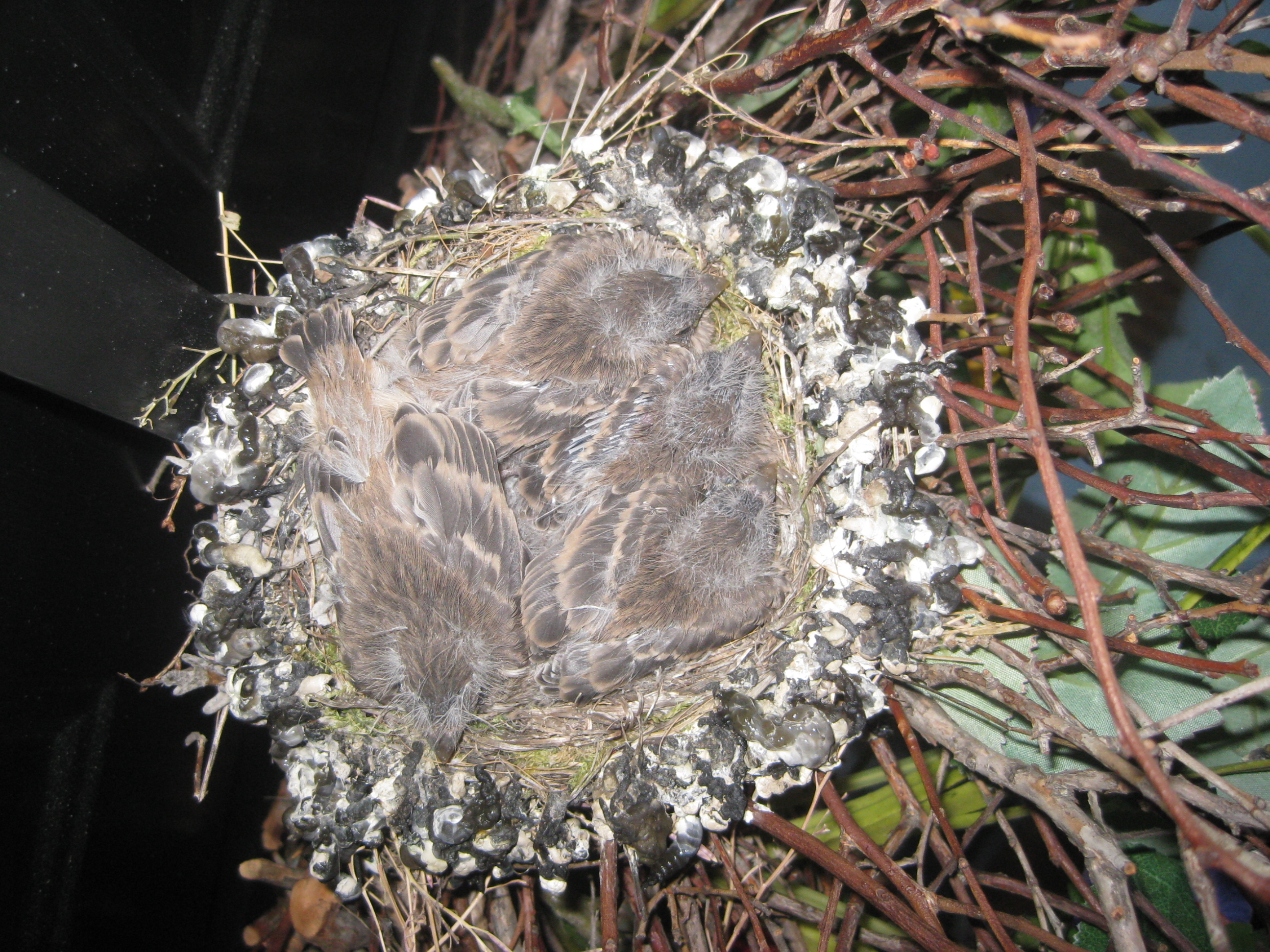
In the middle of our friendly little game, a cat jumped from the top of the fence surrounding the court into a nearby tree. Squawks ensued and shplat! — a whole nest of baby birds fell onto the court, right at hubby’s feet. One was critically injured. Its neck appeared broken and its legs were spread out in odd angles. Two others hopped off into the nearby bushes to take cover, trying to escape impending doom. Meanwhile, the mama bird screeched loudly. Shrieking, I imagined she was frantically calling, “My babies! My babies!

Looking up, we heard the cat mewing. He appeared to be stuck way up in the tree. I felt sympathy for the cat. Hubby was for the birds. (Pardon the pun.) “Maybe we should help the cat down,” I suggested.

Hubby shook his head. “This whole scene has made me sick. Let’s go home.” He packed up his racquet while I sat down on the concrete and decided to wait for the drama to unfold. I was thrilled. I think I even licked my lips. (Meow.)

Finally the cat made his way down from the tree and stared intently into the tennis courts, trying to figure out how to get inside so he might enjoy his new feathered playmates. Meanwhile, hubby was begging me (now, from outside the fence – saying things like, “C’mon,” and “Let’s go!”).

I knew what I had to do.

I walked outside the fenced-in area, assumed a squatting position, and cooed towards the cat. “Here kitty, kitty, kitty. C’mere kitten . . .” I sang as I opened the gate leading to the court. The cat cautiously stepped onto the green cement, then turned back, looked at me with gratitude, and went on to find the maimed bird with the splayed legs.

It wasn’t a vicious or bloody attack. The cat simply pounced lightly on the little, dying bird and after a few smacks of his kitty-lips, the wee-winged fellow was gone and the cat strutted off the court, disappearing behind some trees.

I left the court feeling I had done the right thing in helping the cat to put the bird out of its misery. I figured if I were dying, I’d rather have someone snuff out my breath than let me gasp and twitch and suffer needlessly.

Obviously, that’s just me.

On the way back home, my husband would not look at me, let alone hold my hand. He fumed, “Why did you help the fucking cat?”

When death is inevitable, would you prefer to let nature run its course or would you rather help things along?

Lessons From Nan, Who Passed On June 16, 2004

Nan (Tilly Epstein) & Pop (Irving Schuls)

My grandmother’s name was Tilly. As a child, I wrote her name on envelopes and birthday cards and doodled it on pictures. I never questioned the authenticity of my grandmother’s name because no one had ever said anything about it. And frankly, her name didn’t much matter to me because I called my grandmother Nanny, or sometimes Nan for short.

In 6th grade, my social studies class did a genealogy project, and I sat down with Nan to ask her about her siblings, about her childhood, about her memories, how she met my Pop – all kinds of questions. It was during this interview that Nan told me that her name wasn’t really “Tilly.” She informed me that her real name was Telia, which she thought was a pretty name, but that no one had ever called her by that name so she just went by Tilly, the nickname that was given to her by her parents and siblings. To me, this story is emblematic of the grandmother I knew all my life.

Nan didn’t complain. She didn’t pick fights or confront. She didn’t sweat the small stuff. Unless someone had really wronged her (or flirted with Pop), in general, Nan just kind of accepted things. She found in my grandfather a soulmate and, while they would never be rich in dollars, she was satisfied to be rich in love.

When we four grandchildren were young, we would run down to Nan and Pop’s apartment after a lazy day of swimming in the pool located in the middle of their apartment complex and demand drinks and snacks and candy and cartoons. Nan always opened the door with a smile, ushered us in, and quietly delivered the goods. When her french-fried potatoes became our summertime obsession, she dutifully peeled and sliced and fried those potatoes to golden perfection – sometimes in a very hot apartment – and we would devour them hungrily, asking for seconds and thirds and sometimes probably even forgetting to thank her for her efforts.

Nan never asked for thanks or looked for recognition. And while some people spend their lives dissatisfied or longing for things they do not have, Nan truly had the ability to appreciate life’s simple gifts: the gift of good health and the gift of a loving family.

Nan was intimately connected to her family. She somehow managed to keep both of her children close to her. While she never learned to drive, Nan always found a way to get what she needed. She was resourceful. Nan was not cocky, but she was proud: proud, first, of her children, then her grandchildren and, finally, proud of her great-grandchildren.

While moving Nan’s belongings into a nursing home, I was amazed to find a small wicker basket filled with hundreds of scraps of papers inside of it. Each scrap bore an address of someone Nan had cared about. At the very bottom, there was a calling card bearing the address of the house she and Pop had lived in on Ranier Avenue, a street lost long ago. She had kept my various college and graduate school addresses, though I hadn’t lived in any of those places for decades. She had my brother’s addresses in Ithaca, NY and Charleston, South Carolina, my cousins’ addresses at Oneonta, and other names I didn’t know attached to addresses I didn’t recognize – little scraps of paper with numbers and letters representing much more to Nan.

Nan was home-loving and intensely private. She was unobtrusive, but involved. A tiny woman, who seemed to grow shorter each year, Nan was truly a matriarch. When her husband, my Pop, died in 1990, Nan swore she’d never leave her apartment again: never return to the Jewish Community Center, or to shul, or to the grocery store – but eventually, she did all of these things. Though she appeared frail, she was strong and – when feeling good – had a hearty appetite that never ceased to amaze us. And, even in the end, when she suffered a broken pelvis and arthritis and weakening knees, she went to physical therapy and strove to walk independently. Nan possessed an inner fortitude that is indicative of a great strength.

I will always remember Nan, wearing a snazzy pair of purple pants, sitting on the gold couch in my parents’ living room. Just sitting quietly, patiently, watching my brother and me as we made up games or put on little shows. Many years later, she would sit in the same place, dozing off and on, awaking with an almost apologetic smile.

Agatha Christie once said, “I like living. I have sometimes been wildly, despairingly, acutely miserable . . . but through it all, I know quite certainly that just to be alive is a grand thing.” I believe Nan knew this, too.

Seven years and six months later, I still think about her.

Who do you miss and what did they teach you?

Contemplating Quitting The Classroom

A black and white icon of a teacher in front o...

Image via Wikipedia

I have been thinking that this will be my last semester in the classroom. It’s been a hard year for a variety of reasons, but I have been thinking I just am not connecting with my students the way I used to. Part of it may be that I am getting older. I have somehow become an “old-fashioned teacher” who doesn’t show movies, rely on Smart Boards or Power Point presentations. In other words, I have always been able to “be my own show,” create my own bells and whistles, and that was enough. I was enough.

This year is different. I don’t like how my students seem less prepared each year. I don’t like having to repeatedly tell adults to put away their technology/toys. It’s exhausting. I haven’t lowered my expectations with regard to their assignments or how I grade them, but I have a lot of students with D’s and F’s. That doesn’t feel good to me. Part of it is the 15-week gig: It doesn’t feel long enough to get my students where they need to be. I don’t understand why some of my students come to class without full drafts of their papers when I tell them they need to come to class with completed papers. I don’t understand why they leave their books in their cars. I don’t understand why they come to English class without pens or paper, even though it is clearly stated as a basic expectation on my Course Information Sheet. I don’t understand their lateness, why they don’t recognize walking in late as a terrible act of rudeness and incivility. I don’t understand why they struggle so much with citation. Except I do: it requires meticulous attention to detail  – and, based on this last essay I collected – about 7 students out of about every 22 possess the ability to attend to detail. Here’s a newsflash: some students don’t attempt to write papers at all. They take zeros, and they seem fine with this.

Me? I’m not fine with any of this, so I’ve been feeling run-down.

There is a bit of ego in teaching, maybe more than teachers might care to admit. I can’t speak for all teachers, but I think it is fair to say we are willing to take the ridiculously low pay, work the long hours, plan our lessons, grade the papers into the wee morning hours – as long as we see progress. Positive change. Forward movement. Progression. I need to feel as though I am helping my students move from point A to point B: even better if I can take them from point A to point Z! That said, it’s been a little light on that this semester. So I’ve been thinking about jumping ship and hopping onto a different boat.

And then I received a poem from Niquette Kearney.

Niquette in 2010

I taught Niquette in New Orleans back in the mid-1990s at Metairie Park Country Day School, nearly twenty years ago. When I first met Niquette, she was in 10th grade Honors English while struggling with some big life stuff. Big. Life. Stuff. And she was floundering. Because it is hard to focus on writing papers when you are dealing with Big Life Stuff. I suggested Niquette drop out of her high-pressure Honors section (with me as her teacher) and pop into another section of Regular English, (also with me as her teacher.) Poor Niquette. There was no escaping me that year as I taught the entire 10th grade! Boy, was she pissed off! I’m pretty sure she wanted to kill me; instead, she agreed. (Really, though, what was the alternative?) And the Regular section was easier for her. She got her work done, earned stellar grades, and she was able to focus on herself.

From the beginning, I adored Niquette. Teachers aren’t supposed to have favorites, but Nikit (the nickname I began to scribble on her papers) was beautiful and smart and funny and strong. How can you not love that? She was the whole package. She just didn’t seem to realize she was the whole package. But then, honestly, in high school, who feels they are “all that”? Nikit and I spent lots of time on a beat-up old couch in the English Department. Sometimes we talked about papers, but lots of times, we didn’t. Sometimes I just listened to her talk about her life, her experiences. Sometimes she cried, but mostly she didn’t. Her voice always quavered a little, as if she lived right on the verge of tears. That year, Nikit found herself at a crossroads. Without sharing her secrets, let’s just say, because she is beautiful and smart and funny and strong, she has managed to survive this very difficult year – maybe even thrive despite the adversity.

So here I am thinking of leaving the teaching biz, and I get this piece of correspondence.

Niquette’s message read simply: “Here’s a poem I wrote recently and thought I’d share with you, as you were in my thoughts.”

In a moment bigger than I knew,
At a time which could have been many,
I glanced at myself

In the mirror of my own eyes,
As if greeting a stranger for the first time,
I introduced myself with wonder
At the amazing sight of me

After so long without looking,
I finally saw
What I thought they’d lied about
Suddenly, it covered my reflection, overcoming me
So bright, I shuddered, reaching out my hand,
Welcoming the newcomer,
The one I thought I’d seen before

It was then, that I saw myself
And what I’d never even looked for,
And I blushed when I knew
That it was there the whole time

What a rare sight,
To view myself that way,
As a stranger meets another pleasantly, then parts
This moment passed but was mine
I saw what I did, and it was precious; beautiful

It was me.

Niquette Kearney, 2010

I am pretty sure I am one of the ones who tried to convince Nikit about her strength, her smarts, her internal and external beauty. I’m pretty sure I’m one of the one’s she assumed lied to her about all her fabulousness. I’m just so happy to know that she saw it, felt it, if only for a moment. And I’m even happier to know that she sat down and recorded it – as if it had been an assignment for English class – so she can have it to hold on to. I love that, after all these years, she is still writing poetry.

And then, thanks to Nikit, I remember this is the reality for teachers, especially college educators. We do our stuff. We try to shimmer and shine and get our junk into our students’ heads in 15 short weeks – and then, if we are lucky — maybe — 10, 15, 20 years later, someone reminds us that we helped them along the way. Someone might send us a poem, or a card, or run into us in the grocery store and give us a giant hug and tell us how much we helped. Teaching is like parenting; it involves a lot of delayed gratification. Folks shuffle in; they shuffle out, sometimes without so much as a smile. Sometimes it’s really hard to wait for gratitude.

I am happy for my sweet Nikit. She is going places, that one.

Me? I’m not so sure if I’m jumping ship. Time will tell.

For now, my course is set, and I will continue to power ahead through these choppy waters, full throttle.

Grammar & Facebook Do Not Mix

Image representing Facebook as depicted in Cru...

Image via CrunchBase

I am in love with this post! Gabe Doyle is a fourth-year graduate student in Linguistics at the University of California, San Diego. He is a computational psycholinguist. I don’t exactly know what that is, but I believe it means he is interested in how people choose to express the ideas they want to express. Or something like that.

While I am definitely a Facebook fan, I do not enjoy what social media and texting are doing to our language. It is becoming increasingly difficult to define and get people to agree to stick to a set of rules upon which we can all agree are necessary to follow with regard to language. Because, really, that’s all the conventions of writing are – little polite agreements between communicators.

I think of writing like driving. Just as there are rules of the road created to maintain civility and prevent chaos, so too, there are rules for writers. When we write, our pens are our cars. So we zoom around our little pen-cars where it is implied we have agreed to follow the same conventions because it helps us to better understand each other. Grammar conventions are kindnesses we bestow upon our readers, so they can understand us more easily. For example: Commas are little road bumps which make us slow down. Periods are stop signs. Semicolons are flashing yellow lights. The only problem is very few people follow the grammar rules anymore, so we are starting to have a lot of difficult situations out there like when people don’t use capitalization or end punctuation and just keep going on there is no break or anything at all to indicate that the sentence is coming or has come to an end so it just keeps going which can be confusing because sometimes writers  change topics suddenly you and are in outer space floating among the planets which is cucumber cool except you didn’t want to go to outer space. You wanted to go to a movie.

So check out the link to the great article above. I wish I’d written it.

My Reading Glasses: Revisited

I’ve had my reading glasses for over a year now. At first, if you’ll remember when I posted about new glasses, I was suffering with the concept of how the damn spectacles represent that my eyes are getting older and that, by extension, I am getting older, too. I’m getting used to the concept. Some of you suggested that I try to find a pair of glasses that I really love, so I don’t feel as though I’ve lost my mojo.

Well, I’ve been trying. So here’s what I’ve got:

My actual prescription pair.

These are okay. They are kinda boring though, right? Anyway, this was my starting point.

Round?

These turned out to be some weird, unintentional tribute to John Lennon. So. Totally. Not. Working.

Do I look like a sexy librarian? Hmmmm. Not so much.

These are a vintage pair of specs from the 1960s that I picked up at a local street festival for $2.99. I like them a lot, but the burnt-orange finish is peeling off.

Okay, this pair is a hoot. Emergency purchase. On the way to school one day, I realized I did not have my glasses. Question: How would I ever be able to read all those English papers without glasses? Answer: I wouldn’t. So, I stopped at my local Walgreen’s and snagged whatever I could find in my prescription. There were two choices. I grabbed this pair and, without ever trying them on, made my way to the register. This pair cost about $15. In the classroom, I realized the frames were completely crooked, and no amount of bending or manipulating would make them sit right on my nose. That was a long day. (These glasses now live in our downstairs library. And by library, I mean, bathroom.)

These are my Drew Carey‘s. They are quite awful, but in a weirdly fabulous way. I really like them. I mean, I know I look like my dad in 1963 – but I actually think they are kind of hot. I think I am starting to love them.

My son used these for Halloween when he dressed as Harry Potter – about 6 years ago. They are useless, of course, seeing as though as they are completely lens-less. Still, if I could find a real pair in hot pink or apple green, I might be persuaded to go for them. 😉

I’ve decided that finding the perfect pair of reading glasses is kind of like dating: While searching for the right fit, I’m enjoying all the different types out there. And who knew there would be so many different types out there?

End of the Semester Blues

Students taking a test at the University of Vi...

Image via Wikipedia

I have one section of students that  hasn’t mastered the necessary skills to show they understand how to properly write a college essay, complete with proper citation. Their last batch of essays was pretty bad. With the exception of a few papers, most students bombed their Works Cited pages and their writing felt unpolished.

I asked a few other professors what to do.

“Tell them to suck it,” one said. “If they don’t have it by now, it’s not because you haven’t shown them; it’s because they haven’t taken the initiative to learn the material.

The other professors agreed.

But I didn’t want them to “suck it.” Why am I hesitating? I wondered. What has happened to me? As always, I want my students to master the material, so regardless of what my colleagues said, I decided to give them an option: I returned ungraded essays to them with extensive feedback and told them they could ask me for the grade they received on the essay and forfeit the right to revise, or they could revise their essays (with rough drafts attached) by Wednesday at the beginning of class. And by Wednesday, I mean tomorrow.

No one asked for his or her grade.

Now, I’m not crazy enough to believe that everyone will actually revise, but I am hopeful that some will. I am hoping that they will use their style books, the extra time along with my feedback, and give it one more try. Because after this, that’s it. There are only a few tiny assignments, 7-minute oral presentations, and self-evaluations.

I know students have other classes, but mine is required. English Composition-101 is required. Required. So if a student fails, he or she will have to take it again. It’s expensive to fail classes, but some students don’t seem concerned about the debt they are piling up.

At this point of the semester (with 6 classes remaining before the end of the term), certain students wake up and realize they have been doing poorly (for most of the semester), and act shocked by this revelation. They ask about extra credit and want to be passed because they need to keep an athletic scholarship, and/or avoid parental wrath. Requests for points for nothing or for passing grades are easy to handle. I offer a “no” along with my sympathy, plus advice about how to retake the class.

Today, as we began week 14 of 15, I had a student with an overall average of 54.4% ask me what he could do to bring up his grade. I shrugged. He shrugged. Later, I saw this video. I’d send him the link, but I don’t think he’d get it.

*Note: This little ditty was made by Clay Morgan at Educlaytion.com*

In reality, it is kind of hard to fail my class. I offer a lot of help to students to want it. I make myself available to conference. I allow students who show initiative to revise their papers. I offer extra credit opportunities throughout the semester – just not as an “emergency out” at the end.

I hate watching students unravel at the end of the semester but – the reality is – there are always some who come unstitched.

It’s reality, but I don’t have to like it.

Seriously though, why am I more upset about my students’ failing grades than they are?

An Unwelcome Dx

“Mouth” by Phineas H @ flickr.com

It should not have been a surprise when I received the diagnosis; after all, I was a shrieking cheerleader in high school. And while I never had a single voice lesson, I used to sing in a band. For fifteen years, I shouted to my father while he pushed his lawnmower to let him know that I’d brought him a drink and some cookies. I hollered when riding snowmobiles, dune buggies, motorcycles and motorboats, and I shouted to get attention in noisy places: bars, restaurants, at concerts, hell, even while at the salon while under the hair dryer. During my years at summer camp, I intentionally tried to scream the loudest to show my spirit, and over the last decade, I’ve morphed into that crazy mom (you know the one) who cheers for everyone’s kids at the baseball games – even the kids on the opposing teams. I laugh a little too loud. I squeal and carry on when I am reunited with people whom I haven’t seen in way too long, when a friend’s child dives into the pool for the first time, or when I find out someone has just gotten engaged. In my car, I am Madonna, Mariah Carey and Whitney Houston. I try not to shout when I am mad, but sometimes I can’t help it.

Over the last few years, I’ve noticed that after a day of teaching, my voice is pretty shot, that I am hoarse and I strain when I speak. At first, it was kinda cool: I sounded like Stevie Nicks, all husky and sultry. . . but when I developed a night-time cough and realized I’d lost more than a full octave when singing, even I knew it was time to make an appointment with the Ear, Nose and Throat doc who told me exactly what I didn’t want to hear: I’m a vocal over-doer.

Yup, that’s my diagnosis.

Dr. Anat Cedar and Dr. Robert Bastian coined the term “Vocal Over Doers Syndrome” to designate an individual whose manner of voice use can be considered excessive and thereby put the person at risk of injury. Typically, the vocal over doer is talkative (Check.) And possesses a life circumstance that demands much voice use. (Um, double check.)

I’m supposed to rest my voice and do these weird breathing exercises to prevent further damage. It’s called practicing “good vocal hygiene.”

I am supposed to avoid nicotine and caffeine, shouting, cheering and excessively loud laughing. I am supposed to clear my throat only when absolutely necessary. I am not supposed to cough or make “strange noises” with my voice. (I swear, I am not making this up.) I should talk when I wish, but not too much. (I’m finding “too much” is too relative of a term.) I am supposed to avoid spicy foods and substitute skim milk for whole milk. When I teach, I am supposed to sit in the center of the room so I can be heard easily without talking loudly. (That one cracks me up.) The list goes on, and truth be told, I fail miserably on nearly all fronts, except the nicotine. That one is easy: I don’t smoke.)

Alas, I don’t know how many more years (or semesters) I have left in the classroom. It has definitely become more difficult for me to project my voice the way I used to, but I am still wildly enthusiastic about my subject matter, so it is incredibly frustrating when I open my mouth and a tiny squeak of nothingness comes out instead of my intended passionate auditory gush over a well-placed comma or properly used semicolon.

You should hear me on roller-coasters. Terrified, my hands balled into fists, my mouth agape, I’m positively silent.

There is a compelling gospel song that repeats the line, “God is trying to tell you something.” Maybe this is the case. Perhaps some cosmic force is trying to tell me to quiet down, exercise my ears, and become a better listener. I am open to anything.

tweet me @rasjacobson

Functional Illiteracy: The Repost

People who know me know I’m struggling this semester. I try to explain how a larger number of my college students seem to have weaker skills this year; how I can’t get them to use capital letters (or, in some cases, how I can’t get them to stop randomly capitalizing words that don’t need to be capitalized); how they won’t stop writing “im” instead of “I’m”; how I can’t get them to stop using the letter “u” when they mean the word “you.”

“They don’t know how to outline!” I exclaim. “Or write in five paragraph essay format!”

People think I’m exaggerating. “Things can’t be that bad,” folks say.

Finally, here is a perfect example of why my panties are in a bunch this year.

This post called “Functional Illiteracy” from Just Sayin’ addresses some of the very real struggles that educators are facing today, even at the college level.

Do you have discussions with your kids regarding their use of language? Are they writing as well as you would like? Do error-filled papers (with high marks) come home from your children’s schools? Do you think their grades are inflated? Because, I am here to tell you, graduating high school students are not using capitalization or punctuation.  Many high school graduates have not figured out basic written communication skills which my peers and I had mastered in the 6th grade and spent the following years perfecting.

Many of this generation’s students are essentially unemployable, and if you don’t believe me, read this post from my friend, Michael Hess, of Skooba Design. Because as a business owner, he cares about the way people write.

Do you care about how you write?

Or r u 2 busy txtin 2 care?