In the days before mousse and gel and other hair care products, Iprayed to G-d to make my horrible curls go away.
Each night, I slathered my hair with V-05 — a greasy, grayish paste — and went to bed with a red bandana tied around my head.
All the popular girls had straight, shiny hair — parted at the center and held back by painted barrettes with whales or hearts on them.
My frizzy hair looked stupid when I tried to do that.
Rainy days were the enemy; humidity was my undoing. I learned to stay away from boys at water fountains.
Once, an old woman stuck her fat finger inside one of my corkscrew curls. She muttered words in Yiddish that I didn’t understand. Her translator told me the woman had said she’d had hair like mine when she was young. I didn’t know if that was a compliment or not. Her head was covered with a plastic rain bonnet.
People often told me my hair matched my personality.
*I assumed this meant they thought I was surly and uncooperative.
And I watched her lose the soft, dark locks that framed her face. Soon, another friend was diagnosed with something else. And I watched her hair come out in clumps as she brushed it. One day, she brought out the clippers that — until that moment — she’d only used on her son, and she used them on herself. Leaving pieces of herself on the kitchen floor, she hopped in her truck and went off to buy wigs. When another friend lost her hair, she bought hats. Another bought do-rags. Another friend preferred bald. She said wigs went lopsided and scarves itched.
I stopped complaining about my hair.
Because I have hair.
And having hair means that my cells are not behaving badly. That I am not facing chemotherapy or radiation. That I am not making videos for my children to see when they are older because I might not be here. That I am not battling cancer — that goddamn monster — that takes people too young.
I’ve stopped wasting my prayers on hair. G-d has other things to do.
The instructions were to write about hair. Use it as a vehicle to tell us something about your character, a situation, you and/or your life. I tried.
Not one but two cute dudes drove into my driveway offering me steaks, chicken breasts and shellfish. Initially, I was skeptical. But then I saw the meat had come from a reputable company, a name I recognized. I considered 36 pieces of filet mignon and 12 marinated chicken breasts. The guys wanted $400.
I looked at the guys again.
I wanted that meat.
“It’s guaranteed for freshness for 24 months,” they insisted all cute and muscle-y.
I hesitated.
They offered to drop the price by $50.
I hesitated some more and batted my eyelashes a little.
They added an extra carton of filet thus confirming I still had my magical powers at 40-something.
The meat dudes did not accept credit cards, so I gladly wrote one guy a check as the other more muscle-y guy concentrated on stacking the bags of meat into our garage freezer.
I was elated.
The two men screeched backed carefully out of my driveway and zoomed off down the street.
Eventually Hubby saw the charge in our checkbook and asked about it.
“I got 48 pieces of fillet and 24 chicken breasts for $318!” I exclaimed.
“Have we had any yet?” he asked.
“No!” I said, “I’m saving it for something special. Maybe New Year’s Eve or something.”
“Open it up!” Hubby practically shouted.
I didn’t know what he was so worked up about. I mean the guys were so honest and I had a 24-month guarantee for freshness. Sheesh.
The meat defrosted on our kitchen countertop and, eventually, we cut open its clear plastic wrapper.
I’m not sure if it was the color or the smell that tipped us off first.
“I don’t think that’s from a cow,” Hubby declared as he plugged his nose and plopped the meat into a trash-bag.
I pictured cats, dogs, gerbils, nutria — and I knew I had done a bad thing.
An organized person, I quickly found the 24-month freshness warranty and dialed the 1-800 number.
Doo doo doo. We’re sorry, the number you have reached is no longer in service.
I called the local distributor.
Doo doo doo. We’re sorry the number you have reached is no longer in service.
I knew I had been scammed.
Few things set me off more than being lied to.
Furious, I called the Better Business Bureau where I learned the company I had done business with had over 300 complaints filed against it. I didn’t care. I would not be a number.
Long story short: It took a few months, but I got our money back.
Were you not paying attention the first time around?
Cross me and this twit will make you wish you had Harry Potter on speed dial so you could ask to borrow his invisibility cloak.
If this were a fable by Aesop, the lesson might be something like this: If your stuff is good, you don’t have to brag about it. Or sell it door to door. So if some guys come around bragging about their meat, just say no because — chances are — their junk is already spoiled.
Have you ever been scammed? What happened? What weird lessons has life been teaching you lately?
In 5th grade, Mr. Zych lectured all of his students about how to properly sharpen a pencil. He wasn’t messing around. His speech was not short, and he covered everything from how to properly grip the pencil to the cranking motion – how it should be smooth and continuous, not jerky. He even discussed the perils of over-sharpening, which could lead to premature tip-breakage. Mr. Zych turned pencil sharpening into a science.
Personally, I have had a love-hate relationship with pencils. I first learned how to print my alphabet in pencil and then I learned how to write in cursive in pencil. That was Paradise. Finally, a way to write all the stories stored in my head. Later, I preferred to write with pens – preferably ones filled with purple or green ink. But ever since my son started school, he has been forever in need of pencils; they seem to always be around, and so I returned to the yellow pencils of my youth. I had learned to appreciate the feel of a pencil in my hand again. I even started to like the scratchy-scratchy sound of the graphite as it dragged across the page. After I recently stepped on a pencil, I became suspicious of them again and switched back to pens.
Meanwhile, my son is still on a steady diet of pencils. In middle school, the kids seem to devour them: literally and figuratively. I know my son nibbles on his; I’ve seen the teeth marks. I’ve watched him crunch while he contemplates before committing to writing an answer on paper. But sometimes I wonder if he actually eats them, too. I mean, where do they go? How many pencils does one kid need in a school year?
A few weeks back, Monkey came home in a tizzy.
“I’m out of pencils again,” he announced.
Nonplussed, I told him there were under three weeks of school left and that I was pretty sure he could make-do with his nubs until June 20.
He started at me with contempt.
“Are you serious?” he questioned. “I have exams! I need pencils! Ticonderogas. Now!”
He was not messing around.
The next day while in the grocery store – to my horror – I found plenty of office supplies, but they were only generic pencils. And even I know that those erasers don’t do the job. You need another eraser to get rid of the smears those lame pencils leave behind.
So I made an extra trek, this time to Staples – home of the Ticonderoga pencil – and invested in the Bulk pack. (Because that was all they had.) Let’s be clear. Ticonderoga pencils are like platinum. They cost a fortune. The only way a pencil could be more fabulous would be if you printed your name on pencils. A Ticonderoga is the Hum-V in the wonderful world of pencils. Teachers definitely prefer them. Definitely.
I rationalized that I could spend $15.77 + nearly 9% tax on pencils because they are non-perishable, so it is not like they will ever rot or mold. And I figured whatever is left at the end of the school year, Monkey can use in 7th grade, thus saving me some back-to-school shopping hassle.
A few days later, a good friend of mine called me and reported that her son – also a 6th grader – had run out of pencils. While requesting to buy more, she said my name was invoked. Apparently her son said:
“Can you just be like Mrs. J. and get the Giant Pack of 72 Ticonderoga pencils?”
Apparently Monkey had been bragging about his new stash.
I laughed at the sheer ridiculousness of it. Bragging about pencils?
And then I thought about how I had come full circle. Just one week before, I was cursing pencils as my husband dug around my heel with a needle in an attempt to get the lead out. (I know, I know. Pencils are made of graphite. I was going for the funny.) But now I found myself saying a silent prayer on behalf of all pencil-loving children everywhere. Uncharacteristically, I clasped my hands together and thought to myself:
Lord, may this be the worst thing my child ever desires. May this be his worst addiction. May he never see cocaine. May he never use LSD or heroin. May he avoid cigarettes and alcohol. May he avoid the ‘shrooms, the X, the meth. May he never huff. May he find the strength to avoid the Oxycontin and Adderall.
May he always be addicted to Ticonderoga pencils.
Because, honestly, I’ll happily help Monkey score his Ticonderoga pencils forever. I’ll even help him sharpen them. Mr. Zych schooled me on that a long time ago, and I feel confident I can help my son with his #2 pencil fix without any need for an Intervention.
Many Junes ago, after swimming all afternoon with friends in a pool that was nestled behind a tall fence on the grounds of the apartment complex in which my grandparents lived, I decided to pay my grandmother a visit.
My decision to visit was not a completely selfless act. The ice-cream man had come and gone, and I had forgotten to bring money to go to the 7-11 down the street, so I was crazy hungry and figured my grandmother would make me some of her fabulous french fried potatoes.
To get to my grandparents’ apartment, I could have walked on an asphalt road, but I generally opted for the short-cut across a broad expanse of grass that had been allowed to grow tall and wild. The prickly weeds made quite the obstacle course, and I always made a game of zigzagging from one patch of yellow flowers to another.
On that particular day, as I raced across the field barefoot, I stepped on something that made me look around to see if I had landed on a discarded cigarette. Alas, there were no burning embers, just a partially squashed yellow-jacket clinging to me, his stinger nicely embedded into the arch of my foot.
Midway between the pool and my grandparents’ apartment, I alternately limped and hopped across the grass. It was an eternity. The grass grew taller as I walked; the sun burned my shoulders. Eventually, I hobbled up the three flights of stairs to my grandparents’ apartment and knocked on the brown door marked simply with the number “7”.
I knew my grandmother would be home.
When I told her what had happened, she looked nervous. I showed her where the stinger was lodged and asked her if she could, maybe, get it out. A pre-teen at the time, I could tell from the look on my grandmother’s face that she would not be able to help me. Rather than get upset, I simply asked for some tweezers – which she ran to retrieve. Try as I might, I couldn’t get that pesky stinger out. I asked my grandmother for a needle and some ice, and while she obliged, she turned her head as I drove the needle into my own foot, digging around for the elusive stinger.
Eventually, victory was mine and, the stinger – pinched between the tips of the borrowed tweezers and no bigger than the sliver of hair – was inspected. Sure I bled a little bit, but as I rubbed antibiotic ointment on the area and put on a little Band-Aid, I felt strangely euphoric, crazy proud that I’d been able to take care of business, independent of adult help. As I devoured the french fried potatoes my grandmother set out before me, I remember feeling that I needed to rely more on myself, a simultaneously exhilarating and terrifying realization.
I haven’t needed tweezers or a needle again as I have managed to remain splinter free for nearly 30 years.
Until this past Monday night.
Monday night, I walked around the house doing what mothers do. I was cleaning up, making sure everything was where it was supposed to be, checking that all laundry was in the bin, and taking inventory of what food would need to be purchased during the week. Basically, I was on the prowl for misplaced K’Nex, unplugged gadgets, and dirty underwear. That’s when I felt it.
I screamed out loudly and uncharacteristically enough that Hubby and Monkey called out in unison: “Are you okay?”
“I stepped on something,” I said attempting to balance gracefully on my left foot while trying to check out what was going on with the bottom of my right. Instead of awaking my inner White Swan, I succeeded in recreating a pretty pitiful imitation of an uncoordinated pink-flamingo with a nerve palsy. Finally, using a chair for balance, I inspected the sole of my foot, where I saw a perfectly black and tiny, round something-or-other lodged in my heel.
Stooopid graphite!
I did what had worked before. I went straight for the needle. I dipped the pointed tip into rubbing alcohol and got to digging, but I couldn’t get anything out. I didn’t know what I might have stepped on, but that same stinging heat had returned. A body remembers things.
I called to my husband. “What is it?” he asked.
I have no idea, I said, “But I can’t get it.”
Hubby put on a headlamp.
“We may have to get you some lidocaine or something,” he said. “I don’t know if I can poke around without hurting you.”
“Just get it,” I said.
So Hubby took the needle and the tweezers and dug around for a good fifteen minutes, peeling away layers of skin and blotting blood, trying to grasp the foreign object which kept crumbling into dark fragments each time he announced he had it.
“Do you think it’s a rock?” I asked.
He shook his head.
“Do you think it’s a twig?”
Silence.
“Do you think I’m going to die?”
“You know what I think?” Hubby asked. “I think you stepped on a pencil.”
Great, I thought of my ironic obituary.
Teacher steps on pencil, dies of lead poisoning.
How rich.
“What happens if you have lead in your body?” I asked.
Hubby kept digging, “They don’t use lead in pencils anymore. These days, they use graphite.”
“Even in Ticonderogas?” I asked nervously, “Because those are really good pencils. You’re sure? Graphite?”
Hubby ignored me.
Awwwww, shizzle sticks.
“We have to get it out because you could get an infection. And I can’t get it because it keeps breaking.”
So I did what any woman who does not want to spend the next eight hours at the hospital would do. I gave my husband carte blanche. “Don’t worry about how much I complain. Or scream. Or bleed. Just dig.” (Oh, and be a sport and try not to be bothered by the fact that I am asking you all the questions that I just asked you – again. And that I’m filming you. It’s for my blog.)
Eventually, Hubby was the victorious and removed the slim sliver of graphite from my foot. Seriously, there was no way I was ever going to get that thing out by myself. And you know what, it’s nice to know there is someone you can rely on in times of need. Not like I didn’t know that before, but sometimes it’s nice to be reminded.
So anyone think it is hot to have the tattoo of a tiny, black circle on your heel?
‘Cuz, you know, I’ve got one.
Also, if you are looking to find me between now and September, I’m the one wearing flip-flops. Everywhere.
How do you do with splinters? And would you trust your spouse to do the deep probing?
The other day I saw a sign that read: “Free Babies Clinic.”
Which I thought was weird.
It was a warm day, and I imagined folks handing out babies like ice cream cones.
What exactly is going on? I wondered.
But as I got closer, I saw that the sign was actually advertising a “Free Rabies Clinic,” which made me wonder: Are we giving people rabies these days? And who would want that? Even for free?
I kind of remember A “very special” Little House on The Prairie episode where Mary or Half-Pint or Carrie (or maybe it was the Jack, the dog?) got bitten by something – a raccoon or a bat – and Ma and Pa and Doc were pretty freaked out, and Pa had to saddle up the horses and ride all the way to Mancato to get… um, I don’t know. Special shots? Pills? Now that I think about it, maybe Pa just had to shoot the dog.
I also might have completely fabricated that whole thing.
A few days later, as the stars aligned in the universe, I stumbled across the following video which features a child fondling a freshly killed squirrel, and I wondered: Have we stopped completely worrying about rabies to the point that we are now allowing our children to carry glorified rats wild animals around and snuggle them?
Don’t get me wrong. The video is fabulously, adorably morbid.
And I’m guessing this dad just got caught up in the moment the way his daughter did.
It is also probably why the aforementioned father repeatedly stresses the need for his wee dead animal lover to come in and take a bath.
I’m thinking little Thea might grow up to be a fabulous doctor. Look how caring she is.
Other options include taxidermist or mortician.
It’s good to have options.
I don’t know where I’m going with this. It’s Friday. See where poor eyesight and bad signage leads me? Tell me something you saw this week. Or thought you saw.
So this month I bopped in, said hello, made my way to the room where the warm massage table was waiting. I quickly disrobed, slid between the heated sheets, and spent a fabulous relaxing hour with Dean. (That sounds kind of naughty, but it wasn’t.)
I was so relaxed that I almost missed it.
I almost peed in my pants!
How much did I love that sign?
Those folks at Massage Envy not only got the sign right, but they had such a great sense of humor about the whole thing!
Plus they patiently waited for me to notice the sign – which had to be killing them.
I’m sure the girls up-front (not to mention the manager) wanted to smash my nose against it!
But they didn’t. They were professional and waited for me to notice it in my own good time.
And afterwards, they still let me eat a few fabulous dark chocolates wrapped in purple foil at the end of my session.
The other day Monkey came home wanting to know how old I was when I learned about HIV/AIDS. (He’s learning a lot in his 6th grade Health class.)
I told him I learned about HIV/AIDS at the end of high school, that I vividly remembered the Surgeon General at the time, the white-bearded C. Everett Koop, coming on television in 1985 to talk to the American people and explain how scientists believed the disease was being transmitted.
“It was a scary time,” I said. “People were getting AIDS from blood transfusions and worrying you could get if from kissing.”
Monkey started schooling me about how HIV/AIDS was a virus that attacked the immune system, that it was not passed via “kiss-spit,” but by blood and urine and other bodily fluids, like sperm. Frankly, I was pretty impressed by what he had learned in school.
“You know,” I said, “HIV/AIDS is still a huge problem in Africa and in other communities. It hasn’t been cured.”
But Monkey didn’t want to talk about the world’s AIDS crisis. He had other designs. Squinting at me from the opposite side of our kitchen island, he turned on me.
Monkey: So when you met daddy you both knew about AIDS?
Me: Yeah, it was pretty big news back then.
Monkey: And you met in what year?
Me: We met in 1990 and started dating in 1993.
Monkey: And when did you get married?
Me: In 1997.
Monkey? So you were together for 4 years before you got married?
Me: Yup.
I could feel his wheels turning. He was going to ask me something big. I held onto to kitchen counter trying to steady myself. Was I going to have to confess that his father and I lived together in New Orleans, that we shared an apartment before we married? And where would that take us? Would he assume we had separate bedrooms? The questioning continued.
Monkey: Did you get AIDS tested?
Me: Can we talk about this when daddy gets home?
Monkey: Answer zee kveschun!
(Actually, he didn’t say it like that. It only felt like I was being interrogated by the Gestapo.)
Me: Yes, we both got tested.
Monkey: Before you got married.
This came out of his mouth as a statement, not as a question, so I didn’t feel the need to tell him that his father and I were AIDS tested about 3 months after we started dating – waaaaay back in 1993.
But Monkey was satisfied and announced we had acted responsibly and added he planned to wait to have sex until he’d married, too.
I smiled at my 11 year-old son who had grabbed a plum and wandered off to do his science homework. Here, I thought he was about to grill me about safe sex practices and demand to know if his father and I had remained chaste until our wedding night.
I am not ready for that talk.
That same night, I saw an episode of Glee where the father, Burt Hummel talks to his gay son, Kurt, about sex. His monologue was short and sweet and brilliant.
Frankly, I think all parents should be required to memorize this speech before leaving the hospital on the day their child is born so they can use it later.
Here is what Burt Hummel said to his son (with a few gender changes):
For many people, sex is a thing we want to do because it’s fun and it feels good, but we’re not thinking about how it feels on the inside or how the other person feels about it. But it’s more than just the physical. When you’re intimate with someone in that way, you gotta know that you’re exposing yourself … You gotta know that it means something. It’s doing something to you, to your heart, to your self-esteem, even though it feels like you’re just having fun.
When you’re ready, I want you to be able to do everything. But when you’re ready, I want you to use it as a way to connect to another person. Don’t throw yourself around like you don’t matter, because you matter.
Here’s a link to the whole video, if you care to see it.
At some point, probably sooner than I think, Monkey might ask me to clarify the status of my virginity prior to marriage. Lord knows, that boy can ask me answer any question that might be roiling around in his brain.
I think I just bought myself a little time.
And next time, we are definitely waiting until his father gets home.
Nearly every parent I know has wrestled with deciding how important it is to have their children take Advanced Placement (AP) courses. Parents want their children to have all the opportunities they can get so that they can succeed and be happy in life. (If only happiness could be achieved that easily!) Meanwhile, kids feel the pressure and report feeling exhausted, unhappy and anxious.
People often ask me, as a person who has spent nearly twenty years in the classroom, what I think about AP classes. Should their child take this AP or that AP. And they are often surprised when I respond with a question: “Does your child love French? Because if he doesn’t love it, why would you want him to take the AP which is going to require so much of his time and energy?”
What people (and by people, I mean parents) do not seem to understand is that the demand of an AP class is designed to be similar to a 100-level college class. The difference is that, in high school, that class will likely meet every day – while in college, there is usually an “off-day” where students have time to read and generally better manage coursework.
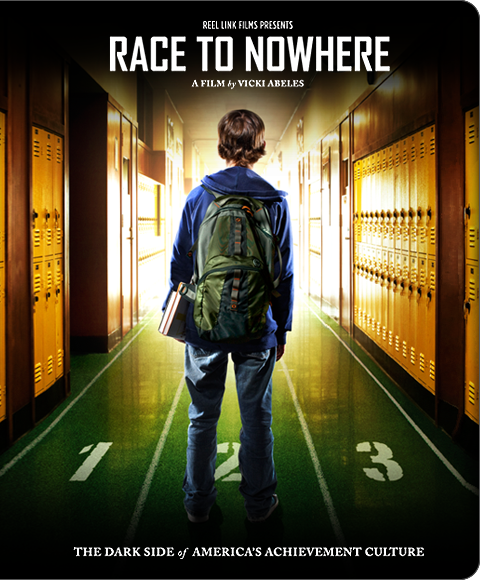
In RACE TO NOWHERE, filmmakers Vicki Abeles and Jessica Congdon speak to educators, parents, tweens, and teens about the pressures they face academically and emotionally, and the physical toll these expectations exact. What results is a picture of a fractured educational system that pushes kids to become successful — but at a cost.
During the Post World War II Advanced Placement pilot program, AP courses were designed to draw the top students into a small class of other students who LOVED the material. In 1952, AP classes were designed to be small so teachers could move at an accelerated pace because of the students’ voracious love of the subject matter. The idea was excellent.
Of course, what has happened over time, is that parents have demanded that their children be allowed entry into AP classes because, these days, there is a warped race to create the best college application. (Believe me, parents want those AP’s on their college applications.) So AP class sizes have ballooned, and there is less one-on-one with teachers. And kids who had no business being in an AP in the first place struggle. Because AP classes are hard. Really hard. When the idea was created, I don’t think anyone from the Ford Foundation would have recommended that any one student take five AP courses.
I always tell parents that AP courses are not the be all/end all. When I say this, they look at me like I have five heads. Then they ignore me completely. (I’m telling you, parents don’t like to hear this.)
I truly believe that the point of education is for children to love to learn. When students are getting sick, when they arrive at college unprepared and unmotivated, there is a problem. Students who feel too much pressure to perform, burn out. Feeling the pressure to achieve, students self-medicate, turn to drugs and alcohol as an escape, and sometimes cheat to complete the ever mounting pile of assignments which need to finished – now! From my vantage point, I see kids who are over-scheduled and overtired.
School should be the place where our teens learn about balance. Schools that allow students to skip lunch periods so they can take five Advanced Placement courses have bought into the hype (or caved into parental pressure). And that is sad. Lunch should not be optional. Humans need to stop and eat healthy food (not a bag of chips) to provide their bodies with energy. I don’t care how many times a parent calls and says, “I want my son to take 5 APs.” Administrators need to grow a set and say, “I’m sorry, but we just don’t think that is beneficial to your child.” Students need help learning how to make healthy choices. Sometimes that means they need the school to shield them from demanding parents. And anyway, kids don’t have to be enrolled in a course to take AP tests: a really self-motivated kid who loves to learn should be able to access all the material he needs to prepare him/herself for any AP test.
For the love of Pete, I’m a Tiger Momma. I believe our children need to pick the things they do and do them well. But we need to help guide them to understand they cannot do everything. Our kids need to study hard – absolutely – but they also need to eat. They need to be able to go to the bathroom without worrying they are missing crucial information. And they need to be allowed to tune school out for a while so they can exercise and nurture friendships. They should not be running from this practice to that recital just be sitting on their asses in front of their computers every night.
When I was in high school, I had the opportunity to take regular English, AP English, or Syracuse University Project Advance (SUPA English). At the time, SUPA was a college curriculum class taught by our own high school instructors who had been trained to teach the course. I worked my butt off in that class, and I did not always excel. I remember getting one paper back with a big fat “D” on it. (Maybe it was a “C,” but in my mind, I remember it as a “D.”) I also remember taking that paper to the library and weeping next to a huge potted plant. I had worked so hard on that paper. And English was the subject in which I was supposed to excel. I did not understand how I could have failed. My ego was battered, but my love for the subject matter made me want to figure things out. I busted my hump in that class. It was truly an amazing experience, and I believe it was the course that best prepared me for college.
When I think back on it, I cannot imagine how grueling it must put in that kind of work into every subject, every day. To me, taking all those APs seems utterly unnecessary. No one has ever asked me: “How many AP courses did you take in high school?” (Well, one pretentious fuck did, but it was after he had polished off an entire bottle of red wine himself.) In fact, many colleges don’t even accept AP credit anymore. It’s true.
So, my recommendation is this: If you’ve got a kid who is interested in some accelerated academic experience, have him/her enroll in a summer course at a real college. That looks good on college applications, too. And the credit might actually transfer somewhere, and it might help transition him or her to the realities of actual college life. Help your child live a balanced life. Have your kid go to summer camp, get a job, plant a garden, try something he/she has never done before. Not for the college application, just because.
In the United States, success has long meant making a lot of money. And the way to do this has traditionally meant attending a great college. But we need to redefine success for children. We have gotten caught up in this “race to nowhere,” as described by Abeles and Congdon. We need to teach our kids to do what they love – not pressure them into taking five AP classes because it will make them look good on paper.
This personal narrative was written by Megan Killinger, a student in one of my Composition-101 classes during the Fall-Winter 2010 semester.
“No, no, no! Look at me, Megan!” my mother would say to me tapping the tip of her nose with her finger, repeatedly trying to get me to make eye contact. She did her nose-tapping routine in public — pretty much everywhere, anytime I’d forget to look at her or at someone else. I hated her for it. She never understood me, no matter how I tried. Whenever she did her nose tapping thing, I could feel a hot flush of anger rush through me, aching like the pulse of blood behind a bruise. Apparently, I needed to get it through my head that the person who I was “wasn’t cutting it,” and I needed to transform myself into someone else more acceptable: a hard lesson to learn — that “what you are” isn’t good enough.
As a child, I hated crowds — hated going to the mall — rarely made eye contact, and had a tendency to say whatever I wanted. I was constantly told my actions were “inappropriate,” and I learned to live in a world filled with criticism and boundaries.
I was always the odd one. School was a penitentiary for me, for it was difficult to make friends. I watched my peers react to each other, and that’s how I learned the basics on “How to Make Friends-101.” Personally, I would have preferred to have hit myself in the face with a shovel rather than associate with people, for kids always saw me as “weird.” I was too blunt or too curious; I learned that telling the truth was not always acceptable. For example, when someone asked me if the outfit she was wearing made her look fat, I learned that it isn’t always appropriate to tell the truth.
So I clammed up.
Guest blogger, Megan Killinger
Growing up, my mother and my doctors were the worst. My mother constantly told me “We’ll find out what’s wrong and fix it.” But I didn’t think anything was wrong with me; nevertheless, I must have seen fourteen different psychologists. No one could figure it out, until one day, as I sat there, playing with some little wooden blocks (as per usual), I heard something I didn’t think I’d ever hear.
“I know what it is!” Quack Doc #14 said to my mother, oh so casually, after spending a lovely ten minutes with me. His stupid tone, just like all the others and their lame stereotypical Quack Doc questions; how I wished I could kick him his shin and see how breezy his tone would be then.
I was diagnosed with Asperger’s Syndrome, a form of autism, and no — it doesn’t mean I’m “retarded.” My life drastically changed that day — November 12, 1999. My mother was finally granted a reason for my so-called “abnormal” behavior. She cried, and her sobs sounded like a dying mouse; maybe someone told her that I was a retard.
Once I had a diagnosis, my mother enjoyed telling people “my secret” to anyone I brought home. This shattered the “normal” image I worked so hard to create. I watched and tried to make myself as much like the others as possible, so I’d have a chance at fitting in. Honestly, I’m still impressed at how well I did. I was (and still am) careful about how close I let people get to me at first, so when I drop “the Asperger bomb,” they know me and then they can decide whether it changes anything. But back then, with my mom beating me to the punch, it made maintaining friendships a lot more difficult. When people heard the word “autistic,” they automatically conjured up a drooling idiot or something along those lines.
After I was diagnosed at age 9, I felt like a drug-lord-zombie for a while. It seemed like Quack Doc had me trying out a new medicine every month. Concerta was a real winner. When I took Concerta, I felt like all my life’s blood had been drained, like I wasn’t present — almost. Once, while on that medication, I sat and counted the lines on a bug’s wings. It is amazing how a person can tell her doctor that what they’re giving her is making her ill and then have that doctor respond by prescribing a higher dose of the same medication. Things were eventually adjusted.
I used to get angry with myself, when someone could tell I was autistic. I kept telling myself I didn’t have Asperger’s, that I wouldn’t be that person, but I stopped fighting and learned to accept my diagnosis. I tried to make small changes, for I understand now in order to obtain what I want — a “normal life” — I have to play by everyone else’s rules: Monkey-see, monkey do.
These days I have some fancy coping mechanisms. One of my coping methods is to play a type of mind game, which involves me asking a ridiculous amount of questions without giving much information about myself. In other words, I get the person I’m talking to inform me about themselves without really having to say much at all. In addition, I always check myself to make sure I look everyone square in the eye and, I am happy to report, I have made some close friends. I even like going to the dreaded crowded, noisy mall.
What I have gathered from my 18 years of life experience is that people reject what they don’t know. If they don’t understand something, most people don’t even want to try. My first semester at college was exactly what I expected, for the most part. To be honest, I was just really excited to have a fresh start. At college, no one knows anything is “wrong” with me, which is a great feeling. I’m finding acceptance in college, and its a part of what I have always wanted: to be seen with unbiased eyes. Sometimes I still speak a little too quickly and I still have to watch what I say to people. I suppose I will always find it hard to blend in, but college is showing me that there can be more to life than just blending in.
I was prescribed Klonopin for insomnia in 2005. Seven years later, after a slow, medically supervised wean, I became cognitively impaired, and after 30 months of intense suffering, I have been resurrected - a phoenix, come from the ashes, ready to battle doctors and big Pharma, while offering empathic support to those still suffering protracted withdrawal symptoms.
A perfectionist by nature, I'm learning to find beauty in the chaos. I'm the girl with the big ideas and the big hair. And words. Always words.
All rights reserved. Excerpting portions of posts and/or linking them is encouraged, provided full and clear credit is given to renée a. schuls-jacobson with proper attribution via hyperlinks directing folks to the original content. Duplication in whole or substantial portion of this site or any component is not permitted: neither is reblogging.










 renée a. schuls-jacobson