Tag Archives: Parenting

Growing Up Is Hard & Bullies Just Stink

photo from Chesi - Fotos CC's at Flickr.com

My husband and I have always taught our son that it is important to be friend-ly with everyone. To us, being “friendly” means being kind and tolerant and respectful toward another person, even if you don’t like him so much. We have always been clear with our son that being friendly does not mean that he has to be friends with everyone. He seems to get it.

My son knows that friends are important to me. He understands that my closest friends are the people I can trust to help me when I need them, and he sees I am there for them just the same. If we are lucky (and I consider myself lucky), we have people with whom we can share our deepest secrets; folks who come over even when they know we are sick and barfing; they see us without our make-up on and don’t care that the house is a complete mess; they are the people we shop with, take walks with, or sit still with. I am lucky enough to have people in my life who keep little cans of Canada Dry Ginger Ale in their garages refrigerators because they know it is my favorite drink.

There is, of course, an ebb and flow to friendship. Sometimes one person gives more and the other receives – but friendship cannot be one way. Interactions may be brief or extended, but interactions with true friends should – in the ideal – leave us feeling filled up rather than emptied out.

photo of "angryboy" by bolinhanyc @ flickr.com

For kids, it’s harder. I imagine sometimes life must seem more like the reality-show Survivor where there are alliances that change daily. There are secret merges. One day you are in, and the next you are on exile island, alone. Or just voted out – excommunicated, without explanation. Blindsided. My son has been negotiating these waters for a few years now. He knows he has friends; it’s just that many of them don’t attend his school or aren’t in his same grade.

Last year, when my child found himself on the ground at recess, getting kicked in the nuts, he noted later, it wasn’t the being kicked that hurt so much (although it did hurt) but that the fact that a person he’d thought was his friend for many years stood by and watched it happen. That betrayal hurt him much more. He felt – and still feels – that if that person had intervened with a “quit it,” or a “leave him alone,” that somehow it wouldn’t have been so bad because he would have known he had that one person. That one friend.

These playground dynamics are also a terrible reminder of the ever-present social hierarchy, that author William Golding was right: It is Lord of the Flies out there, and everyday there are still perpetrators, bystanders, victims, and (sadly) precious few rescuers. And despite all the anti-bullying campaigns, no, we simply cannot seem to all just get along.

This year, things have been much better for my guy. Since he is heading for middle school in the fall, last week I asked him to tell me the biggest lesson he’d learned from elementary school. As we walked side by side, I was pretty sure he was going to say something about making sure to include quotes in his essays, or to try not to get hit in the face during dodge ball, or something about not eating Diet Coke and Mentos at the same time.

He thought for a good while and then said, “For better or for worse, one thing I learned while getting picked on last year is that the only person I can really count on is myself. And that the people you think are your friends one day may not be the next.”

His words seemed too adult, like he understood and has come to accept something dark about humanity that has taken me almost my whole life to understand. I’d be lying if I said I am more than a little sad that he understands it so well at 10 years old.

What is your experience with bullying? Would you rather have your child be the bully than the victim?
What Would You Do?

Your child brings home a handout from school that is riddled with more than quite a few teacher errors (misspellings, grammar etc.).

In fantasies, what would you like to say or do? What do you do in reality?

Can You Leave Your Kids Alone?

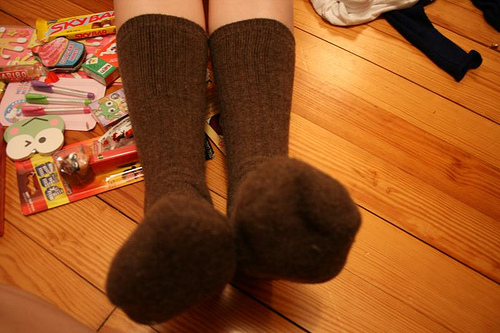
Muppet Feet by irreverentwidow @ flickr.com

My mother left me alone in our house when I was in 4th grade. She would sometimes make a quick run to the grocery store and I would watch (torture?) my younger brother for about an hour before she came back home with the goods. By 6th grade, I was making pretty good money as a regular babysitter to several neighborhood families. (When I say “good money,” I mean I was making $1/hour to watch up to 3 children – and sometimes even a dog with a bladder problem.) I would typically arrive at 6 pm, make the kids dinner, entertain them, feed the dog, help them get into pajamas and brush their teeth, get everyone into bed and have them sound asleep by the time the parents came home around 11 pm or so! Pretty responsible for an 11-12 year old, right?

Last year, my husband and I started leaving our (then) 9-year old son alone in the house for little chunks of time. We didn’t leave him for very long. Maybe hubby and I wanted to take a walk around the block after dinner or stop and chat with some neighbors. That kind of thing.

Since things went so well, we gave our li’l monkey greater independence this year. Sometimes he comes home from school, and I’m not home. He knows how to get in, how to make his own snack, knows to get his homework done. He might (or might not) practice his piano. He knows not to let strangers in the house. He knows what to say if someone calls on the phone. I’ve been feeling mighty good about m’boy who has morphed into a pretty confident and competent little person.

That said, I’ve been catching a little grief from people who seem to think that age 10 is simply too young to leave a person “unattended” for any length of time.

Most people have heard of Lenore Skenazy. The author of Free Range Kids, she’s the chick who let her 9-year old son Izzy ride the train from Bloomingdales in the middle of Manhattan to their home in Queens without a cell phone (and she wasn’t even secretly following him or anything. She simply believed he could do it.) Was Izzy too young to take the Subway? Hell, he did it!

I’m not even putting my kid on a train or a bus! He’s happy to have a bit of time alone in the house. And I’m seriously wondering, what could happen to my kid in our home? Why is everyone so worried about him? About me? About my parenting skills? After all, my mother trusted me to stay at home and watch my 6-year old brother when I was 9 years old. Think about the first time you stayed home alone? How old were you? Chances are, if you are over 40, you were about the same age.

So I’m curious: When is it okay for a child to stay home alone for the first time? And would you hire a 6th grade babysitter these days?

“Just-a-Minute” Syndrome: Have We Caused It?

This entry is courtesy of my dear friend, former high school teacher turned full-time parent, Betsy Whitehouse. If you’d like to pipe in about a topic pertaining to parenting or education (or a place where these world’s collide), please feel free to let me know! I’m glad to shut up from time to time!


photo from joleenieweenie @ flickr.com

I never said boo to my parents. When they told me to do something, I may have slumped my shoulders, but it never occurred to me to reply. I do not mean I wanted to object but showed restraint and held my tongue instead; I mean, the thought of disobeying a parental command never floated across my synapses. How has this tradition not been repeated?

When I ask my son, age 11, to put down his book and come to dinner, I first get silence.

I say, “Please come to the table,” and then I get, “Just a sec, Mom.”

Me: “Fritz!”

Ungrateful child: “I’m coming!” Then silence, followed by no movement from the couch.

Some people will no doubt snicker as they read these words because the child I’m complaining about is reading and not playing video games or texting friends or screwing around on Facebook, but my frustration level is the same, and my dinner is congealing. My mother would whistle up the stairs at me like a dog, and I’d come running.

Why are kids different this generation?

Because it takes work to give kids consequences. We often think that the grounding or the taking away of the hand-held video-game or the cell phone is uncomfortable enough to be a deterrent for the child, but really, it’s uncomfortable for us. We want to teach our kids the right way to live, but how far out of our way are we willing to go?  Not far enough. We are slow to react to bad behavior because it’s disappointing for dad to come home to a child who’s unavailable, banished to her room; because – without a cellphone – it’s inconvenient for us to be unable to call the kid to tell him you’ll be late at pick-up; and, let’s be honest, it can be distracting to have one’s pre-teen PSP-less and yammering while you’re trying to clean, cook, manage. Setting consistent limits for our kids means parents have to suffer the consequences, too. We have to be willing to live with, and be strong with, whatever punishment we mete out.

I never really wanted to turn into my mom; maybe I could just have that one, confident, in-charge, diligent piece of her.

Please Don’t Give My Kid a Trophy

Little League was in full swing over Memorial Day weekend, and my son had two games. On Saturday, I watched my boy get up there to bat three times … only to strike out on three separate occasions. It was painful. I could make all kinds of excuses: The 14-year old umpire made a bunch of bad calls; the sun was in my child’s eyes; he was really tired after a late night get-together the night before. I could make excuses, but what is the point?

The reality is my kid is not a ‘ball boy.” He never has been.

My kid is cerebral. At 3-years old, he could easily build elaborate structures out of LEGO’s by following the often complicated instruction guides. These days, he has graduated to K’Nex and creates working shredders, beverage dispensers, even guns with working mechanisms. Granted, these devices shoot rubber bands or other K’Nex pieces, but still they are incredibly complicated little inventions. And the world needs engineers, right? That’s why they make pocket protectors.

So why am I all bent out of shape over his poor performance on the field?

"Little League Baseball" from metzgarpaul at flickr.com

I think it is because I am an athletic person, and sports have always come easily to me. I guess I’d hoped that by now – his 5th year in the League – he’d be more assertive in the sport and that those skills would transfer to his real life. I imagined he’d regularly hear his teammates praise him for catching a pop-fly or hitting a double or (dare I dream) a triple. I could hear them screaming his name as he slid into home, and as he stood up – his white pants brown and dusty – his teammates would smack him on the back and tell him of his awesomeness.

Bottom line: the fantasy didn’t happen. My child’s team got clobbered two days in a row, and he didn’t help much.

A friend of my husband’s recently commented, “The geeks rule the world,” and I guess I believe it to be true. I know everyone struggles somewhere and that adversity builds character; luckily, my child doesn’t define himself as a baseball player so his self-esteem is intact. Nevertheless, I think about these things as my son prepares to enter middle school. Perhaps I remember it all too well – the social hierarchy, and I know that no matter how cool computers have become in the last decade, sports are still important, and it is still easier to be a jock.

I hope they don’t give him some kind of trophy for “showing up” at this level of play. Frankly, he has more self-respect than to accept a bogus trophy for “participation.”


Stealth-Mode Purse Texters: OMG!

As if The Mosquito Ringtone isn’t enough (see a few blogs back: 5/22/10), teachers also have to worry about making sure students aren’t texting in class. At Monroe Community College, once in a while, I’ve seen students swishing around in their backpacks and purses for extended periods of time. I usually approach these students and quietly tell them to turn off their cell phones. I want my students to know that I notice what they are doing, that their behavior matters to me.

In “How to Successfully Text During Class: Using Your Purse,” Laura Mae instructs students on how they can master stealth-mode texting. She writes:

First, [get a big floppy purse]. Instead of holding your purse in your lap, try laying it sideways on your desk. Keep the opening … facing toward you. Place your phone near the opening. … Your teacher won’t be able to … see your phone … because he/she will be at his/her desk. So you’re good there. If they suspect something and get up to walk around, casually, without looking, push your cellular device back into your purse with your finger just enough so you’re [sic] phone is covered.

If you have a Qwerty keyboard, you can text, but not as easily as if you have an original keypad. If you do have an original keypad, … memorize how many times you need to press each button for the desired letter. I believe every phone has that little bump in the number 5, so that should be easy to navigate to the letters if you find it. Example: While your [sic] not looking, move your finger to the number five. Move up one key. Press three times. Wait a few seconds. Press once. Move back to the center. Move down one key. Press once. I just spelled “cat.”

The dozens of grammar errors in Laura Mae’s article make it clear to me that Laura Mae has not been listening to her instructors for a while. How could she possibly be paying attention when her brain is expending so much energy on composing blind messages as well as thinking about where she has to place her fingers and how many times she has to tap-tap-tap in order to send her messages so that they will be coherent upon receipt? Or maybe it isn’t so much that she isn’t paying attention, but that she seems to care more so much more about her social life than fine-tuning or editing her ideas, important skills which she will need to draw upon in the future.

The pervasiveness of text-messaging in class poses problems for teachers, particularly in the area of  test security, as students can send answers or hints to fellow students via cell phones, destroying the integrity of an entire test with a few keystrokes. Obviously, cheating damages classroom culture, but this is not really the main issue in my essay driven classroom. More annoying is the fact that instruction is interrupted when someone is caught texting. Then the problem extends beyond breaking the rules and not paying attention because instructors have to stop teaching to handle the situation, disrupting the learning environment, wasting time and tuition.

Some people will give me their best Darwinian argument: Students who honestly pay attention will do well on their tests and papers and end up doing better in life then those who are screwing around with their cell phones in class, so let the texters text and grow up to be ditch-diggers. I’m sorry, but I just can’t buy into that argument: Not at the college level and not at the high school or middle school levels either. And my reasons only partially have to do with concern over future skills. I’m genuinely concerned with civility and respect: Two other important values Americans seem to be eagerly flushing down the toilet.

Is it really so much to ask to turn off the technology and respectfully tune-in to and engage with other humans for 50 minutes?

idk.


Note to a Twit, I Mean NYS Governor Paterson

Dear Governor Paterson:

On Tuesday, May 25, 2010, you sent out your plea to your constituents to understand and embrace your “new and improve” modified sugar sweetened beverage tax package of “one cent per ounce excise tax [to] be added to sugary soft-drinks, bottled coffee and tea drinks with added sugar . . .  [while] eliminat[ing] the sales tax for bottled water and low-calorie drinks that have 10 or fewer calories per 8 oz. sugar-sweetened drinks.”

Later that same day,  I sat and watched a morbidly obese woman eating a ginormous bag of potato chips for lunch. And what was she washing those greasy chips down with? A liter of Diet Coke.

I don’t deny that there is an obesity epidemic in this country, but Governor, c’mon.

Photo by Todd Pitt/PictureGroup at Flickr.com

I understand your stated intentions, but who do you think you are kidding here? Truth be told, drinks that contain aspartame and other artificial sweeteners are not any healthier for people than drinks that contain sugar.

Your proposition is doomed to fail because the  premise upon which it rests is that in charging people more, you will somehow teach them to change their behavior. This is just like the cigarette tax. Did it stop people from smoking? Not so much: Nicotine fiends still find the money to get their smokes.

The same is true here. Fat or thin, people with poor eating habits will continue to make the same choices. No one is going to change his or her behavior because their favorite sugary drink costs a few extra nickels and dimes here or there. And I’ll let you in on a little secret: I know plenty of people who feel like because they drink diet soda they are earning “brownie points” – literally. Like the woman eating the bag of chips, I know folks who feel they can eat that extra slice of pie or that extra cookie because they are washing it down with diet soda. By gosh, they’ve earned it.

Oooh, I have an idea! Why don’t you tax items like chips, cookies, cakes, donuts and all fast food items in addition to sugary drinks. Yes, this is a good idea! Why stop with just the drinks? You aren’t thinking broadly enough.

You say that it is necessary to “take steps to help all New Yorkers adopt healthier lifestyles.” I’m all about helping people adopt healthier lifestyles, but a government tax on soda will not make people skinny or healthier; good diet and exercise by individuals will.

Listen, a lot of us are fat. We know. It’s kind of hard to miss. But that isn’t really what this is about, is it? Clearly, the State needs money, right? Why be so underhanded? Just tell the good people of New York that you need to raise taxes, but don’t pretend to care about the obesity problem in the country. Seriously, you don’t think that taxing sugary drinks is the answer, do you? Or . . . do you?

Could adding taxes on sugary drinks help curb obesity?

Sure, I’ll Write You A Recommendation…

Mr. Stephenson circa 1980s

In 11th grade, I needed three stellar recommendations that I could send off with my college applications. I felt confident that I would receive solid letters from two of my former English teachers, but then I was kinda stuck. There was no way I could ask any of my math teachers. I mean, I enjoyed Geometry, but I wasn’t necessarily good at it, and my Algebra teacher had retired.

Finally, I decided to ask my French teacher. I’d been in his class for two years. I was reasonably interested in the material (kinda); I liked him a lot (that should count for something, right?); I did my homework (sometimes); and I tried not to laugh too much. Yes, I decided, Monsieur Stephenson would be the perfect person to write me the outstanding recommendation that I was seeking.

You can imagine how shocked I was when he flat out said no.

“Think about your performance in my class,” he said. “Do you give 100% ? Do you take everything seriously? Do you show me that you want to be here? Do you do anything extra?” He pushed his hair back with the palm of his hand and sat up straight in his chair. “Think about the answers to those questions and then you’ll understand why I can’t write you a letter.”

He did not say he was sorry.

Fast forward 25 years, and here it is, recommendation letter writing season and my former students are returning to me, sometimes three semesters after I’ve had them as students. Like frantic homing pigeons who have been lost for an awful long time, they ask me to write them all kinds of letters –  to get into four year colleges, to enter the military, to give to potential employers – so I find myself thinking of Monsieur Stephenson a lot.

Mr. Stephenson in the 1980s

When Monsieur refused me that day, he gave me a big dose of reality. It is not enough to simply show up: A person must do more than make a good impression. Many of my former students think that because they liked me – that because I was kind to them and they passed my class – that they are entitled to strong letters of recommendation, but the best letters of recommendation are not just about “passing the course,” but about work ethic and character, growth and potential.

I am grateful to Monsieur Stephenson for refusing me, as I see his wisdom in holding up the mirror before me and having me take a good hard look at myself and my choices. I understand that his mediocre letter could have prevented me from getting into the college of my choice. Students need to think carefully and be direct in asking any potential letter writer if that person can produce a strong letter of recommendation on their behalf. If a student cannot find a professor or teacher, they may have to get creative and look to coaches, neighbors, religious leaders, perhaps someone who has witnessed their involvement in community service.

I learned more than just French from Monsieur Stevenson: I learned to be selective about whom I agree to write letters of recommendation. They are time consuming endeavors; labors of love.

Having said that, I am happy to write one for you – if you deserve it.

Anybody refuse to write you a letter of recommendation? How’d you take it?

A Day Of Community Spirit

This year, our temple invited members from synagogues from all over the area to join in a huge community celebration. While rabbis and daddies manned the grills outside to make sure that the laws of kashrut were being observed,  students and parents enjoyed instrumental and vocal performances, saw their children dance to Israeli music, and act in little plays. Afterward, everyone spilled out to a buffet lunch on our first really gorgeous blue-sky, green-grass day.

Girls enjoying the day

Before the kids in this video went inside to perform, I asked permission to videotape them. They are clearly a tight bunch; performing together does that to people. When I asked one of the kids how he felt about the year coming to an end he said, “It’s been a great year. Once we understood and accepted everyone’s different personalities, we could just focus on working together to make something cool.”

So on that day, I served burgers, offering seeded and unseeded rolls (there were also hot dogs and vegetarian alternatives), and my son got a little recognition for having stellar attendance. It felt good to come together as a community. The youngest children played simple games (the kind that involve ping-pong balls and spoons and a lot of running) while older kids played tag, teenagers lounged in the courtyard, and adults stood and chatted nearby. A gentle breeze blew. Not a bad way to end May.

When is the last time you did something that touched your spirit?

Ringtones Adults Aren’t Supposed To Hear

Texting & the rocket summer, originally uploaded by racheocity.

As a general rule, unless someone has an Individualized Educational Plan, I require students to turn off all electronics for the 50 minutes they are in my class. iPods and MP3 Players? Off. Laptops? Off. Cellphones? I don’t even want them on vibrate as I find the buzz distracting. No one has ever balked; however, this past fall I did have a weird experience that caused me to learn about something new in the ever-evolving world of technology.

In this one particular classroom, students generally sat in straight lines facing front: Not my favorite configuration, but we didn’t have many options in our tiny, sterile, windowless space. One day, for no apparent reason, several students looked sharply to the opposite side of the room at the exact same moment while other students covered their ears. Thinking nothing of it, I simply continued my lesson. After class, a most loyal student told me about The Mosquito Ringtone, a tone specifically designed to ring at a decibel that is not easily detected by adult ears. This student also told me that some students use it to cheat.

Apparently, British inventor, Howard Stapleton discovered an ultra high frequency that drives away teens much like a dog whistle affects dogs. His idea was to use his invention to keep teenagers from loitering outside of shops at night, thus making the area around his storefront uncomfortable for loitering teens while leaving the money-spending adult customers unaffected.

As stated in the website for Mosquito Ringtones:

… teens from the inventor’s hometown caught on to what the company was doing and decided to put turn the idea into something they could use. They took the ultra sonic frequency and converted into to a cell phone ringtone which they aptly named “Teen Buzz.”… The ringtone caught on like wildfire in the UK and quickly spread throughout the reaches of the Internet to teens everywhere. Teens learned they could hear each others phones ringing at school but their teachers couldn’t.

Initially skeptical, I was amazed when tried the hearing test experiment with my 10 year-old son and learned that I simply could not hear certain tones beyond a certain frequency. I kept saying, “Can you really hear something?” and he kept saying, “Yes, I can hear it. Now can you turn it off!” I thought I had great hearing! Sheesh! Since that day, I have remained ever-vigilant in class, relying on my eyes as well as my ears. Students are clever and always a step ahead when it comes to technology – especially when it comes to finding a way to use it to cut corners or keep up with their important social lives!

I must admit, I have been waiting for a similar incident to occur. It hasn’t (yet), but at least now I am prepared.

Have you come across this technology in your life? What do you think about it?