
Image by tim ellis via Flickr
I’m kicking off Wednesday #TWITS: a fancy-schmancy acronym for Teachers Who I Think Scored / Teachers Who I Think Sucked. (It only took me eleventy bajillion hours to think up that one.) So here is my middle school memory about one very specific moment. Obviously, I have changed the teacher’s name.
• • •
In middle school, I had the meanest homeroom teacher. Unfortunately, she was also my English teacher, which meant I had double doses of her each day. Mrs. Dour ran a tight ship. She liked her rows straight. She liked her students quiet. She hated boys who leaned back in their chairs. She also hated girls who wore clogs. “Too noisy,” she complained. She called on people when their hands were down, and when she wrote words like “onomatopoeia” on the blackboard, she pressed so hard against the slate that the white chalk often crumbled into dust. Mrs. Dour wore her reddish-hair in a tight bun every day, but by 8th period, when I had her for English, most of her hair had fallen down, giving her a slightly deranged look.
I was pretty scared of her.
One June day, Mrs. Dour gave us all a 7-minute writing assignment during which time we were supposed to do something in our black and white composition notebooks.
I can’t remember what we were supposed to do because of what happened next.
Mrs. Dour turned her back to the class to write on the board. She was wearing a lightweight, white top and a long, gauzy, white skirt that day. I remember this because at that time I was preoccupied by what everyone wore. I noted in my superficial middle school manner that white did not flatter Mrs. Dour’s pasty complexion, and I planned to deconstruct her ensemble after class with my two friends during our bus ride home.
Right about then I noticed a small, reddish dot on the back of Mrs. Dour’s skirt.
Initially, I figured Mrs. Dour must have sat on one of her red felt-tipped markers. She was the only teacher who wrote in red felt-tip marker, and her fingers were often covered with red lines by the end of the day. While waiting for inspiration, I stared at the red mark on Mrs. Dour’s skirt – and I noticed the stain had grown larger. I looked around to see if I could catch anyone else’s eye, but everyone was madly engaged in our teacher’s in-class activity. As Mrs. Dour’s hand carefully crafted perfect cursive letters, I tracked the red as it spread across her bottom. What started out first as a dot, morphed into a quarter-sized circle and rapidly grew into an asymmetrical patch of red, the size of my adolescent fist.
I remembered how, midway through that year during gym class, we girls had been made to watch The Movie, a film created to explain what was starting to happen to our female parts. Our innards. I learned why some of us had boobies already and why some of us would have to wait. (In my case, years. Stupid hormones.) I remembered how we had grabbed each other’s hands as we huddled together in the gymnasium, trying to stifle our giggles. And before we left the locker room that day, each of us received a plastic “goodie-bag” filled with a cute little free sample of mouthwash, some deodorant, two sanitary napkins, and two tampons.
So I knew what was going on.
Meanwhile, I waited for someone else to notice. Or do something.
But as I watched the hand on the clock do that backwards-to-go-forwards click, I realized I was going to have to be The One.
I quietly pushed back my chair and, leaving my clogs behind so as not to make noise, I tiptoed across the room to join Mrs. Dour at the board.
She saw me out of the corner of her eye but kept writing, her back to the class.
How I wanted her to turn sideways and look at me, but she didn’t.
“Is there a problem?” Mrs. Dour snapped without so much as glancing my way.
If she had looked at me, I could have been more discreet. Instead, I fumbled for words. It hadn’t occurred to me to get the words right and then approach Mrs. Dour. My feet had just moved me to where I needed to go. I figured the words would follow.
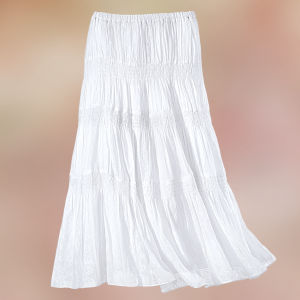
Imagine blood all over this.
“Yes,” I said.
Mrs. Dour spat, “Well, what is it?”
Heads popped up.
As inaudibly as I possibly could, I whispered: “There is blood all over the back of your skirt.”
Mrs. Dour, whom I had always assumed to be very old, was probably in her late forties. She was always so terse; she came off like The Wicked Witch from The Wizard of Oz, which definitely added a decade of scowl lines to her deeply furrowed forehead.
So there I was, Dorothy Gale, stuck in the tornado that was Mrs. Dour.
“Come with me!” Mrs. Dour growled. She took my left arm firmly and escorted me from her desk to the door which she snatched open. Together, we marched directly across the hall to the student bathroom where Mrs. Dour disappeared behind a stall door.
I stood by a trio of sinks, waiting for directions. For divine intervention. For Mrs. Dour to tell me to go. Or stay. Or something.
I didn’t expect Mrs. Dour to cry.
But that is exactly what she did.
From behind the stall, I could hear her pulling the terrible, industrial squares of toilet paper and weeping.
For the first time, I stopped seeing my English teacher as Mean Ole Mrs. Dour, the persnickety disciplinarian with all those rigid rules: the woman who gave me detention at least once a week.
I saw her as a small, embarrassed, woman who didn’t know what to do.
I looked at myself in the mirror and found enough courage to ask Mrs. Dour if there was anything that I could do for her.
My voice echoed against the empty bathroom walls.
“Do you think many people… saw?” Mrs. Dour asked.
“I don’t think so,” I lied.
Truth be told, I suspected that nearly everyone had seen the mess on the back of Mrs. Dour’s skirt, and if they hadn’t seen it with their own eyes, the people who had were likely telling everyone who hadn’t.
I was pretty sure that would be the end of Mrs. Dour. After suffering such public humiliation, I was positive she would resign that afternoon.

Oh, yes she did.
But Mrs. Dour was in homeroom the very next day. She was not any nicer. She continued to do her job just as she had before.
She continued to complain about the girls who wore clogs. She continued to issue me my weekly detention. Mrs. Dour was not a nice teacher. I cannot remember any books that I read or projects that I did that year. I remember only that single incident. But I learned something important from her nevertheless.
I learned that sometimes a person has to push through her fear no matter how scared she might be and just keep moving forward. Sometimes, you have to take a deep breath and face the thing that you fear: which in this case – as is often the case – is the fear of ridicule or the laughing masses. Because sometimes that’s all you can do.
I suppose Mrs. Dour did teach me one other lesson.
A teacher myself, I can tell you I have never, ever worn a white skirt.
Ever.
And I never will.
When is the last time you were truly afraid? What got you to push past your fear?













 renée a. schuls-jacobson
Hey! Why Is It So Quiet in Here?
I have my best listening ears on!
I have been gaining subscribers for a year now. I have this cool, little dashboard that tells me how many people have viewed my blog, which pages they have checked out, what words they searched to find me, and a whole lot of cool information. My lice post is still the number one most frequently viewed post and, if you Google search “drag needle splinter twit,” you will find this.
Here’s what I don’t understand. Every day, more people are visiting my site. Which is totally excellent. And I am grateful to everyone who comes to check me out. And I’d like to take this opportunity to say to the folks searching for “psicologia: esconderse bajo la cama”: I’m sorry I couldn’t be more helpful.
But here is what I’m pondering:
Why do so few people who read blogs actually leave comments? I mean I have my regulars, the folks upon whom I can rely on to say something. They are the people with whom I have come to know and have developed cyber-relationships. Through these online exchanges, I have met so many smart/interesting/funny people. Some cyber-friendships have progressed to emails; some to phone calls. Heck, I’m playing concurrent games of “Words with Friends” with Jessica Buttram and Ironic Mom.
So imagine my surprise when a friend that I actually know in real life — yeah, I’m calling you out, Aaron — admitted that he has been reading my blog since my blog was born, that he has been there since its infancy, and added that he has really been enjoying watching li’l boggie mature. Now this of course made me all shivery and happy inside, and I immediately gave him a hug Actually, I may have hugged him first and then squealed when he made the comment, but you get the idea.
Of course, I love the idea that people are reading my content.
But later (after the hugging and squealing), I wondered, Why doesn’t Aaron ever comment? What’s up with that? And if Aaron isn’t commenting, why aren’t other people commenting? I decided to create a poll to try to find out. Seriously, I’d love to hear from you lurkers who read but don’t necessarily comment. Please know I don’t have any way to identify about you except the answers you leave here because all the info is collected at Poll Daddy and reported back to me anonymously. You know, unless you put your name in the comment or something.
I love writing and I am working my butt off trying to bring you interesting stuff. Am I missing something? I can never predict which posts people are going to go bonkers over and which ones will be duds. (I mean head lice? Really? Over 200 hits every day?)
Author Kristen Lamb (a woman to whom I refer to as “The Queen”) often writes about how important it is for writers to try to connect with one another in her blog and in her books We Are Not Alone–The Writer’s Guide to Social Media and Are You There, Blog? It’s Me, Writer . I know not all of my readers are bloggers, but whether you are or not, I would love it if you would leave me a comment. For me, blogging is — of course — about writing, but it is also about creating a dialogue. After I have written something the delicious part is hearing what people have to say about it. The comments are like a fabulous dessert you get to eat — after slaving away for hours making a difficult meal.
If you are writing a blog, you are hoping that someone is maybe (*hopefully*) reading your words. Admit it. It’s true.
And if you are checking out other people’s stuff, you don’t have to feel pressured to write a crazy long comment. Even a short little “Thanks for this!” or “Hilarious!” can really make someone’s day. So don’t be shy. Just say, “Hi!”
Truly, I am interested as to why people choose to be quiet when they could be part of the dialogue. So please, enlighten me. At the risk of sounding like the National Inquirer, inquiring minds really do want to know. Has anyone else given any thought to this phenomenon?
What drives people to comment? And what makes lurkers stay in the shadows?
Tweet This Twit @RASJacobson
93 Comments
Posted in Writing Life
Tagged @RASJacobson, Blog, blogging, connecting with other writers in the blogosphere, curious about quiet readers, figuring things out in the blogosphere, how do you feel about lurkers, Poll Daddy, Poll Daddy poll, psychology, Social media, technology, why don't people comment on blogs, Writer, writing