Tag Archives: writing

Who Me? Stylish?

" You read me? You really read me?!"

I said I was taking a break from blogging to work on my book.

I must not have been very convincing because the next thing I know, I received this message from Clay Morgan over at Educlaytion: “I have something for you over at my blog.” Well, for the love of Pete, that’s like crack. I mean, how can anyone resist that? You would have to have to be one cold-blooded bitch not to heed the call of a fellow blogger.

So I popped over to Clay’s blog and found an honor bestowed.
Clay has passed along the esteemed Stylish Blogger Award.

I’m told that in order to accept The Stylish Blogger Award, nominees must do the following:

  1. Write seven things about yourself.
  2. Present the award to six bloggers.
  3. Contact those people.
  4. Create a link back to the person who did this to for you.

I started looking around the blogosphere, and I have to say I’ve seen many variations of this theme. I’ve seen folks asked to name ten things about themselves (Can you say overkill?) and name fifteen other bloggers (Glurg!). So I decided that with this shiny, happy, and slightly imaginary award comes a little lee-way, so I’m going with the six-pack.

I’m giving you all six things about me that are mildly titillating and then I’m passing the torch to six people whose stuff I love to read. In fact, some of them may have already have received this award, but I’m throwing some traffic back at them. Because they are THAT good.

Okay, so six things about myself:

1. SK sat behind me in fourth grade. On the first day of school, I said I had a pair of blue flip-flops at home, and he said they were actually called “thongs.” From then on, we disagreed about everything. These days, I have a lot of thongs at home, but I don’t wear them on my feet.

2. In 3rd grade, I had a mad crush on a kid named Savallas. He could turn his eyelids inside out. He called me on Saturday mornings and we sang K.C. and The Sunshine Band songs together.

3. My first kiss was with a girl. And she liked it so much she became a lesbian. True story.

4. Somebody wrote in my high school yearbook: “May your tail fall off and your hair shrivel into snakes. I’ll never forget you.” His handwriting is completely illegible so I can’t read the name. I’m pretty sure he (or she) has forgotten me.

5. I am extremely competitive, and I have never “let my child win” at anything. Not chess or tennis or Crazy-Eights. This might be why he has taken up fencing; I do not own a sword.

6. I am not afraid of anything, except contracting lice and not getting my manuscript published. Either of those things would totally suck.

• • • • • •

Now for my six nominees to be forever immortalized should they accept this honor (and by honor, I mean, homework assignment disguised as an honor).

Chase McFadden of Some Species Eat Their Young – I will have to fight Clay over who discovered Chase first. (I swear it was me.) Chase is pee-in-your-pants funny. Seriously, I think I’ve actually had to change my pants after reading some of his posts. A must-read for dads who blog.

Valerie Stone Hawthorne of Mompetition – This chick is a hoot. She makes parenting a competition. And when it comes down to it? Isn’t it? Really? Check out her photographs. She manages to capture a whole blog’s worth in a picture and one snarky caption. (Damn her!) Plus her electronic videos are a hoot.
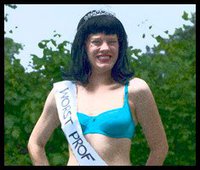
Worst Professor Ever – She won’t reveal her name. And after a while, you don’t want her to. I love WorPro. She is my hero. She came, she taught, and she got out alive. She is hot as a blister in the sun, sharp as a whip, tough as nails, and smart as a Bermuda bag in The Preppy Handbook circa 1982.

Zach Sparer of Faux Outrage – One of my former students, Zach is a hot, young, Jewish lawyer. He is funny and smart. He is also single and living in the D.C. area. What? This isn’t J-Date? Fine. Strangely, Zach and I have a lot in common. We both attended the same summer camp – though we missed each other by about 20 years. We also share a disdain for the man who subbed for me while I was out on bed-rest during pregnancy. (That man destroyed The Great Gatsby for over 125 students. Unforgivable.) Zach sees the world through sassy glasses – literally. Except he doesn’t wear glasses.

Kasey Matthews is an old comrade of mine from high school. I think we double dated for Senior prom. (Didn’t we Kasey? Shall I look for pictures?) Anyway, she has just started blogging, and her stuff is the stuff that moms wrestle with all the time. She has a new book coming out called Premature Journey: Lessons in Love, Life and Motherhood, and I can’t wait to read it.
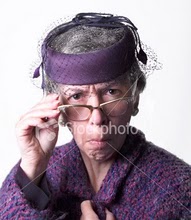
Kathy English of Mom Crusades – What else can you say? Kathy is consistently funny, on topic, and spot on. She is incredibly prolific. I don’t know how (or when) she does it. All I can say is that her house had better be really, really messy!

So there you have it. It was lovely to come up for a little air. Clay, you know me so well. I needed a little watering and light. Thank you for thinking of me and putting me up there with so many great writers. Because there are so many great writers!

Now back to the trenches.

Lessons on E-readers

A Picture of a eBook

Image via Wikipedia

I’ve been considering getting an e-reader for a long time because I read a lot of books, but I hate the clutter that they leave behind. In fact, a Facebook friend recently commented on my sloppy bookshelves which were in the backdrop of a photo. Can you imagine? (Thanks a lot, Todd!)

Anyway, I have been holding out on getting an e-reader for three reasons:

1) Sheer laziness: For a long time, I just couldn’t justify moving up “Research e-readers” in the queue ahead of “Buy new bra.” Guess what? Went to Victoria’s Secret yesterday! 😉

2) Fear. I am definitely afraid that the e-reader could become a chore, another gadget that I have to charge and worry about losing. I worry that I won’t like the experience of an e-reader because I like to write in my books. Back in 1940, Mortimer Adler told his readers in his article “How to Mark Up a Book” that:

The physical act of writing, with your own hand, brings words and sentences more sharply before your mind and preserves them better in your memory.

As a teacher, I could not agree with him more. And yeah, I know you can highlight and leave notes with these gadgets, but there is nothing like flipping through an old book and finding my old handwritten scribble to remind me where I was at a particular point in time. I pick up favorite old books all the time and giggle when I find: “This is sooo mom!” or “Make husband read this whole paragraph!” I’m not sure I’ll have that same experience with the e-reader.

3) There is something creepy about e-readers. I don’t know. I’m not anti-technology or anything, but it’s like when I found out one publisher of the latest version of The Adventures of Huckleberry Finn had taker out the “n-word” and replaced it with the word “slave,” I got a little bent out of shape. Things felt all Big Brothery to me. I worry that libraries are going to start closing, and I love libraries – even though, these days, they seem to have become places where the mentally unstable like to hang out to avoid the inclement weather. I don’t know, for me, books are as much a part of my head as they are my heart. I’m not so sure I’ll feel that in an e-reader.

Still, Valentine’s Day is coming up, and all the stores seem to be insinuating that the best lovers buy their significant others e-readers, so yesterday, I drove around town trying out various e-devices. I needed to feel them in my own hands, see what they could and could not do.

And so I am definitely leaning in one direction, and I must admit, it is not the direction in which I thought I would be going.

Without dragging things out (you know, the way I usually do), I figured I’d ask you, my beloved readers, for your opinions.


Note: iPads are not in the running. (I don’t need all those bells and whistles. Plus I need to be able to read outside, and the iPad has too much glare.)

For those of you who have e-readers, can you tell me which one you have, what you love most about the one you have, and if you had a chance to do it all over again, if you would make the same purchase. If not, what would you choose now?

Wegmans’ Grammar


English: A Wegman's store in Manalapan, NJ.

English: A Wegman’s store in Manalapan, NJ. (Photo credit: Wikipedia)

There is almost nothing wrong with Wegmans. It is the world’s best store. Indeed, people visit from across the globe to see how things are set up. They bring cameras and snap pictures of our amazing store, which is set up to look and feel like an outdoor market in Paris.

In the produce section, the fruit is heaped in baskets and barrels. There is usually someone cooking and serving something simple yet delicious — like sautéed shiitake mushrooms with shallots and basting oil — (and all the ingredients just happen to be right there for you to pick up for dinner that night). The marketing people are amazingly brilliant.

Wegmans also has a deli, a bakery, a fish shop, a meat market, a cheese department, a tea bar, a coffee bar, a place to buy sushi or salad or pizza or subs, and they have this one entrée and two sides deal for $6 that cannot be beat. There is a pharmacy and a café. They have an organic food section, a kosher food section, a lactose-free section. They cater. The store sparkles. The public bathrooms at Wegmans showcase nicer tiles than some private homes I’ve visited. The soap dispenser is always full. They have towels and air dryers.

If you buy a jar of tuna and get home and see it is dented, they will take it back. If you buy a pound of meat and think it smells a little bit funny, they will take it back. If your kid is hungry, you can let him nibble an apple or a cookie, and no one hassles you. Alec Baldwin’s mother loves Wegmans so much, he did some schtick about it on Letterman, and he landed himself a few pre-holiday commercials discussing Wegmans’ awesomeness. Frankly, Baldwin’s commercials are awful, but anyone who has ever been in a Wegmans understands; there really is nothing like it.

That said, the following sign has been tacked up in my local Wegmans for years! I don’t think anyone notices it except me, but it drives me bonkers. Given their attention to detail, I can’t believe the sign has lasted this long. I figured, surely, someone would notice it. After all, it’s right next to the water fountain.

For those of you who appreciate spelling and grammar, as well as the art of letter writing, see how many errors you find.

What has become of me?

And should I say something to Bob?


Guest Post by Megan Killinger: Lessons From The Spectrum

photo by Sean Rogers at flickr.com

This personal narrative was written by Megan Killinger, a student in one of my Composition-101 classes during the Fall-Winter 2010 semester.

“No, no, no! Look at me, Megan!” my mother would say to me tapping the tip of her nose with her finger, repeatedly trying to get me to make eye contact. She did her nose-tapping routine in public — pretty much everywhere, anytime I’d forget to look at her or at someone else. I hated her for it. She never understood me, no matter how I tried. Whenever she did her nose tapping thing, I could feel a hot flush of anger rush through me, aching like the pulse of blood behind a bruise. Apparently, I needed to get it through my head that the person who I was “wasn’t cutting it,” and I needed to transform myself into someone else more acceptable: a hard lesson to learn — that “what you are” isn’t good enough.

As a child, I hated crowds — hated going to the mall — rarely made eye contact, and had a tendency to say whatever I wanted. I was constantly told my actions were “inappropriate,” and I learned to live in a world filled with criticism and boundaries.

I was always the odd one. School was a penitentiary for me, for it was difficult to make friends. I watched my peers react to each other, and that’s how I learned the basics on “How to Make Friends-101.” Personally, I would have preferred to have hit myself in the face with a shovel rather than associate with people, for kids always saw me as “weird.”  I was too blunt or too curious; I learned that telling the truth was not always acceptable. For example, when someone asked me if the outfit she was wearing made her look fat, I learned that it isn’t always appropriate to tell the truth.

So I clammed up.

Guest blogger, Megan Killinger

Growing up, my mother and my doctors were the worst. My mother constantly told me “We’ll find out what’s wrong and fix it.” But I didn’t think anything was wrong with me; nevertheless, I must have seen fourteen different psychologists. No one could figure it out, until one day, as I sat there, playing with some little wooden blocks (as per usual), I heard something I didn’t think I’d ever hear.

“I know what it is!” Quack Doc #14 said to my mother, oh so casually, after spending a lovely ten minutes with me. His stupid tone, just like all the others and their lame stereotypical Quack Doc questions; how I wished I could kick him his shin and see how breezy his tone would be then.

I was diagnosed with Asperger’s Syndrome, a form of autism, and no — it doesn’t mean I’m “retarded.” My life drastically changed that day — November 12, 1999. My mother was finally granted a reason for my so-called “abnormal” behavior. She cried, and her sobs sounded like a dying mouse; maybe someone told her that I was a retard.

Once I had a diagnosis, my mother enjoyed telling people “my secret” to anyone I brought home. This shattered the “normal” image I worked so hard to create. I watched and tried to make myself as much like the others as possible, so I’d have a chance at fitting in. Honestly, I’m still impressed at how well I did.  I was (and still am) careful about how close I let people get to me at first, so when I drop “the Asperger bomb,” they know me and then they can decide whether it changes anything. But back then, with my mom beating me to the punch, it made maintaining friendships a lot more difficult. When people heard the word “autistic,” they automatically conjured up a drooling idiot or something along those lines.

After I was diagnosed at age 9, I felt like a drug-lord-zombie for a while. It seemed like Quack Doc had me trying out a new medicine every month. Concerta was a real winner. When I took Concerta, I felt like all my life’s blood had been drained, like I wasn’t present — almost. Once, while on that medication, I sat and counted the lines on a bug’s wings. It is amazing how a person can tell her doctor that what they’re giving her is making her ill and then have that doctor respond by prescribing a higher dose of the same medication. Things were eventually adjusted.

I used to get angry with myself, when someone could tell I was autistic. I kept telling myself I didn’t have Asperger’s, that I wouldn’t be that person, but I stopped fighting and learned to accept my diagnosis. I tried to make small changes, for I understand now in order to obtain what I want  — a “normal life” — I have to play by everyone else’s rules: Monkey-see, monkey do.

These days I have some fancy coping mechanisms. One of my coping methods is to play a type of mind game, which involves me asking a ridiculous amount of questions without giving much information about myself. In other words, I get the person I’m talking to inform me about themselves without really having to say much at all. In addition, I always check myself to make sure I look everyone square in the eye and, I am happy to report, I have made some close friends. I even like going to the dreaded crowded, noisy mall.

What I have gathered from my 18 years of life experience is that people reject what they don’t know. If they don’t understand something, most people don’t even want to try. My first semester at college was exactly what I expected, for the most part. To be honest, I was just really excited to have a fresh start. At college, no one knows anything is “wrong” with me, which is a great feeling. I’m finding acceptance in college, and its a part of what I have always wanted: to be seen with unbiased eyes. Sometimes I still speak a little too quickly and I still have to watch what I say to people. I suppose I will always find it hard to blend in, but college is showing me that there can be more to life than just blending in.


Guest Post by Leanna Best: Lessons From Javan

Photo by Travis S. at flickr.com

This narrative was written by Leanna Best, a student in one of my Composition-101 classes held during the Fall-Winter 2010 semester at Monroe Community College.

My aunt’s third child, Javan, was born with his umbilical cord wrapped around his throat. Without air for five minutes, doctors told my aunt that Javan was not going to survive because he had lost too much oxygen. My aunt asked the doctors to try anything they could to help him to regain consciousness. The doctors put him on a respirator where each minute felt like an hour. Amazingly, Javan began breathing independently again, but the doctors told my aunt that Javan would be handicapped for the rest of his life as a result of the brain damage he had suffered. The doctors also told my aunt that Javan’s lifespan would be shorter than normal.

Guest-blogger, Leanna Best

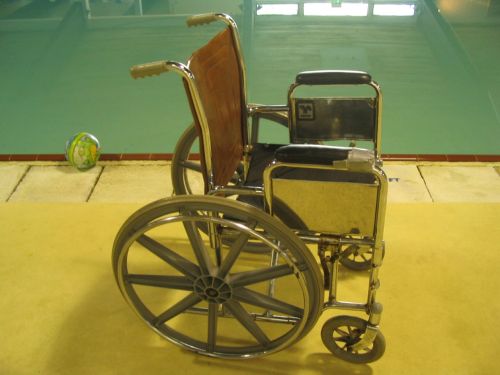
All my aunt wanted was for her son to live, and her wish came true. But the doctors were right, too. Javan is handicapped. He cannot walk, talk, eat, or dress himself. Throughout his life he has always been in a wheelchair. Every few years, Javan has to get a bigger wheelchair because he is still growing. He is now sixteen years old and has been in a wheelchair for his entire life.

Javan has short, dark brown hair. He is very thin, but he is still very heavy. Javan can only wiggle his arms and legs in his black wheelchair, but he does not have enough muscle strength to walk or lift anything; nevertheless, he is a very happy teenager and always has a smile on his face.

Each day, my aunt faces the struggles of having a handicapped son. He has to go to a special school and get special care every day. Each day, my aunt lifts Javan out of his bed, washes him, dresses him, feeds him, and even changes his diaper. She has a huge responsibility and will have to live with this for the rest of her life. As Javan’s body grows, he gets heavier, and lifting him has become challenging. She will always have to worry about her son having a reduced lifespan.

Knowing Javan has made a huge impact in my life because I see how my aunt struggles with my younger cousin. I love him just as I love each of my cousins, and I hate to see him suffer. I hate to see him cry, and I hate not knowing what he is thinking or what he wants us to know. I know it will be extremely hard for my entire family the day he is no longer with us.

I have learned so much from watching what my aunt goes through every day, taking care of Javan. I don’t know if I would be able to do what she does every day without a lot of help. From watching my aunt, I have learned how big a responsibility it is to take care of a special needs child on a daily basis. Javan cannot communicate in words at all; he can only make sounds. My aunt has to try to figure out what he needs or wants on her own. I have seen how hard it is raising children, and I can hardly imagine what it would be like to try to raise a child who cannot clearly communicate in words or gestures.

My aunt is very patient and caring. She gives Javan the care he needs every day. While I like to think that I am good with Javan and enjoy the time I spend with him, I also like taking him home. I don’t think I could handle this type of responsibility every day, along with having four other children to care for.

My whole family loves Javan so much and we would not trade him for anything. My aunt was given this challenge and she has mastered it with lots of love, time, and effort. My wish for my aunt and Javan for 2011 is a simple one: for them to be happy and healthy!

Lessons From Nan, Who Passed On June 16, 2004

Nan (Tilly Epstein) & Pop (Irving Schuls)

My grandmother’s name was Tilly. As a child, I wrote her name on envelopes and birthday cards and doodled it on pictures. I never questioned the authenticity of my grandmother’s name because no one had ever said anything about it. And frankly, her name didn’t much matter to me because I called my grandmother Nanny, or sometimes Nan for short.

In 6th grade, my social studies class did a genealogy project, and I sat down with Nan to ask her about her siblings, about her childhood, about her memories, how she met my Pop – all kinds of questions. It was during this interview that Nan told me that her name wasn’t really “Tilly.” She informed me that her real name was Telia, which she thought was a pretty name, but that no one had ever called her by that name so she just went by Tilly, the nickname that was given to her by her parents and siblings. To me, this story is emblematic of the grandmother I knew all my life.

Nan didn’t complain. She didn’t pick fights or confront. She didn’t sweat the small stuff. Unless someone had really wronged her (or flirted with Pop), in general, Nan just kind of accepted things. She found in my grandfather a soulmate and, while they would never be rich in dollars, she was satisfied to be rich in love.

When we four grandchildren were young, we would run down to Nan and Pop’s apartment after a lazy day of swimming in the pool located in the middle of their apartment complex and demand drinks and snacks and candy and cartoons. Nan always opened the door with a smile, ushered us in, and quietly delivered the goods. When her french-fried potatoes became our summertime obsession, she dutifully peeled and sliced and fried those potatoes to golden perfection – sometimes in a very hot apartment – and we would devour them hungrily, asking for seconds and thirds and sometimes probably even forgetting to thank her for her efforts.

Nan never asked for thanks or looked for recognition. And while some people spend their lives dissatisfied or longing for things they do not have, Nan truly had the ability to appreciate life’s simple gifts: the gift of good health and the gift of a loving family.

Nan was intimately connected to her family. She somehow managed to keep both of her children close to her. While she never learned to drive, Nan always found a way to get what she needed. She was resourceful. Nan was not cocky, but she was proud: proud, first, of her children, then her grandchildren and, finally, proud of her great-grandchildren.

While moving Nan’s belongings into a nursing home, I was amazed to find a small wicker basket filled with hundreds of scraps of papers inside of it. Each scrap bore an address of someone Nan had cared about. At the very bottom, there was a calling card bearing the address of the house she and Pop had lived in on Ranier Avenue, a street lost long ago. She had kept my various college and graduate school addresses, though I hadn’t lived in any of those places for decades. She had my brother’s addresses in Ithaca, NY and Charleston, South Carolina, my cousins’ addresses at Oneonta, and other names I didn’t know attached to addresses I didn’t recognize – little scraps of paper with numbers and letters representing much more to Nan.

Nan was home-loving and intensely private. She was unobtrusive, but involved. A tiny woman, who seemed to grow shorter each year, Nan was truly a matriarch. When her husband, my Pop, died in 1990, Nan swore she’d never leave her apartment again: never return to the Jewish Community Center, or to shul, or to the grocery store – but eventually, she did all of these things. Though she appeared frail, she was strong and – when feeling good – had a hearty appetite that never ceased to amaze us. And, even in the end, when she suffered a broken pelvis and arthritis and weakening knees, she went to physical therapy and strove to walk independently. Nan possessed an inner fortitude that is indicative of a great strength.

I will always remember Nan, wearing a snazzy pair of purple pants, sitting on the gold couch in my parents’ living room. Just sitting quietly, patiently, watching my brother and me as we made up games or put on little shows. Many years later, she would sit in the same place, dozing off and on, awaking with an almost apologetic smile.

Agatha Christie once said, “I like living. I have sometimes been wildly, despairingly, acutely miserable . . . but through it all, I know quite certainly that just to be alive is a grand thing.” I believe Nan knew this, too.

Seven years and six months later, I still think about her.

Who do you miss and what did they teach you?

End of the Semester Blues

Students taking a test at the University of Vi...

Image via Wikipedia

I have one section of students that  hasn’t mastered the necessary skills to show they understand how to properly write a college essay, complete with proper citation. Their last batch of essays was pretty bad. With the exception of a few papers, most students bombed their Works Cited pages and their writing felt unpolished.

I asked a few other professors what to do.

“Tell them to suck it,” one said. “If they don’t have it by now, it’s not because you haven’t shown them; it’s because they haven’t taken the initiative to learn the material.

The other professors agreed.

But I didn’t want them to “suck it.” Why am I hesitating? I wondered. What has happened to me? As always, I want my students to master the material, so regardless of what my colleagues said, I decided to give them an option: I returned ungraded essays to them with extensive feedback and told them they could ask me for the grade they received on the essay and forfeit the right to revise, or they could revise their essays (with rough drafts attached) by Wednesday at the beginning of class. And by Wednesday, I mean tomorrow.

No one asked for his or her grade.

Now, I’m not crazy enough to believe that everyone will actually revise, but I am hopeful that some will. I am hoping that they will use their style books, the extra time along with my feedback, and give it one more try. Because after this, that’s it. There are only a few tiny assignments, 7-minute oral presentations, and self-evaluations.

I know students have other classes, but mine is required. English Composition-101 is required. Required. So if a student fails, he or she will have to take it again. It’s expensive to fail classes, but some students don’t seem concerned about the debt they are piling up.

At this point of the semester (with 6 classes remaining before the end of the term), certain students wake up and realize they have been doing poorly (for most of the semester), and act shocked by this revelation. They ask about extra credit and want to be passed because they need to keep an athletic scholarship, and/or avoid parental wrath. Requests for points for nothing or for passing grades are easy to handle. I offer a “no” along with my sympathy, plus advice about how to retake the class.

Today, as we began week 14 of 15, I had a student with an overall average of 54.4% ask me what he could do to bring up his grade. I shrugged. He shrugged. Later, I saw this video. I’d send him the link, but I don’t think he’d get it.

*Note: This little ditty was made by Clay Morgan at Educlaytion.com*

In reality, it is kind of hard to fail my class. I offer a lot of help to students to want it. I make myself available to conference. I allow students who show initiative to revise their papers. I offer extra credit opportunities throughout the semester – just not as an “emergency out” at the end.

I hate watching students unravel at the end of the semester but – the reality is – there are always some who come unstitched.

It’s reality, but I don’t have to like it.

Seriously though, why am I more upset about my students’ failing grades than they are?

Functional Illiteracy: The Repost

People who know me know I’m struggling this semester. I try to explain how a larger number of my college students seem to have weaker skills this year; how I can’t get them to use capital letters (or, in some cases, how I can’t get them to stop randomly capitalizing words that don’t need to be capitalized); how they won’t stop writing “im” instead of “I’m”; how I can’t get them to stop using the letter “u” when they mean the word “you.”

“They don’t know how to outline!” I exclaim. “Or write in five paragraph essay format!”

People think I’m exaggerating. “Things can’t be that bad,” folks say.

Finally, here is a perfect example of why my panties are in a bunch this year.

This post called “Functional Illiteracy” from Just Sayin’ addresses some of the very real struggles that educators are facing today, even at the college level.

Do you have discussions with your kids regarding their use of language? Are they writing as well as you would like? Do error-filled papers (with high marks) come home from your children’s schools? Do you think their grades are inflated? Because, I am here to tell you, graduating high school students are not using capitalization or punctuation.  Many high school graduates have not figured out basic written communication skills which my peers and I had mastered in the 6th grade and spent the following years perfecting.

Many of this generation’s students are essentially unemployable, and if you don’t believe me, read this post from my friend, Michael Hess, of Skooba Design. Because as a business owner, he cares about the way people write.

Do you care about how you write?

Or r u 2 busy txtin 2 care?

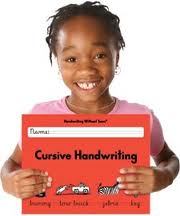
Cursive as a Font Option?

image from Wikipedia

Not too long ago, my 6th grade Monkey had to sign several contracts – various agreements between himself and sundry teachers and coaches.

“Do I have to write in cursive?” 11 year old Monkey asks.

“It’s probably a good idea,” I reply.

There is a pause. Silence during which time I assume he is signing his name on the assorted colored sheets of papers. But after a while, I glance over and notice he has written only the first three letters of his first name. He is looking off into space, clearly stuck.

“Mom,” he says eventually.

“Mmmmm?” I ask, pretending to be oblivious but definitely aware of his dramatic pause. But I’m thinking to myself, maybe boy has some deep moral, ethical or philosophical opposition to being asked to sign a particular contract. I’m thinking maybe he is hung up on one of the terms. Maybe something seems unreasonable to him, and he is not willing to just sign on the dotted line. For a moment, I’m actually proud. I figure he’s read the contracts and internalized the content, and now he has questions, reservations. He’s thinking critically about his commitments and if he can take on more responsibility. . .

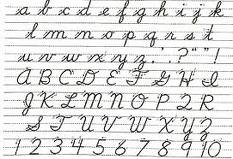
“I can’t remember how to make a “v” in cursive,” Boy announces. “I kinda forgot how.”

image from Wikipedia

My child is in 6th grade. He is a stellar student. How could it be that he has forgotten how to make his “v’s” in cursive? I wonder. But I am patient. The school year is just kicking off, and he has been away for three weeks at overnight camp, playing in the dirt with friends, enjoying the heat of summer, so maybe he needs a quick mini-lesson.

“Sure, honey,” I say and prepare to give him a quick tutorial in cursive – which morphs into an elongated lesson because, as it turns out, Boy doesn’t remember how to make a capital “J” (which, for the record, is the first letter in his last name); neither does he recall how to make a lower case “b” (also a letter in his last name!).

At this point, I hear the ocean in my ears.

This is never a good thing as it generally means a giant wave is rising up from the deepest, angriest depths of me, and it generally culminates in a boatload of phone calls.

“Buddy.” I ask Mr. Calm, Cool and I’m-Not–Worried-At-All-That-I Don’t-Know-My-Alphabet-In-Cursive, “How is it that you do not know all your cursive letters?”

My son proceeds to explain to me that, while cursive letters were taught in 3rd grade, his teachers didn’t really require that he (or any of his classmates) write in cursive.

“Writing in cursive was pretty much optional,” Boy tells me.

Optional?

Optional!

(Can you hear the Atlantic, the Pacific, the Antarctic and Indian Oceans rolling around inside my head?)

picture from Google Images

I couldn’t help myself. I made a few calls to a few principals (who shall remain nameless) in a few local public schools (which shall remain nameless) in a few nearby districts (which shall also remain nameless). Most principals agreed that there is just so much material to cover to prepare students for standardized tests, that many things have had to go. (Damn you, No Child Left Behind!)  One administrator told me that decisions had been made (note the passive voice) to focus less on cursive writing but that students could select cursive as “a font option” when printing from their computers.

Cursive? As a font option?

Really?

Hold on folks. I’m going back for a nostalgia moment.

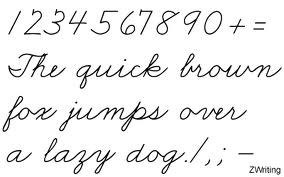
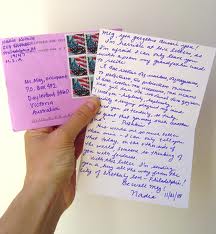
I remember a time when we kids couldn’t wait to move from our world of block letters to the world of cursive which was infinitely more adult. (And I’m not the only one who felt this way! Read Kathy English’s awesome essay on the death of cursive!) My babysitters used cursive to write notes to each other, but I could never read their words as they were like some crazy, secret code I couldn’t decipher no matter how hard I tried. But I knew that one day I would eventually be deemed mature enough to learn “The Code,” that I would figure out how to connect letters by one single, continuous stroke. I knew I would learn to create words in loopy cursive letters and that, ultimately, I would be able to read my grandmother’s shaky script, my mother’s slanted hand, as well as my teacher’s perfect penmanship.

from Google Images

In the 18th and 19th centuries, cursive was one’s special signature. It distinguished one individual from another. The most elite received special training, and possessing a “fair hand” was considered a desirable trait for both men and women.

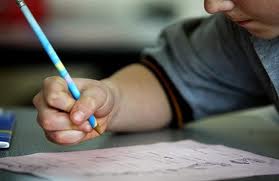
By the 1960s, a standardized method for teaching penmanship called D’Nealian Script had been introduced into schools all over the United States, and handwriting became more homogenized. I didn’t know any of this, of course, as I sat in class in 3rd grade in the mid-1970s. All I knew was that during “cursive time,” each of us learned to write the same way: on thin, oatmeal-colored paper that consisted of a series of two straight continuous horizontal lines with one broken line between them. We students sat with our pencils poised “at the basement” of the line ready to “go all the way up to the attic” or to stop “at the first floor.”

I remember being totally geeked up about learning cursive, but apparently, not everyone was as psyched about switching to cursive as this twit. And while I might have considered learning cursive a bit like taking a second art class, apparently, it wasn’t that way for everyone. For some kids, learning cursive was really difficult. I remember “the lefties” really struggled as did a bunch of kids who probably would have been diagnosed with some kind of fine-motor skill problem if they were going through the ranks today. But they didn’t test kids for things like that back in the 1970s. Instead, our teachers encouraged us (or goaded us, or punished us) until we learned our letters. And while we weren’t necessarily good at it right away, with daily practice, our shaky letters improved.

I wrote all my papers in cursive until my senior year in high school in the mid-1980s when my father brought home an enormous TRS-80 around the same time teachers were setting up the first “computer lab” at my high school.

So much has changed in twenty-five years! With the advent of word-processing and PDA’s and all things electronic, cursive has completely fallen out of favor. In fact, it has almost gone the way of the dinosaur. Without a doubt, typing is infinitely faster and easier to read than handwritten papers – but, now that I hear that cursive is not being reinforced, I wonder, is something being lost in making cursive optional?

First, there is the obvious, esoteric stuff. When written properly, cursive is beautiful. Reading a handwritten note from a friend or lover is actually a completely different experience than reading the same content typed. Don’t believe me? Go back and look at some old photo album that belonged to somebody’s great grandmother. Look at the handwriting. You can actually feel something of the person in the handwriting. It is so much more intimate than reading something on a piece of paper that looks like it came from a school or the mortgage company. Have you ever received a thank-you note via email? Ewwwww. What about a thank-you via text? Double ewwwwww! There is nothing more lovely than holding a card in your hands on which someone took the time to write a nice note thanking you for something that you did for them. I swear, you can feel the gratitude in the loops.

But “pretty” probably isn’t a good enough reason to keep cursive in the curriculum, right?

Ever the pragmatist, my husband says cursive will likely eventually disappear along with so many other “quaint niceties” like handwritten thank-you notes. He says the convenience of email and text will drive us away from handwriting altogether and computerized voice recognition and grammar programs will continue to improve. Hubby points out his signature is barely legible. It is his mark. “Well,” I countered, “At least you have a mark. Soon an entire generation of kids will be making X’s as they won’t be able to put their John Hancock on anything.” Hubby says I’m being overly dramatic, that I should calm down.

from Google Images

But I can’t calm down when I feel desperate inside. I’m the girl who still writes in journals and keeps yellow pads of paper filled with notes – all in cursive. My lesson plans are drawn up in cursive. My first draft of anything is always done in long-hand. I wonder what this means: if people cannot decipher their grandparents’ letters, how can they ever read important documents like our nation’s Constitution, Lincoln’s “Gettysburg Address” or our Declaration of Independence?

They’ll read those documents in textbooks,” Hubby responds. “Or online. More likely, they won’t read them at all.”

(I am pretty sure Hubby was just trying to pick a fight there.)

I shudder because as an educator I know things: the focus on cursive around third grade serves a larger purpose; it reflects the developmental connection between writing and thinking. Children who excel in handwriting skills tend also to excel in other academic pursuits. Cursive writing assists in the development of fine motor skills and muscle control, and it’s an introduction to self-expression. To abandon handwriting lessons could potentially interfere with the learning process as a whole.

I wish I could make some powerful claim that indicates students who are unable to read and write in cursive are guaranteed to score at least 100 points lower on their SATs than their cohorts who read and write in cursive. That would probably catch someone’s attention.

Doesn’t that look impressive?

Alas,  I don’t have anything like that.

Sigh.

Americans are tired. We have been told that the sky is falling, the glaciers melting; the earth quaking; that strangers want to abduct our children, that neither government nor lawyers nor doctors can be trusted; the rainforests are being destroyed; that – in fact – the entire cosmos is running out of time. So who can bother to get upset over my li’l ole lament over the loss of cursive handwriting?

I think I’ll go write up a nice long grocery list – in cursive.

Just because I can.

Lessons From Mrs. Church

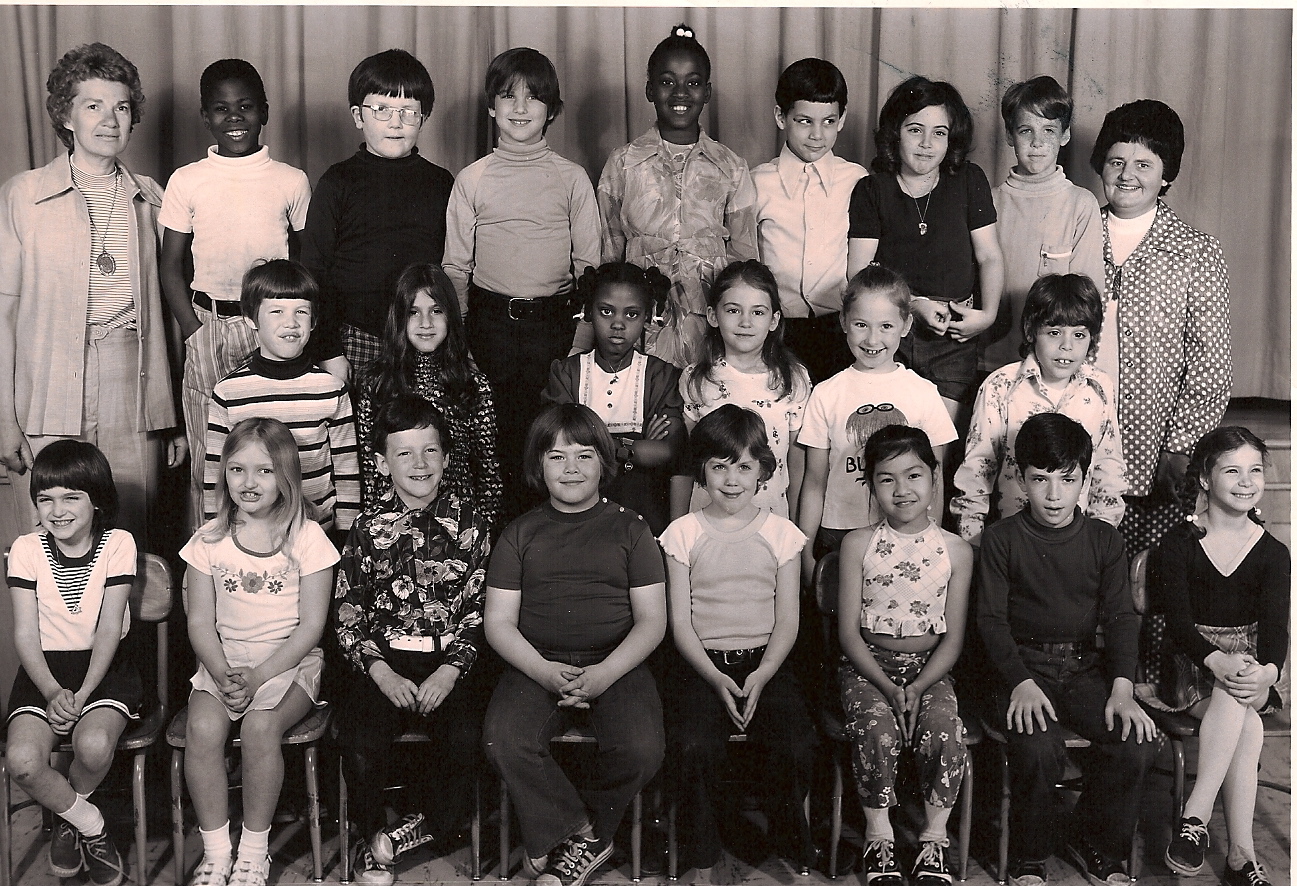
Mrs. Church stands in the far right of the back row.

I loved Mrs. Church, my 2nd grade teacher, from the very first day of school. Among other things, she taught a unit on Hawaii where we made grass skirts and learned songs about “going to a hukilau”: I still know the words. She let us sample real sugar cane and poi, each of us dipping our fingers into the community bowl with our two fingers. Lord knows where she got the stuff. She wore crazy, clunky necklaces that epitomized the 1970s – owls with big eyes, huge butterflies, giant yellow flowers. She wore two-piece, polyester, polka-dotted pantsuits, and her ragged-edged haircut made it appear she did the job herself at home.

Mrs. Church literally had my back, and she rescued me when a certain twit who sat at the desk directly behind me decided that it would be fun to cut my hair with his dull-bladed scissors. She must have read his mind because I barely felt the tug of his hands on the back of my head when she called out, “Mr. So-and-So, you may bring those scissors up to my desk now.”

She encouraged me to write and revise, and – eventually – to enter a writing contest held at our local library the spring of my 2nd grade year. I don’t know if I won or not (probably not), but I remember the way she made me feel: like I could do anything.

Please share a memory of one of your favorite teachers. What did he/she do that makes you remember him/her all these years later?

The prompt was to write about a favorite mentor in under 500 words. I wrote about this when my blog was very new, and I had very few followers. I’d love to honor my old teacher, a woman I think about nearly every day.

Tweet this Twit @rasjacobson