Category Archives: Parenting

Lessons in Losing Things

"boxed in" by massdistraction @flicker.com

I am a pretty organized person. In fact, there was an eight year stint where I worked as a professional organizer and was paid to go into people’s homes and help make systems to create order out of the chaos that surrounded them. And I was really good at it.

Truth be told, I am supremely organized. I used to lie about my house being as neat as it is. It doesn’t look quite as fabulous as the homes in Style Magazine or House Beautiful, you know, where everything has been staged to perfection – the beds heaped with fluffy, organic linens with a thread count of two million and smoothed so they 100% lump-free; every knick-knack is interesting and placed at the proper angle; the glass in the picture frames on the side tables sparkle, and the familes in the frames sparkle too.

It’s not like that here. Things here aren’t perfect; I just know where my stuff is.

Usually.

Except when I don’t. Because that happens sometimes.

One night, around 10 pm, while I was folding laundry and my husband was out enjoying a Jeff Beck concert, my son apparently realized he had lost his book, Pendragon: The Quillan Games, (#7 in the series) somewhere at school. Pendragon is not a book he checked out at school; it is a library book. A thick, hardcover library book. Apparently, he laid there in the dark perseverating. You know, that thing we do that gets us absolutely nowhere except more freaked out? He was running “what if” scenarios over and over in his head, trying to figure out where he might have left his book, even though he thought it was probably in his desk. Alone in his bedroom he was thinking, What if I can’t find the book? What if it’s really gone? What if I left it on the playground? What if the library charges me three times as much as a new copy would cost. What if my parents get really mad at me for losing the book and don’t trust me and won’t let me take out any more library books? (For a voracious reader, that would be a major punishment.)

Apparently, he tortured himself like this for about thirty minutes before he finally exercised the good sense to come downstairs and explain his dilemma.

My child is the responsible type. He doesn’t like to lose things. He doesn’t like to miss deadlines or due dates. The thought is abhorrent to him. I understand this – apples don’t fall from pear trees, right? – so I was glad when I was able to share something with him that a friend of mine helped me with not too long ago with when I was freaking out about something insignificant, that seemed really big at the moment.

I asked my son to sit on the floor beside me, to close his eyes, and listen to my voice. I told him I was going to take him to the worst case scenario: His worst fear.
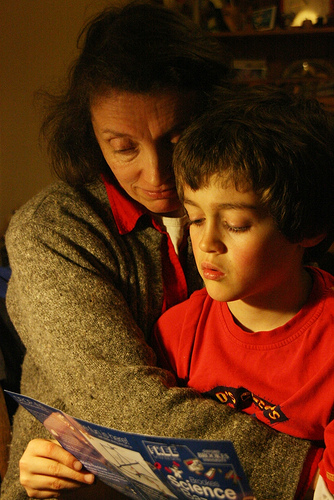
photo of "mother and son" by pcgn@flickr.com

“Are you ready?” I asked.

He nodded.

“The book is, in fact, lost. You will have to pay for the book, maybe even three times the price.” Then I added this part: “But you are okay. You aren’t sick. We are all healthy. You have dad and me. We have a home. We have food and clothes, and we love you like crazy.”

He was calmer. Quieter. It was working. (Plus, he was really tired.) And because he was being quiet, I added, “And just so you know, assuming you live a long time – and I hope you do – you are going to lose stuff. A lot. It happens. I lose things all the time. I write notes to myself on slips of paper and they disappear. I don’t know where they go. I lose bills and receipts. Bottom line is, you have to know that you are going to lose shit, and you have to know it’s not worth losing your mind when you lose something.”

He giggled.

“What?” I asked.

“You said the ‘s-word’.”

Ooops.

Drawing on sage advice from my friend Jennifer Hess and her children’s yoga practice, I asked my son to take a deep breath, take in as much air as he could, and then exhale as if he were blowing out a million candles. At first, he couldn’t do it. He felt stupid, he said. But I insisted that he keep trying. He got it right on the third try.

“That felt good,” he said, calmer now.

Walking upstairs together, he let me hold his hand – something he doesn’t always let me do these days.

I hope he gets it: That adults aren’t perfect. We can strive to be organized and have our perfectly-perfect systems, but nothing is fool-proof or fail-safe. The important thing is to have the perspective to understand that what feels so terribly, awfully, overwhelmingly, miserable at one moment can be dealt with and the awful feeling will pass. Even when it is a big something – the loss of a friendship, a major illness, even death – these things have to be dealt with calmly too. Freaking out doesn’t help.

That night was about a lost book.

That night I counted our blessings.

Afternote: Boy found the book at school the next day. It was rescued just as it was about to be sent back to the public library. All’s well that ends well. He is now well into Pendragon Book #8.


The Perils and Delights of Raw Meat

"Indulgence of the Flesh" by 4T9R @ flickr.com

“You’re not really going to eat that, are you?” a friend asked me just as I was about to bite into a fabulous piece of very, rare filet.

As a little girl, whenever my father would barbeque, he would always let me sneak a few little pieces of meat off the grill long before they were ready to be served. Charred on the outside and raw on the inside; that was the taste of summer.

In the years before microwaves, when mothers had to decide what they were making for dinner by breakfast each morning, my mother would sometimes put out hamburger meat and, if I was lucky, by the time I got home from school, she would have fashioned them into seasoned patties, ready to go into the oven. In super stealth mode, I would sneak into the kitchen to snatch little bits of uncooked burger from the porcelain plate where they waited to be broiled. I think once I actually ate an entire  burger – raw. This was frowned upon by my mother but not seen as dangerous or cause for grave concern.

My immediate family knows I am a carnivore. To this day, I have a taste for raw, red meat, and I totally gross out my husband. People are always telling me that I am going to get E.coli or trichinosis or salmonella or staphylococcus or some other creepy bacteria that I can’t see or smell.

"mince meat" by sinsiwinsi @ flickr.com

I can’t even disagree with the people who tell me this. I know that E. coli 0157:H7 are like super-bacteria and have managed to mutate so that they survive refrigeration and freezer temperatures and, once in food, they can multiply quickly. People delight in telling me I am being stupid and stubborn, and if I would only agree to cooking my meat just a little more, the bacteria would be killed.

I know the FDA recommendations. People tell me I am tempting the food gods. All I can tell you is in a report issued by the Centers for Disease Control and Prevention in 2009, there was a drop in the cases of E. coli 0157 and that it struck “fewer than one case per 100,000 people” and they are clear when they point out that “death is rare.”

Maybe someone should have told my mother 40 years ago that she shouldn’t have left the burgers out at room temperature for more than two hours because, honestly, it was really just delicious. I never got sick. Not even so much as a stomach ache.

People can speak to me about animal cruelty until the cows come home. (Ooh, that is probably a bad choice of words to use here.) And seriously, I am not unsympathetic. I have seen videos of the inhumane ways that cattle have been slaughtered, and it is awful to watch. Truly gruesome. I like to believe the kosher meat that I purchase is prepared a bit more carefully, but I’m not positive that this is the case. For a little while I tried not to eat red meat, but I fell off the wagon with my folk and knife poised over a gorgeous slab of prime rib.

All I know is that I survived my father’s raw steaks, my mother’s raw burgers, piles of steak tartar, 15 years of sushi (some served at restaurants of questionable repute) . . .  and on a tangential yet not completely unrelated note, as I’m sure you can imagine, I absolutely, positively always lick the bowl that held the raw cookie dough. And I’m still here.

I’m still here.

When Should You Give You Child a Cell Phone?

photo by Sheilaz413 @ flickr.com

At what age is it appropriate to give a child a cell phone, and what are the responsibilities and expectations that come along with having one? Do you get the least expensive “pay as you go” plan? Include text? Or go full-blown Internet access?

What are the consequences (if any) if the phone is lost?

Those Crazy Tics (& I’m Not Talking About the Ones That Bite)

Ron Mueck's "boy" photo by Adriaan Bloem @ flickr.com

I know a bunch of 10-12 year old kids who, for whatever reason, have developed these funky, little quirks. One friend’s daughter mashes her teeth together in an oddly rhythmic way: three light taps and a grind-slide that, to my ears, sounds about as delightful as fingernails on the chalkboard. Another friend’s daughter  developed this nervous throat-clearing thing which then morphed into a full-blown frequent cough. For a while, my son was making this bizarre “blooping” sound. I don’t even know how he discovered that he could make such a sound, but he began to do it so suddenly one night that I actually got up to check to see if the kitchen tap was dripping.

Years ago, when my now ultra cool, college-aged nephew was younger, he went through an awkward phase where he grimaced and twitched a little bit, and now I know at least two other 11-year old boys who possess these same twitchy-twitches. One frequently touches his ear; the other prefers to touch his nose.

These kinds of “tensional outlets” (as teachers call them) are not uncommon in children, and I’m told the best thing to do is ignore them, but it can be challenging to let your cougher-twitcher-bruxer live and let live. Truth be told, none of these behaviors seem to bother any of the kids within the peer group. In fact, most of the times,  friends are as oblivious to the tics as the kids with the tics are unaware that they are doing anything that could be perceived as weird or annoying.

For a time, it was thought that these strange little habits were a sign of an anxious child: the nail-biting, the hair-twirling, the teeth clicking, but research has shown that tensional outlets show a patterned progression with change and age. Basic physiological outlets like stomach aches and headaches, and even the more overt outlets such as grimacing and excessive movements involving the whole body that are characteristic of ten, eleven and twelve year-olds become less constant as children age. And of course, most outgrow these little idiosyncrasies completely in due time.

So if your littlun starts up with some strange little behavior, do your best remain calm: he will likely soon outgrow it, and soon find another way to drive you nuts!

In Fear of Lice

I am not a fearful person. I’m not afraid of roaches. I’m not afraid of spiders and have been known to pick them up by their legs and toss them out of the house onto the grass. I’m not afraid of snakes and have enjoyed the cool squeeze of a constrictor as it wrapped around my torso. While I do not like the idea of suffering, I am not afraid of death. I’m not afraid that someone will try to steal my child. I’m not afraid of fire and, once, in a New Orleans restaurant, a waiter whisked away my pretty red candle because I kept pouring hot wax onto my palm (and the fancy tablecloth). I’m not afraid of the dark and have taken long walks on overcast nights when there is no moon or stars. I’m not afraid of thunder and lightning, and while a young’un at Camp Seneca Lake, I used to run outside into torrential downpours with a bottle of shampoo to wash my hair while the sky reverberated and flickered. (I didn’t say I was smart; I just said I wasn’t scared.) There are plenty of other things I’m not afraid of.

I am, however, terrified of lice.

My fear of lice is partially irrational because I have never had them, but I have known many families who have been afflicted, and I am smart enough to know that I never want to meet a dirty, blood-sucking louse. I have heard the tales of woe: how the damn things keep coming back even after people picked-nits and bagged favorite pillows, washed towels and linens, even threw out hair brushes, combs and expensive hair accessories.

I have long, thick, curly hair and it seems like clippers would be inevitable. Like Samson from the Old Testament, I am nothing without my hair, so every time that damn letter comes home saying someone in my child’s class has contracted lice, I feel a little sick inside.

The tiny bugs, no bigger than sesame seeds, spread easily among children who are most likely to come into close head-to-head contact with one another. So while I don’t fall into the “at-risk category,” I do have a 10-year old son who ships out to summer camp each year for three weeks, so I feel my worries aren’t completely unwarranted as someone always comes home with the little buggers.

My good friend has sworn on a bottle of Quell that in the unlikely event I should ever contract lice, she would be my nitpicker. She is a very good friend.

I recently learned that some lice have become resistant to over-the counter remedies. (Be still, my heart!) When that happens, pediatricians sometimes choose to provide prescriptions for heavy-duty pesticides. Although some experts believe exposure in small doses to these chemicals is perfectly safe, these days many parents worry about dumping toxic substances on their children’s heads. (Note: I am not afraid of chemicals.) That said, I just happened to come across a great article about treating lice that talks about using Cetaphil skin cleanser and a hair dryer that “had a 95% success rate when repeated once a week for three weeks.”

So while I am still revolted by the possibility that lice could come into my life, I feel armed with more information and as children head off to summer camps across this great land – perhaps, this cheap and seemingly effective treatment might bring some relief to other moms who live in fear of lice.

Is it just me or is anyone else’s head really itchy?

What Are Your Pet Peeves?

“185” by me and sysop at flickr.com

Clearly, we are fortunate to live in the United States where we have access to clean water and an abundance of food, but sometimes I wonder if we aren’t on the fast track to the fall of Western Civilization. Has the United States become the most “uncivilized, civilized” country?

What are your pet peeves about our collective behavior? The annoying things that you see/experience on a regular basis here at home in the good ole U.S. of A.?

Has “Stranger Danger” Gone Too Far?

photo from Mr. T in DC @ flickr.com

I was in the epicenter of suburbia, standing in a Target store, holding up two bathing suits, and feeling a little indecisive. A little blond-haired girl who couldn’t have been more than 3-years old stood in her bright orange cart while her mother, standing one arm’s length away, sifted furiously through a rack of summer shorts.

“I like the pink one with the flowers,” the girl offered, unsolicited. “It’s pretty.”

“I like that one, too . . .” I said. “But I think I’m going to get the black one.”

Suddenly, the little girl’s mother swooped in, a deranged lioness.

"pink car" by hfb @flickr.com

“We don’t talk to strangers!” the little girl’s mother shouted loud enough for not only her daughter to hear but for everyone in the entire department to hear as well. Clearly, the message was more for me than for anyone else. But instead of smiling politely and wheeling her daughter away to speak with her privately, she made a big ole scene by shouting and pushing the cart (and her little girl) far, far away from (dangerous) me.

Heaven forbid, her daughter and I might have got to talking about shoes.

Okay, I get that there is this weird, American fear about strangers. I don’t seem to have that fear, but I know a lot of people do. That said, 99.99% of the world is composed of strangers, so I have always been of the mindset that one of my many jobs as a mother would include teaching my child about how to respond appropriately to strangers because – let’s face it – sometimes, a person needs to rely on other people. Sometimes even people we don’t know. In her book Free Range Kids: Giving Our Children the Freedom We Had Without Going Nuts with Worry, author Lenore Skenazy points out that Americans watch a lot of  television, and the news is always going on about some child being raped, abducted, or snatched. We hear about how “…this kid went into the bathroom and some guy killed him, and [we] become very scared someone is on the prowl for [our] children” (87). This kind of thinking is crazy-making.

At age 10, my son doesn’t have a cell phone. He can’t call me or text me for immediate rescue. So if, for example, we happen to get separated at the grocery store and he really can’t find me after searching the aisles for a few minutes, he has learned to go to Customer Service – to calmly state that his mother has gotten lost (ha!) and ask for me to be paged. Or, if we are at an outdoor venue, I have taught him to find a mother with children and ask her – this stranger – if she might use her cell phone to call me because we have become separated. He knows not to get into a car with someone he doesn’t know. He knows not accept anything from anyone offering him candy or kittens or balloons or free iPods. He knows not to go anywhere with a stranger asking for help, but instead to reassure that person he is heading home and that he will send help back as soon as he can. He’s known these things since he was small, and he’s actually had to put some of these things into practice.

I guess I’d rather have my kid feel he can trust other human beings. After all, at some point, he will need to know how to interact with people he doesn’t know, why not start early? I also think I have enough faith in humanity to believe that most people are not out to abduct or molest or kill my child.

And really, what did the mother in Target succeed in teaching her daughter by sweeping her away from me so violently? That people are terrifying. That no one can be trusted. That the world is a scary place, and that her daughter is utterly ill-equipped to function in it. She taught her daughter not to speak. That even casual conversation is dangerous. That mother didn’t teach her daughter a thing about safety. She taught her daughter about fear. As far as I’m concerned, she also taught her daughter a big lesson in how to be downright rude to other people.

What could be right about that?

Be Gentle With Your Graduates

photo by pixiesticks23@flickr.com

When I graduated from Hobart & William Smith Colleges in 1989, Professor Lee Quinby made a poignant speech and reminded audience members that another word for graduation is commencement and that commencement means “to enter upon” or “to begin.” She described commencement as a hopeful word, and it is. But she also went on to remind us that whenever there is a beginning, there is also an ending.

I have held onto these words for all these years because they have felt true to me. For example, I understand that when a man marries – while he adores his bride – he may simultaneously long for his bachelor days: the time he used to spend with his friends, unfettered by the responsibilities that come along with being a husband. When a woman gives birth to a child, she is no longer alone; she now must care for the needs of another person. And while she may revel in her child’s newness, she may simultaneously grieve the loss of her independence. When a child moves from one grade to the next, he may be excited about moving to another level of education, but he may be nervous about new expectations. Children may secretly mourn friends they know they will not likely see again; they may become silent and withdrawn or explosive and nervous.

Professor Lee Quinby presenting, recent

Professor Quinby suggested that we consider allowing ourselves to grieve a little bit as commencement can be a scary time, an uncertain place, that middle place where one doesn’t know where one is going yet. We only know where we have been.

My advice to parents during this time of year is an echo of a lesson taught to me by Professor Quinby over 20 years ago: Be gentle with your graduates, whatever their age or grade. Some of them may be feeling a little disconnected – particularly if they will be starting at a new school, separating from old friends, starting a new job, or moving away from everything they have ever known. And while you may not be able to tell it from looking at them, on the inside, they may feel a little bit like lopsided, three-legged tables. Okay . . .  just a little unstable.

George Eliot wrote, “It is never too late to be what you might have been.” So don’t worry if you see your graduates begin to reinvent themselves a little bit over the summer: The rule-following boy who was so kind throughout elementary school, may become a little meaner as he enters middle school; the introverted girl who has always done everything her parents asked may suddenly seriously consider getting her belly button pierced, despite their protests. It’s okay, they are morphing, becoming, and this starting over can make all the difference in the world.

At one time or another, we all want to be someone else. The smart kid. The pretty girl. The cheerleader. The athlete. The guy with the cool car. It’s what children want – and what we grow out of, if we are lucky.

So let them change. Let the star football player put down his shoulder pads and try out for a play, if he wants to. Let the ballerina trade toe-shoes for track shoes; let the drummer try a little yoga. Feed their dreams. Help them discover all the various, untapped parts of themselves. Support them, but don’t rescue them from their jitters as new strengths will come from the discomforts of the middle place. Transition takes time. Give them time.

But for heaven’s sake, don’t baby them. And don’t buy them crap for graduating from kindergarten (“We’re so proud you can finger-paint!”) or elementary school. (Gag.) Instead, give the age-appropriate responsibilities as rewards for their new stage in life.

And trust me when I say that your graduates are going to be fine. Lee Quinby told me so a long time ago and, in my experience, she was right.

What do you remember feeling about graduation?

Tweet this Twit @RASJacobson

What Would You Do?

Your child brings home a handout from school that is riddled with more than quite a few teacher errors (misspellings, grammar etc.).

In fantasies, what would you like to say or do? What do you do in reality?

When Parents Are The Problem

From Maurice Sendak's Where The Wild Things Are

After winning baseball games, our team sponsor – the local Hess station – promised the players free Avalanches, those frozen drinks with the fun (artificial) flavors and colors. One night, my son’s team played particularly well. It had been a hard game, and even my kid made an out and (uncharacteristically) added three points to the scoreboard. Usually, I try to opt out of these kinds of mass-eating-crap-before-dinner kinds of events, but everyone was stoked, so we went.

Before we even left the field, I noticed one heavy-set kid eating a hot dog that his mother had purchased for him from the concession stand. I’m surprised I noticed him except it was hard not to. This kid was going at it, and he put away that hot-dog in three bites. I know this because I watched him: Bite. Chew. Swallow. Bite. Chew. Swallow. Bite. Chew. Swallow. Gone.

photo from horizontal.integration @ flickr.com

Later, at the Hess Station, while the boys were reveling in mixing their (artificially flavored and colored) cherry and cola and blueberry drinks, I saw hot-dog boy again. Only now he had a 64-ounce Avalanche in his left hand and not one, but two extra large Snickers bars in his right hand. At that point, I heard hot-dog boy say (actually, it was more like a loud whine), “I’m still hungry! Can we go across the street and get a hot dog?’ (I thought Snickers were supposed to “really satisfy you.”)

Hot-dog boy’s parents tried (briefly) to reason with their son, to no avail. He begged, he pleaded. He got louder, insisting on how hungry he was. In fact, he was not just hungry, he was starving. The word “no” was clearly not in their lexicon, and hot-dog boy and his parents were last seen walking across the street, presumably to get another hot-dog from the fast food joint across the way.

I’ve been thinking about this whole scenario for a while now. And I’ve been trying really hard not to be judgmental. In fact, I’ve been thinking of a million reasons to justify the allowances they made for their more than a little husky son.

I’m thinking, maybe they didn’t want to make a scene, so they just went along, that they don’t usually behave like this – these parents – but this one time, this one day, they were tired. Maybe they didn’t have food in the house, so they shrugged their shoulders and gave in. I mean, we did, right? Usually, hubby and I take our son straight home after baseball games, but on that day, we said, let’s go buy crap and celebrate with everyone.

I wondered if it was a full-time working parent “thing”: I have seen that many times before, the guilt some parents seem to have in saying no to their children. They don’t want to be the heavies. On weekends, they want to have fun, not discipline.

I considered that maybe the parents liked keeping their kid stuffed. When his mouth was full, he was quiet. He wasn’t loud or obnoxious or demanding, so why not cork him up with some candy or gum or a hot-dog and get a little peace of mind. Truthfully, I don’t know the deal, and it doesn’t matter.

My husband and I have a guiding principle: our child is here to augment our lives, not control us. Granted, it’s easy to have this guiding principle when you have only one child. We have him outnumbered; he can never beat us.

I know others do not share our adult-centered worldview, and I see variations of this “child-running-the-show” theme all the time. I see kids screaming at their parents in the mall, demanding expensive name-brand clothing, shoes and accessories. These kids relentlessly work their parents, generally declaring they won’t be “cool” or have social lives if they don’t have the “right” clothes or purse or game system or cellphone. And that’s okay. That’s what kids do. They cry. They get dramatic. They stomp around. What surprises me is when the parents of these children-behaving-badly cave in to their children’s demands, thus passively accepting their children’s disrespect and assuring a repeat performance in the future.

When I witness these uncomfortable public displays, I often picture myself, a spectator at some weird circus. I can’t help but imagine the child standing center-ring in an over-sized red jacket, black chaps and tall boots acting as a ringmaster. The child is always holding a whip and a microphone. This child is a performer in a well-rehearsed routine. At the same time, I imagine the parents as white fluffy dogs, standing on their scrappy hind legs, being told to wait and then jump and run in a circle. It is a pretty pathetic show.

image by id-iom at flickr.com

You can be sure that as a kid, I asked my parents for all kinds of stuff. And guess what. They generally said no. No, you can’t have a pony. No, you can’t have those jeans. No, you can’t see that movie. No, you can’t sleep at your friend’s house on a school night. No, you can’t eat dessert before dinner. I heard a lot of “no’s” while growing up. I don’t hear too many no’s these days.

What I saw that night at the Hess station was a child masterfully controlling his parents. He knew how to do it. He’d clearly done it before. He knew just how long and how hard to push, and he knew his parents would ultimately jump. He was the ringmaster. Ick. What adult wants to be controlled by his children? It’s our kids’ jobs to push against the boundaries we set (which feel imposed and unfair to them), but it’s our job to remind our children where the boundaries are and to police the borders. To push the kids back, to remind them to be civilized, and to offer consequences to them when they have overstepped, to say no.

Why is it so hard for so many parents to say no?