Tag Archives: @RASJacobson

So About That Sign

Wegmans Food Markets

Image via Wikipedia

Yesterday at 7 am, I posted a blog about a sign in my local grocery store that has been driving me bonkers for years.

By late morning, I received an email from a representative from Consumer Affairs.

While the rest of us were chattering about the sign and its grammar, one of my loyal readers — a former Wegmans’ employee — made a call, and the sign was promptly removed.

Last night at 8:25 pm, another loyal reader sent me this picture — along with an apology about the quality. She explained she was operating in stealth mode. 😀

The new & improved sign!

I felt I had to let everyone know the happy ending to this very big news story.

Mary Joan from Consumer Affairs wrote:

Bob Farr was more than happy to take down that offensive sign. And I have to tell you that reading your blog . . .  and the subsequent comments from your readers was quite enjoyable.  You made my morning!

Further proof that Wegmans positively rocks: Here is a company that received a little constructive criticism, and instead of getting defensive (typical) or just brushing it off and ignoring it (also typical), they got proactive, making this English teacher, blogger, and loyal customer soooooo happy.

So the new sign is up.

All grammatical errors have been corrected.

Wouldn’t it be nice if everything in the world could be fixed so quickly?

I’m feeling empowered. Positively zippy.

So what should I take on today? I’m taking ideas.

Lessons From Nan, Who Passed On June 16, 2004

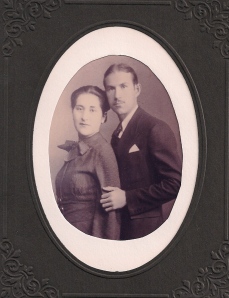
Nan (Tilly Epstein) & Pop (Irving Schuls)

My grandmother’s name was Tilly. As a child, I wrote her name on envelopes and birthday cards and doodled it on pictures. I never questioned the authenticity of my grandmother’s name because no one had ever said anything about it. And frankly, her name didn’t much matter to me because I called my grandmother Nanny, or sometimes Nan for short.

In 6th grade, my social studies class did a genealogy project, and I sat down with Nan to ask her about her siblings, about her childhood, about her memories, how she met my Pop – all kinds of questions. It was during this interview that Nan told me that her name wasn’t really “Tilly.” She informed me that her real name was Telia, which she thought was a pretty name, but that no one had ever called her by that name so she just went by Tilly, the nickname that was given to her by her parents and siblings. To me, this story is emblematic of the grandmother I knew all my life.

Nan didn’t complain. She didn’t pick fights or confront. She didn’t sweat the small stuff. Unless someone had really wronged her (or flirted with Pop), in general, Nan just kind of accepted things. She found in my grandfather a soulmate and, while they would never be rich in dollars, she was satisfied to be rich in love.

When we four grandchildren were young, we would run down to Nan and Pop’s apartment after a lazy day of swimming in the pool located in the middle of their apartment complex and demand drinks and snacks and candy and cartoons. Nan always opened the door with a smile, ushered us in, and quietly delivered the goods. When her french-fried potatoes became our summertime obsession, she dutifully peeled and sliced and fried those potatoes to golden perfection – sometimes in a very hot apartment – and we would devour them hungrily, asking for seconds and thirds and sometimes probably even forgetting to thank her for her efforts.

Nan never asked for thanks or looked for recognition. And while some people spend their lives dissatisfied or longing for things they do not have, Nan truly had the ability to appreciate life’s simple gifts: the gift of good health and the gift of a loving family.

Nan was intimately connected to her family. She somehow managed to keep both of her children close to her. While she never learned to drive, Nan always found a way to get what she needed. She was resourceful. Nan was not cocky, but she was proud: proud, first, of her children, then her grandchildren and, finally, proud of her great-grandchildren.

While moving Nan’s belongings into a nursing home, I was amazed to find a small wicker basket filled with hundreds of scraps of papers inside of it. Each scrap bore an address of someone Nan had cared about. At the very bottom, there was a calling card bearing the address of the house she and Pop had lived in on Ranier Avenue, a street lost long ago. She had kept my various college and graduate school addresses, though I hadn’t lived in any of those places for decades. She had my brother’s addresses in Ithaca, NY and Charleston, South Carolina, my cousins’ addresses at Oneonta, and other names I didn’t know attached to addresses I didn’t recognize – little scraps of paper with numbers and letters representing much more to Nan.

Nan was home-loving and intensely private. She was unobtrusive, but involved. A tiny woman, who seemed to grow shorter each year, Nan was truly a matriarch. When her husband, my Pop, died in 1990, Nan swore she’d never leave her apartment again: never return to the Jewish Community Center, or to shul, or to the grocery store – but eventually, she did all of these things. Though she appeared frail, she was strong and – when feeling good – had a hearty appetite that never ceased to amaze us. And, even in the end, when she suffered a broken pelvis and arthritis and weakening knees, she went to physical therapy and strove to walk independently. Nan possessed an inner fortitude that is indicative of a great strength.

I will always remember Nan, wearing a snazzy pair of purple pants, sitting on the gold couch in my parents’ living room. Just sitting quietly, patiently, watching my brother and me as we made up games or put on little shows. Many years later, she would sit in the same place, dozing off and on, awaking with an almost apologetic smile.

Agatha Christie once said, “I like living. I have sometimes been wildly, despairingly, acutely miserable . . . but through it all, I know quite certainly that just to be alive is a grand thing.” I believe Nan knew this, too.

Seven years and six months later, I still think about her.

Who do you miss and what did they teach you?

Lessons From A Boy In a Skirt

photo from MC Quinn @ flickr.com

Several years back, on the first day of the semester, a student walked into my classroom. A boy, clearly, a male — wearing a long pink skirt, his hair tied in a low pony-tail. When I read the roster and got to his name, he corrected me and told me that his name was Sophia.

I quickly noted the change.

When I met Sophia, she wanted gender reassignment surgery. She wished for it, but knew it would be a long road. As gender reassignment is an irreversible procedure, two letters of therapy clearance would be required. She explained one therapist (psychologist, psychiatrist, social worker, sexologist) would be required to have a doctoral degree, and one of the two therapists would have to know her for an extended period of time. When I met Sophia, she was simply trying to change the name on her birth certificate and running into all kinds of roadblocks. A ward of the State from age 15, if memory serves, Sophia was an emancipated minor living with distant relatives. She had no car, took the bus to campus, and had no expendable money for one therapist, let alone two with the kind of credentials that she would need to put her on the path towards gender reassignment.

That semester, Sophia was distracted. It was hard for her to get to class on-time. Hard for her to make deadlines. Hard for her to deal with the stares and (I imagine) comments in the hallways. A talented writer, Sophia was exhausted at age 19. And I wanted to help her. Eventually, Sophia stopped coming to class. I had lost her.

In June 2009, I read that the person once known as Chastity Bono, the precious little blond-haired daughter of Sonny and Cher who often made appearances at the end of their shows, would henceforth be referred to as Chaz Bono. At age 40, Chaz Bono went public that he was undergoing gender reassignment surgery, and I read the surgery had been completed in May 2010. Of course, I thought of Sophia.

I cannot imagine what it must feel like to be a person stuck in the wrong-gender body.

I am English teacher. I am supposed to teach my students how to improve their writing skills; how to properly use their commas; how to understand and compose for different audiences and recognize the varying modes of discourse. But writing teachers also get to read their students’ words. And I got to read hers.

So while I don’t know where Sophia landed, I still hope she is okay. That she feels good about herself. That she saw the article about Chaz Bono and feels hopeful about her future. And I hope she doesn’t have to wait until her 40th birthday to get the surgery she wants.

tweet me @rasjacobson

Are You Proud of Your Sweet Little Bully?

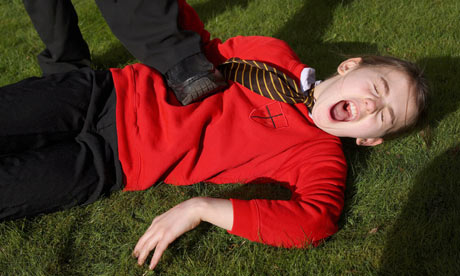
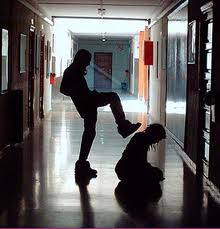
Recently I read one of the most amazing (and terrifying) blog entries called “Memories of a Bullied Kid,” on bullying from single dad laughing, a man who reflects back on a time in his life where he says he was systematically terrorized for years – but that he never said anything to anyone – except once. And he went further to report that when he reported the bullying, things got worse for him. Afterwards, he remained silent and endured the torture for over a decade. With so many students killing themselves these days, it amazes me that he is alive to tell the tale.

In the all the bullying literature that is out there, there is one piece of the puzzle that hasn’t been particularly well documented, and so I’m putting out there. Guess what? Sometimes parents of bullies are proud that their children are bullies. I have heard parents admit they would rather have their children be the ones “standing up for themselves” than the ones being bullied: that they have actually encouraged their children to get physical first, so that they are never made targets themselves. For me, this is the ugliest, darkest side to parenting.

Having been a teacher for 20 years now, and a parent for 11, I see that there is precious little time for elementary school to get to know each other at school. I know this because at the end of their 5th grade year, my son (and one friend) could not identify several of the children in their own class.

“I don’t know his name,” my son admitted.

His friend, who happened to be over that day shrugged: “Me either.”

It was unbelievable to me that my child and his friend could spend an entire year with the same people day in and day out and not know everyone’s first and last names, perhaps some tidbit of personal information.

I guess the sense of community has fallen out of the curriculum. Children are no longer taught to be good citizens, the ethics of being good people. The game is all about getting ahead, getting into the best schools — and kids learn early on that they may need to stomp on a few folks to get there. And I am sad to report that many parents encourage this type of aggressive, mean-spirited competition in athletics and academics. And meanwhile everyone is surprised that bullying in on this rise? Shocked when there is another incident reported, this time more gruesome than the last?

I never thought about college until 11th grade. Now, parents discuss college with their 1st graders. That’s a lot of pressure to put on children. When adults are stressed, they can go for a run, swim a few laps, take a yoga class. Well, kids get stressed out, too.  But sometimes their stress comes out less constructively. So if you don’t even know all the kids in your class . . . well, why not pick on her? She’s weird. Or him? He’s quiet. Or, if you are really sneaky, get someone else to do it for you?

Once learning their children have been acting as bullies, I’m always amazed at how unapologetic parents are. When I hear of kids who have been bullied and that some type of administrative action has taken place – even suspensions – where the school has agreed a particular child had overstepped too many times with too many kids – I am always shocked that part of the restitution never includes a written apology from the bully. No-one ever makes the offending kid write a note to the person he has been kicking around.

If my child intentionally (or unintentionally) hurt someone, he’d either be over at that kid’s house apologizing in person or he’d be writing letters: to the kid he hurt, to the principal (indicating that he understood the infraction), to the parents of the bullied child explicating in essay form precisely what type of punishment(s) he would be receiving at home that would befit his behavior at school.

Apparently, most parents spend more time worrying about their child getting bullied than about their child being a bully. As a result, when they find out their child is bullying others, it takes them by surprise and they don’t know how to handle it.

What would you do if you found out your child was a bully? How would that conversation go? Would you be proud or horrified?

The Problem With Mirows

Photo by Joseph Rodriguez

When hubby and I lived in New Orleans, we kind of came to accept that conventional spelling and pronunciation were often disregarded.

When it came time for us to move north of the Mason-Dixon Line, we hired a few packers to help us with the job. They were nice gentlemen. Plump and toothless, Juno and Orly toiled tirelessly in the June heat to help us prepare for our move, and we appreciated their assistance.

When our moving van arrived in New York State, we were excited to unpack. Eventually came across one strangely enormous bundle labeled “mirows,” that had us stumped.

What the hell is a “mirows?” I wondered.

“I don’t remember buying a ‘meer-rows,'” hubby said as we unwrapped and unwrapped and unwrapped the mounds of bubble-wrap that Juno and Orly had painstakingly taped together in our old apartment several weeks prior.

Bubble-wrap followed by puffy, white foam and packaging tape followed by another layer of bubble-wrap, puffy foam and more tape. It was like peeling an onion. Juno and Orly had put a lot of care into wrapping up the mee-rows (?), but the tape had melted and fused with the plastic bubble-wrap, so we had to be careful because we really didn’t want to hurt our my-rose (?). We plowed away, but the bundle of mire-ohs (?) never seemed to get smaller.

“How many licks does it take to get to the center of a Tootsie Roll Pop?” Hubby joked, referring to a commercial from our youth in which a child questions a turtle and an owl about how long it would take to get to the Tootsie Roll Pop hidden inside the hard candy shell, if one could restrain oneself from biting.

“The world may never know,” I mimicked my best impression of the commercial’s deep voiced omniscient narrator.

Finally, we figured out what was in the package when we heard the pitiful sound of glass shattering: our two, formerly fabulous, incredibly ornate, big-ass mirrors were history.

I wish I had asked Juno and Orly about dem mirows.

Cuz they is gone.

I sho’ do miss N’awlins.

Where have you traveled where you’ve loved the dialect?

To Read or To Unplug?

photo from evelynishere @ flickr.com

Do you let your kids completely unplug over the summer, or do you keep them reading?

If they are reading, what books are they enjoying? Please include the age and gender of your child/ren.

And for even more fun, tell me what books you enjoyed reading as a kid and what you remember liking about them.

So what books do your kids love? Are they the same ones you loved? Or is everybody taking the summer off?

Kids and Guns

"Locked & Loaded" by Phae at flickr.com

With which are you more comfortable and why?

Your 11-year old child having a Facebook account? (Note: According to Facebook policy: “In order to be eligible to sign up for Facebook, users must be thirteen (13) years of age or older.) Or that same 11-year old owning and using an air-soft gun?

Do you find the question ridiculous? Do these things concern you at all?

Post Vay-Cay Gratitude

Colorado River Ride

Having just returned from a fabulous, week-long Tauck-Bridges Tour that started in Phoenix, Arizona, moved through a few of our country’s National Parks, and ended in Las Vegas, Nevada I am finding re-entry into everyday life a little rough as we were so very pampered. Where is my breakfast menu? You mean I have to start cooking again? Sigh. But now that the six loads of laundry are behind me, and I have a fully stocked refrigerator, I would like to take a moment to express a little gratitude because it is easy to get sucked back into the daily grind and forget how wonderful it was just 36 hours ago.

Here goes. Thank you to:

  1. AT&T: For your miserable coverage, which reminded me that I did, in fact, live without a Smart Phone until last December. Had my phone been working, I would not have been able to plug in to my family as fully as I did. Together, we swam, hiked, played chess, read books and chattered away. Not being plugged into technology also afforded me the opportunity to meet everyone on our tour. Yeah, I worked the bus.
  2. Suitcases with Good Zippers: I didn’t believe it was possible at the packing stage, but we were able to live completely comfortably – with everything we needed – for 8 full days – out of 3 medium-sized suitcases. And I still managed to bring 4 pairs of shoes and my favorite pair of cowboy boots. How can you go west without ‘em?
  3. The Grand Canyon: For reminding me how small I am. (Because sometimes I forget.)
  4. Horses & Mules:For being sure-footed where I would surely have fallen. Also for 2 hours of happy-happy, joy-joy bliss.

    Riding in Bryce Canyon

  5. Sunshine: For confirming what I had already suspected: that I am an exothermic lizard-girl who gets happier and happier the drier and hotter it gets. Thank you, sunshine, for showing up every morning around 4:30 am and sticking around – hot on my face – until around 7:30 pm. (Husband would like me to take a moment to thank Neutrogena sunscreen here.)

    Me, doing yoga on a very skinny ledge

  6. Headlamps: So that when day was done and sunset descended into the canyons so completely, we could still see the deer and fox around us. And when we turned them off, we could hear frogs and owls and bats.
  7. Children: Who despite their varied ages all managed to find something wonderful to appreciate about each other and enjoy the time they spent swimming, hiking, catching tadpoles, playing football, rooting on a park ranger as he wrastled a rattlesnake, even just hanging out together on the bus.
  8. Good guides: Thank you Southwest pilots for your sense of humor when the roller-coaster turbulence complete with big dips and swells was not appreciated by everyone. Thank you to William, our motor coach driver, for allowing my husband to truly relax and not have to fuss with maps or GPS systems or reservations (which, in turn, allowed me to completely relax because you know we might have killed each other if we were driving together, getting lost together, for 8 days). With William at the wheel, hubby’s most basic needs were met: he had a bottle of water every day; a rotating but reserved seat; he was able to tune into conversation when he wanted, tune out when he had had enough; and he could nap whenever he wanted, knowing we were still moving toward a destination. He never had to worry about checking in, checking out, dragging a bag, checking to make sure our flight was on time, or arranging for transfer to or from the airport; all of this was handled by our tour company. Thank you to Justin, our riverboat guide, who encouraged us to soak our feet in the Colorado River to understand what 47 degrees feels like. (Note: It’s damn cold.). Thank you Julie, our Tauck-Bridges guide, who worked her butt off to make sure the needs of 40 people were met. That woman managed to land us a king-sized bed and roll-away cot combo in the most remote of places. And thank you to Ver, our more than slightly abrasive Navajo guide who, at the time, pissed me off by snatching the camera out of my hands and screwing around with all the presets – but managed to capture one of the best photographs of the entire trip.

    In Anelope Slot Canyon, Page, AZ

  9. The Navajo Nation: Though skeptical when we met in a rundown gas station parking lot in Page, Arizona. The trip to Antelope Slot Canyon was truly a treat, and we never would have found that skinny little hidden canyon where the sun shone through the cracks and made purple and yellow and orange. Thank you for opening your land to us. I truly feel blessed to have been able to be there.
  10. Bryce National Park: For making me feel like I was on another planet, like there are a million other places on this big blue marble we call Earth that are filled with that kind of magic.
  11. The Strip in Las Vegas, Nevada: For reminding me that everything is better in moderation. That the 2-foot hot dog is a better idea than a reality; that sometimes it’s hard to tell by the height of a woman’s shoes if she is being stylish or if she is a prostitute; that I am not a drinker, a smoker, or a gambler and I prefer living in a place with windows and far fewer bells and whistles; that the shtick, the glitz, the glam – enjoyable as it is – is fake and after you’ve seen the MGM lions and ridden the roller coaster at New York, New York, and seen the fountain at the Bellagio and been to a show, there’s still no place like home.
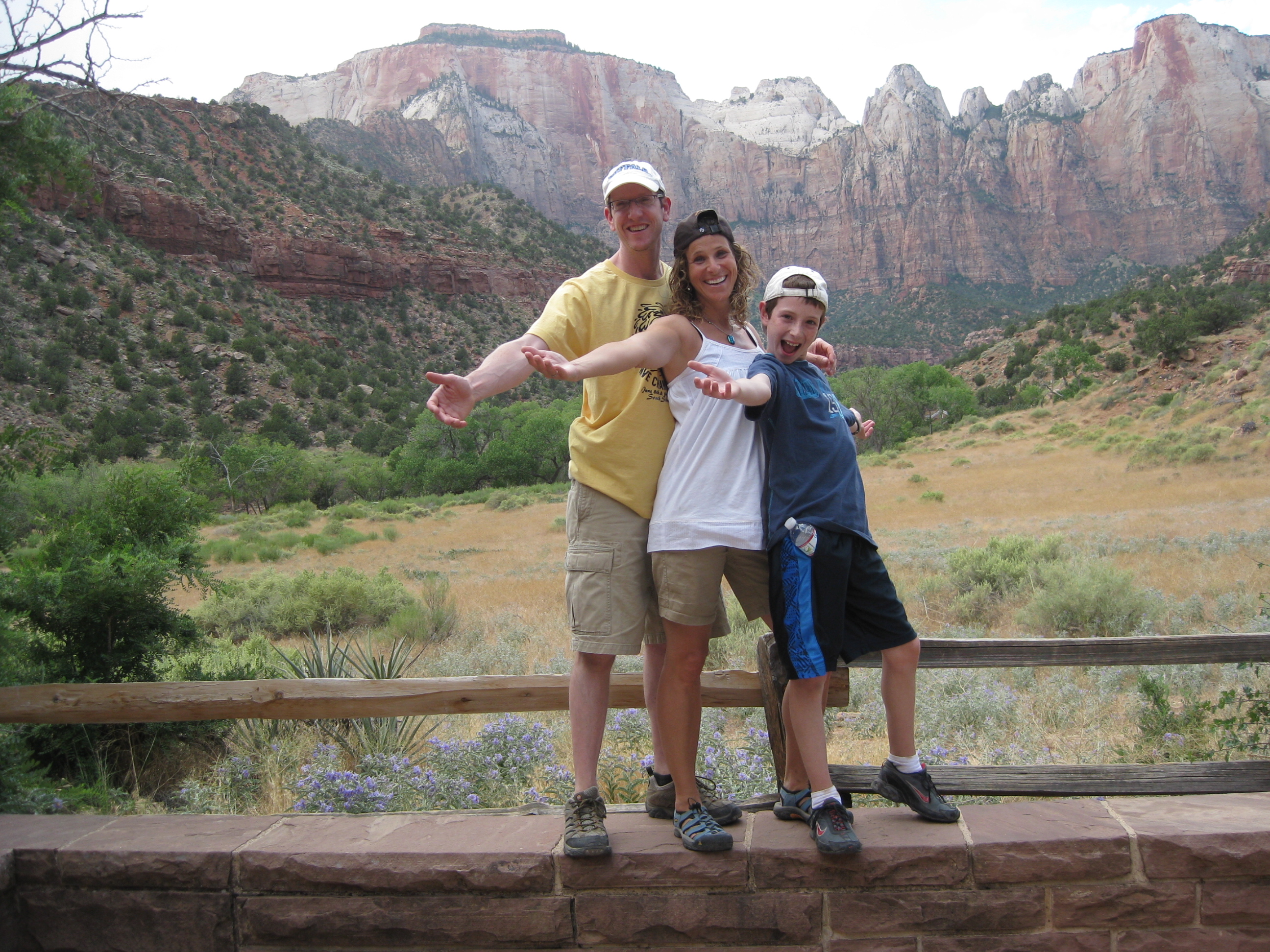
  12. Family: That I am blessed to have one as good as I do. Because I am. Thank you for taking the trip that I have always wanted to take.

    My family at Zion National Park

Lessons in Losing Things

"boxed in" by massdistraction @flicker.com

I am a pretty organized person. In fact, there was an eight year stint where I worked as a professional organizer and was paid to go into people’s homes and help make systems to create order out of the chaos that surrounded them. And I was really good at it.

Truth be told, I am supremely organized. I used to lie about my house being as neat as it is. It doesn’t look quite as fabulous as the homes in Style Magazine or House Beautiful, you know, where everything has been staged to perfection – the beds heaped with fluffy, organic linens with a thread count of two million and smoothed so they 100% lump-free; every knick-knack is interesting and placed at the proper angle; the glass in the picture frames on the side tables sparkle, and the familes in the frames sparkle too.

It’s not like that here. Things here aren’t perfect; I just know where my stuff is.

Usually.

Except when I don’t. Because that happens sometimes.

One night, around 10 pm, while I was folding laundry and my husband was out enjoying a Jeff Beck concert, my son apparently realized he had lost his book, Pendragon: The Quillan Games, (#7 in the series) somewhere at school. Pendragon is not a book he checked out at school; it is a library book. A thick, hardcover library book. Apparently, he laid there in the dark perseverating. You know, that thing we do that gets us absolutely nowhere except more freaked out? He was running “what if” scenarios over and over in his head, trying to figure out where he might have left his book, even though he thought it was probably in his desk. Alone in his bedroom he was thinking, What if I can’t find the book? What if it’s really gone? What if I left it on the playground? What if the library charges me three times as much as a new copy would cost. What if my parents get really mad at me for losing the book and don’t trust me and won’t let me take out any more library books? (For a voracious reader, that would be a major punishment.)

Apparently, he tortured himself like this for about thirty minutes before he finally exercised the good sense to come downstairs and explain his dilemma.

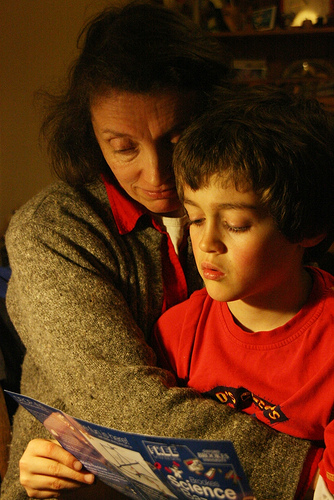
My child is the responsible type. He doesn’t like to lose things. He doesn’t like to miss deadlines or due dates. The thought is abhorrent to him. I understand this – apples don’t fall from pear trees, right? – so I was glad when I was able to share something with him that a friend of mine helped me with not too long ago with when I was freaking out about something insignificant, that seemed really big at the moment.

I asked my son to sit on the floor beside me, to close his eyes, and listen to my voice. I told him I was going to take him to the worst case scenario: His worst fear.

photo of "mother and son" by pcgn@flickr.com

“Are you ready?” I asked.

He nodded.

“The book is, in fact, lost. You will have to pay for the book, maybe even three times the price.” Then I added this part: “But you are okay. You aren’t sick. We are all healthy. You have dad and me. We have a home. We have food and clothes, and we love you like crazy.”

He was calmer. Quieter. It was working. (Plus, he was really tired.) And because he was being quiet, I added, “And just so you know, assuming you live a long time – and I hope you do – you are going to lose stuff. A lot. It happens. I lose things all the time. I write notes to myself on slips of paper and they disappear. I don’t know where they go. I lose bills and receipts. Bottom line is, you have to know that you are going to lose shit, and you have to know it’s not worth losing your mind when you lose something.”

He giggled.

“What?” I asked.

“You said the ‘s-word’.”

Ooops.

Drawing on sage advice from my friend Jennifer Hess and her children’s yoga practice, I asked my son to take a deep breath, take in as much air as he could, and then exhale as if he were blowing out a million candles. At first, he couldn’t do it. He felt stupid, he said. But I insisted that he keep trying. He got it right on the third try.

“That felt good,” he said, calmer now.

Walking upstairs together, he let me hold his hand – something he doesn’t always let me do these days.

I hope he gets it: That adults aren’t perfect. We can strive to be organized and have our perfectly-perfect systems, but nothing is fool-proof or fail-safe. The important thing is to have the perspective to understand that what feels so terribly, awfully, overwhelmingly, miserable at one moment can be dealt with and the awful feeling will pass. Even when it is a big something – the loss of a friendship, a major illness, even death – these things have to be dealt with calmly too. Freaking out doesn’t help.

That night was about a lost book.

That night I counted our blessings.

Afternote: Boy found the book at school the next day. It was rescued just as it was about to be sent back to the public library. All’s well that ends well. He is now well into Pendragon Book #8.

When Should You Give You Child a Cell Phone?

photo by Sheilaz413 @ flickr.com

At what age is it appropriate to give a child a cell phone, and what are the responsibilities and expectations that come along with having one? Do you get the least expensive “pay as you go” plan? Include text? Or go full-blown Internet access?

What are the consequences (if any) if the phone is lost?