Image by slurv via Flickr -- NOTE: This is not a picture of my tattoo. This is gorgeous!
It was out of character for me, but I showed up without a plan.
Just a little scribble on a scrap of paper.
I asked a few million questions about the needles.
“Lady,” said the man at the counter, “we ain’t interested in spreadin’ diseases.”
Jed, the newest apprentice, was available.
I agreed. Jed would be fine.
What did I know?
I wanted a tattoo.
So I dropped my pants and allowed a stranger to drag needles across my skin.
As I laid on the table, I listened to the rain that pummeled the tin roof over our heads.
And through the open door, I watched the rain sweep cigarette butts into the sewer.
Any other day, I would have been sitting cross-legged on the futon in my apartment grading student papers. Lying there, I was grateful I didn’t have a dog that needed to be let out at any particular time. I remembered how – before I was a teacher, a role model — I liked a little spontaneity.
Eventually, Jed finished.
I couldn’t wait to see it.
I had shown Jed that initial sketch, but he had taken some liberties.
And he left me with a permanent lopsided heart.
I paid seventy-five dollars in cash for my little act of rebellion.
Initially, I was annoyed by its wrongness.
But I quickly grew to love it.
And twenty years later, each time I look at my tattoo (that has become even more crooked over time), I remember a lazy day in New Orleans. An in-between time, when I was neither wife nor mother but dangerously free.
My tattoo reminds me of a place I love fiercely. It reminds me how love without patience and care can become unbalanced. Most of all, my tattoo reminds this Type A control-freak that when a person acts impulsively, sometimes the results can be pleasantly imperfect.
What do you think about tattoos? Art or self-mutilation?
• • •
I so rarely have time to do the fabulous prompts from Red Writing Hood, but this week, it spoke to me. The assignment: Write a piece in which a tattoo figures prominently in 300 words.
After my post went up at I Survived The Mean Girls, I learned that Anderson Cooper had run a television special devoted to bullying awareness and prevention called Bullying: It Stops Here.
The special aired from Rutgers University about one year after freshman Tyler Clementi’s suicide. Clementi killed himself by jumping off the George Washington Bridge after a recording of him having a sexual encounter with another man was posted online.
Cooper has been a strong opponent of bullying. He has spent a lot of time on his show and on other programs speaking out about the suicides among young men and women that were done in response to years of being bullied.
If you can, watch all four parts of Cooper’s video clips below.
Watch with your kids.
Cooper asks students to take a pledge to speak out against bullying.
Because studies show that if even one person speaks up and points out the behavior, bullies are likely to stop doing what they are doing.
All it takes is one person to say, “Whoa, what are you doing?!” or “Hey, that’s really mean!”
As usual, it is silence that is deadly.
And cyber-bullying is a disaster.
Because once words and images go viral, there is no escape for the target.
Only torment and embarrassment and shame.
It’s time to stop using our technology to hurt.
How do we teach our children to stand up against the bullies? How do we get them to risk everything to protect someone else? How do we get them to make better choices? How do we move toward civility and tolerance?
If you have a child who has been bullied, or a child who is complaining about feeling like a bystander (which is how many of us feel during our middle and high school years), please check out I Survived The Mean Girls, which offers a supportive community for people who have been bullied or who have witnessed bullying.
Kelly’s other blog, I Survived the Mean Girls, is a site for individuals who feel bullied and alone to see many have been there, survived it, and that it is possible to be stronger because of it. Guest submissions make that site work, so if you are interested in writing something for Kelly K. please contact her. You can also follow that blog at @OstracizedTeens.
In real life, Kelly K. has been beyond helpful to me. When I had my meltdown, Kelly K. was there. She is an amazing “fryber” (my made-up word for a cyber-friend) and a fearless writer devoted to expressing herself in as many ways as possible. Her twitter handle is @danceswithchaos. Feel free to subscribe to all her blogs and follow her. I know I do.
• • • Buzz Champion
Knots twisted my stomach as I stood in front of the class. All eyes focused forward.
“Five.” I stared at him, blocking out the rest of my fourth grade class.
“Six.”
“Buzz.” I grinned. I knew better than to fail this early.
He smiled back. “Eight.”
“Nine.”
“Ten.”
“Buzz.” I smiled again.
“Twelve.”
“Thirteen.”
“Buzz.”
Of course, he wouldn’t freeze on the first one. “Fifteen.”
“Sixteen.”
“Buzz.” Would today be the day I finally triumphed?
“Eighteen.”
My palms grew sweaty again, just like several minutes earlier when I’d faced the last classmate standing – finally taking him down to win the title for our class: Buzz Champion.
The numbers climbed and our pace slowed. On each turn, I frantically ran through the lists of Buzz numbers: multiples of seven, numbers with seven in it, matching double digits like fifty-five.
“Eighty-five?” My answers became hesitant, my knowledge of anything past seven times twelve no longer committed to memory.
“Eighty-six.”
“Buzz.” What was the next multiple of seven?
“Buzz.”
What number were we on now? “Eighty-nine?”
“Ninety.”
“Ninety-one…”
He smiled but didn’t speak and I knew.
I had failed. Again.
Mr. Wicks turned and shook my hand. “Congratulations, Kelly.”
He clapped his hands, directing his applause at me.
The class joined in.
I turned to face them, spying looks of awe for battling so high.
I smiled.
I’d get him next time.
• • •
I never beat Mr. Wicks in Buzz, but I did manage to last past one hundred a few times.
I was undefeated in my class for the year.
Mr. Wicks was unique. He was fun and engaging.
He played games like Buzz to make multiplication interesting.
He made you want to please him.
Mr. Wicks saw I thrived on a challenge, and he gave it to me. He never let me win. He wore his pride in my attempts as though I had won.
I was only ten years old, but mourned for the class behind me, because he left our school to become vice-principal at another.
I mourned for all students, because he wouldn’t teach anymore.
As I learned his fate and we turned in our textbooks, he pulled the piece of paper off the wall where it had hung all year long, accumulating names.
“You won more than anyone else. Would you like to keep this, Kelly?”
I reached for the paper, donning a proud smile at how often my name appeared. “Yes.”
I still have it today.
And every time I look at it I grin, remembering the little girl who believed she could defeat her teacher at Buzz.
And I want to thank him.
Buzz Champion -- 1987
In which subject did you kick butt while you were in school? Do you have any weird old elementary school mementos that you keep around?
• • •
If you have writing chops and are interested in submitting a teacher memory, write about one teacher you had and explain how that person helped you (or really screwed things up for you), as well as the life lesson you took away from the interaction.
When I was a little girl, a Sunday School teacher told me that on Rosh Hashanah, G-d opened a big book that had everyone’s names in it, young and old.
My teacher explained how, each year, between Rosh Hashanah and Yom Kippur, G-d decided who would live and who would die in the upcoming year. And how. By fire or by water; by plague or by earthquake. The list went on forever.
I remember imagining a really old, wrinkled guy in white robes sitting at a silver desk perched on top of clouds. In his smooth, shaky hand, he held a gold pen that he used to cross-out people’s names.
On The High Holy Days, I dressed in the fancy clothes that my mother had laid out for me and sat in temple all day with my family.
And as the adults chanted words in English and Hebrew, I played nervously with the knots on my father’s prayer shawl.
And I looked around and wondered who was not going to be there the next year.
Because it was a pretty scary idea: that G-d was making decisions all the time based on how we behaved.
(‘Cuz I wasn’t always the best little girl.)
But there was a lot more to that prayer: a part that I didn’t figure out until years later.
The prayer reads:
But Repentance, Prayer, and Charity avert the severe Decree! This is Your glory: You are slow to anger, ready to forgive. G-d, it is not the death of sinners You seek, but that they should turn from their ways and live.
Until the last day You wait for them, welcoming them as soon as they turn to You (314).
Those words are a gift.
An exhale.
They mean that if we really have open hearts and want to do right for all the messed up shizz we have done throughout the year, through prayer and acts of love and kindness, we can change a course previously set in motion.
Jews have ten days between Rosh Hashanah and Yom Kippur to try to set things right.
And G-d is reasonable.
Like a good parent.
For example, when your kid messes up and you calmly explain: “Listen, I asked you to clean your room, but you ignored me. If you clean your room, take out the garbage, wash the dishes, and walk the dog, you can have your iPod back tomorrow.”
G-d is cool like that. G-d does not say:
You were bad so I’m putting you out of your house, buddy. Nothing you can do about it now, sucker!
Not at all.
G-d wants us to recognize and admit that we have goofed up during the year.
And we can fix these things.
We can apologize.
To have that chance, to be able to fix what has been broken, is something I take pretty seriously.
It is a scene that shows a little of what Yom Kippur is about.
For those of you who might be unfamiliar with the film, Yussel Rabinovitch, the son of an Orthodox cantor, decides to leave his religious tradition and follow his heart.
He leaves his synagogue and the expectations of his family to continue as a cantor. (Whaaat?)
He leaves his childhood sweetheart, Rivka. (Unheard of.)
He drives across country because he wants to sing popular music. Non-religious music. (He’s meshuganah.)
He changes his name, loses his Jewish identity, and becomes Jess Robin.
He meets another woman. (Oy.)
She’s not Jewish. (Double oy.)
They fall in love.
At some point, Jess is in New York and he runs into one of his father’s old friends who tells him that his father has been ill.
The doctors won’t let Cantor Rabinovitch sing on Yom Kippur due to his high blood pressure.
We learn that a Rabinovitch has always sung on Kol Nidre for — like — 912 generations. (Or at least 3.)
But Jess Robin humbly returns to his roots and becomes Yussel Rabinovitch for Yom Kippur.
Even though his father has declared him dead.
Even though he has been excommunicated.
He goes back to apologize the only way he can.
In song.
(Note: I start crying at 1:24.)
This is what we are supposed to do.
(No, not the singing thing!)
We are supposed to humble ourselves — to those we have hurt, to G-d — in that kind of honest way.
The High Holy Days give Jews a chance to reflect on the wrongs we’ve committed to those around us, to make amends for those wrongs, and face the new year with gratitude, and hope that we’ve been given a chance to start anew.
Bottom line: We have all sinned.
We are human.
This year, the fasting is over.
The table has been cleared.
What’s done is done.
The Book is closed.
I’ve done what I can.
I guess this is where the faith part comes in.
Now the trick is to be a better me in 5772.
Now listen to Babs sing and tell me what you feel when you hear her voice.
Stern, Chaim. Ed. Gates of Repentance: The New Union Prayerbook for the Days of Awe. 2. New York: Central Conference of American Rabbis, 1985. 313-4. Print.
To review for those of you who might be late to the party:
We failed Goldfish-101. (So we squished three googly-eyed goldfish into one tiny bowl without a bubbler or filter? What’s your point?)
We failed at Puppy-101. (After two weeks with the puppy formerly-known-as-Mojo, Rubie now resides with my husband’s brother and my sister-in-law.)
We failed at Kitty-101. (Right at the three-week point, just as we had all fallen sufficiently in love with him, our fabulous polydactyl cat’s dander caused my husband’s allergies to go haywire, so Hemingway had to go back to Habitat for Cats.)
That was a heart-breaker.
The other night, I was informed that every one of Monkey’s brand new tropical fish – in his brand new tank is either dead or contaminated with something called Ichthyophthirius or Ich.
I don’t know; it’s some kind of parasite or something.
Ick.
I’ve said this before, but no one seems to want to listen to me.
The Lord clearly does not want us to have pets.
We are great with houseplants and lawn maintenance.
My husband can grow a mean tomato.
But pets?
Not so much.
So while Husband was feverishly Googling “How to make Ich Disappear,” Monkey was a little mopey.
He had dared to name his fish, so he was more than a little bummed about Hoodie and Mad, Derpy and Silverstein and The Something Brothers.
I went to his bedroom to console him, and offered to read him a book,
He wanted something short.
Something light.
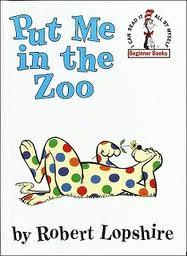
I picked this.
“Really mom?” Monkey said, “A book about animals with spots?”
In hindsight, perhaps not the most sensitive selection.
Returning the book to his shelf, I grabbed another.
I hardly looked at it.
Hubby came upstairs then and adjusted the temperature in the tank to 86 degrees.
He announced that Ich can be killed if you increase the temperature, but that the tank would need treatment too.
You know, because the parasite is all over everything. The rocks, the plants.
I hate parasites. How they get all over everything like that. They are so nervy.
Anyway, Hubby saw the book I was preparing to read.
Excellent choice,” he said, “One Fish, Two fish, Red fish, Dead Fish.”
We all laughed.
Because pathos can be funny.
Especially when it rhymes.
Hubby and I smooched our son and told him we’d work on things in the morning.
Meanwhile, I ran downstairs and hopped onto Facebook to discuss the issue.
My friend Melissa reminded me of those dog collars they used to have at fairs.
You know, the ones that have a little harness and make it look like you are walking a dog?
Only there isn’t a dog.
Because that is what we need.
An invisible pet.
And to the person who joked that we need to get a pet rock?
Can you think of other things that would be insensitive (read: really funny) to sing/read/watch/do when your kid has a fish tank contaminated by a funky parasite?
Larry Hehn is my special guest blogger today. He is the brains behind Christian in the Rough, and I feel honored to be the Jewish girl he lets hang around the joint. As Larry says, “I encourage people to find fun in the middle of dysfunction, action at the end of distraction, and grace at the end of disgrace.” Every time Larry posts something I learn something new. I really wish I knew him in real life. Feel free to Twitter-stalk him at @LarryHehn.
• • •
Ode to Werner Berth
Werner Barth was the best teacher I ever had. A wiry man with a spring in his step, a sparkle in his eye, a gravelly voice and a thick German accent, Barth had a tremendous effect on me. Strangely, it had nothing to do with the topic he was teaching.
Barth taught statics – defined in one dictionary as “The branch of physics that deals with physical systems in equilibrium, in which no bodies are in motion, and all forces are offset or counterbalanced by other forces.”
It was potentially one of the most boring subjects on earth.
But not with Barth as the teacher.
He loved to teach. And he loved his students.
He communicated ideas in ways that were fun and memorable.
One day, to illustrate the difference in direction between a positive bending moment and a negative bending moment, he stood on his chair and swung his hand up to his head. As he scratched his head, he said, “You can do this on the subway. That’s a positive bending moment.”
He then swung his hand down to his rear end. As he scratched, he said, “You can’t do this on the subway. That’s a negative bending moment.”
Twenty-five years later I still remember the difference.
What impressed me most, though, was his reaction when our entire class performed poorly on a test.
At that point he had been teaching for more than 25 years, longer than most of us in the class had been alive. But there was not an ounce of pride in Barth. At our next scheduled lesson, he pulled up a chair in the middle of the classroom, sat down and questioned us for an hour about how he could improve his teaching methods.
Even after years of learning, applying and teaching, he was still a student.
What I learned in that classroom had only a bit to do with statics, and a lot to do with a lifetime of learning, humility and working within your passion.
Sixteen years after leaving the program, I tracked him down and called him out of the blue to thank him. He remembered me. “Ah, Larry . . . skinny guy!” He remembered all of his students by name, and kept in touch with many of them.
He told me about his retirement 14 years earlier, his recent hiking trip, and how he had beaten colon cancer a few years ago. He spoke with a positive attitude and an appreciation for life that surpassed just about anyone I’ve ever known.
When I grow up, I want to be like him.
It has been eight years since that phone call. I’m sorry to say that I have again lost touch with Barth, but I know we’ll meet again. And when we do, I’m sure he’ll have a sparkle in his eye.
Can you recall a memorable lesson? Who was the teacher? What did he/she do?
• • •
If you have writing chops and are interested in submitting a piece for #TWITS: Teachers Who I Think Scored / Teachers Who I Think Sucked, write a specific memory about one teacher you had and explain how that person helped you (or really screwed things up for you), as well as the life lesson you took away from the interaction.
Essays should be around 700-800 words.
Interested but have questions? Email me!
My information is under the Contact Me tab.
NOTE: If you haven’t yet voted in the poll to determine which definition best fits for the word “castanurgle,” click HERE. The polls close on October 20, 2011 at 7 am EST.
When I was in middle school, I took horseback riding lessons from folks who lived in a broken down old house but who took fantastic care of their horses. Sometimes I came straight from ballet class, and I had to pull my jeans over pink ballet tights, leave my skirt and slippers in the car and lace up my tan Timberline boots. I was a quick study and easily learned how to get my horse to respond. I learned to give the appropriate kicks to get him to trot, to jump over logs, banks and ditches. I learned to canter, my favorite stride.
After a while, I begged my instructor to teach me how to gallop.
I was sure I was ready.
I did not look like this.
She disagreed.
One day, after school, my friend Kim suggested we take her horses out bareback – no saddles or stirrups – “Just bridles,” she’d said. “Because you always want to have the reins.”
An unseasonably warm fall day, the woods near Kim’s house were filled with trails and we casually bumped along on the horses’ backs under pine trees and blue skies. Eventually, we came to an open field where the trail disappeared. Surrounded by tall grasses, the oranges and yellows and browns of late October trees, Kim and I were quiet; our animals walked side-by-side, the sound of their hooves beating the earth was calm and rhythmic.
Until it wasn’t.
All I know is that suddenly I was clinging to the neck of an unfamiliar horse, my legs kicked out wildly behind me, bumping in an unfamiliar gait, which I assumed meant I was galloping. And since I’d never galloped before, I didn’t know what to do — especially without stirrups to steady myself.
And then I started to slip.
I tried to grab the reins that had slid through my fingers, but I couldn’t reach them. As the dust made it impossible for me to see, I had no choice but to give in to the will of a black horse that simply needed to run. And when I could not hold on any longer, I fell onto the ground, smashing my head against a big rock.
I was sure I was going to be trampled to death.
Or at least have a bloody nose.
As I huddled on the ground, I remember thinking, If I survive, one day, this will make a great story.
Truth be told, I loved the thrill of the ride, the holding on and not knowing where I was going-adrenaline-rush.
(Note: The falling off part was not so hot.)
Riding horses isn’t so different from writing. With both writing and riding, there are basics that one must first master. Just as a novice equestrian can’t go from walking to galloping in one day, a beginning writer cannot produce a great novel in a week, a month or a semester. One must first become a smart writer. One must learn the art of storytelling. Of suspense. One must understand the rules of grammar and punctuation. And then learn when it is appropriate to break these rules. One must learn the nuances of language, play with all the modes of discourse, and acquire eyes that can fearlessly revise. As well as a million other things.
If I were still actively riding horses, I would have to practice.
Every day.
Like I do with my writing.
At least seven-hundred words every day.
Because the more I practice, the easier the writing becomes.
Sometimes a piece of writing slides out effortlessly like a new foal birthed in a spring field. But other times — like with that crazy Arabian — my words get away from me and they want me to start describing things like the uncomfortable red chair in the corner of the room, which clearly does not belong in this piece. It’s okay. This ballerina-cowgirl learned long ago that sometimes she has to pull leather chaps over her jeans and tights and click her tongue and say, “No! We are not going over there!” She is not afraid to give a little kick and tug her writing in a different direction.
Some days I drop the reins on purpose and let my muse take me somewhere. And I don’t know where I’m going and the whole getting there is scary and, in the end, what I’m left with is sometimes raw or terrifying. Or awesome.
But sometimes it is a disorganized mess.
It happens.
As I said, I like the thrill of the ride: the not knowing where I’ll end up.
For me, writing is like unintentionally riding bareback on a galloping horse. It isn’t the easiest or the smartest way to get somewhere, and Lord knows it isn’t pretty to watch, but eventually I end up where I’m supposed to be. Usually without even a concussion.
What is writing like for you? I’d love to know. Or maybe you’d rather tell me about your experiences with horses. Or falling off horses. Maybe you’d rather tell me about your experiences as a dancer. Or falling as a dancer. Oh, just say something.
Sometimes "fancy" is good. Sometimes, not so much.
When I started Made-It Up Mondays, I figured it would be no big whoop.
I’d simply take one of the many made-up words I use on a regular basis and see what kind of definitions my bloggin’ friends, the wordsmiths, might conjure up.
But if there is one thing I’ve learned, it is that people have to vote when you’ve told them they are going to get to vote.
So I had to figure it out.
An hour later, I stopped shouting expletives at the computer tried again, and PollDaddy was much more cooperative.
So here’s what I’ve come up with.
I selected my top five favorite entries and entered only the definitions in PollDaddy.
Below the poll, you will find the example of the sentence that illustrates the definition as well as links to the folks who created them in that same order.
Bloggers, feel free to tell your peeps to come on over and vote for you.
Because you know you want the prize.
What do you mean you didn’t know there was a prize?
Well, of course there is a prize!
What kind of contest doesn’t have a prize?
Duh.
The winner of this week’s prize will receive a bushel of cyber-apples and several thick-skinned cyber-pumpkins, perfectly round and ready to be carved or placed on your mantle.
What do you mean you don’t have a mantle?
Yes, you do.
You know, that invisible mantle on your blog where you put all those awesome invisible awards, like the Versatile Blogger, the Stylish Blogger, the Liebster, etc. That mantle. I think a collection of autumnal fruits and veggies will look great on one lucky blogger’s cyber-mantle.
Also, the winner also has immunity in next week’s challenge and cannot be voted off the island.
Wait. Whaaat?
So – whose definition of “Castanurgle” do you like best?
A. “I want to go out for Italian tonight and my partner wants Chinese. We are facing a real castanurgle; there is no good compromise!” Chrystal.
B. “I was feeding the baby prunes this morning when I was hit by a ton of castanurgle.”She’s A Maineiac
C. “I found it difficult to interpret Ricky Ricardo’s castanurgle every time he discovered Lucy was one of his showgirls in disguise.” Julie C. Gardner
D. “C’mon kids, we’re going to visit your grandfather this weekend. I know he’s let himself go and smells like a castanurgle, but he hasn’t seen you in months and we need to help him take a sponge bath.” Brown Road Chronicles
E. “Everyone thought the sound was indicative of her being hungry; little did they know that the castanurgle was a warning that she was about to blow!” Carol H. Rives
So there you have it. And from here on out, I’m back to being a dictator.
Or a monarchy.
Or just a twit who makes up words.
And to think, I thought a castanurgle was the rare situation when a person finds him or herself with a bad head-cold in a damp castle and, after a vigorous bout of sneezing, realizes that he/she is without a single tissue.
Shows you what I know.
(NOTE: *Winners did not have to be bloggers. It just worked out that way.)
I was prescribed Klonopin for insomnia in 2005. Seven years later, after a slow, medically supervised wean, I became cognitively impaired, and after 30 months of intense suffering, I have been resurrected - a phoenix, come from the ashes, ready to battle doctors and big Pharma, while offering empathic support to those still suffering protracted withdrawal symptoms.
A perfectionist by nature, I'm learning to find beauty in the chaos. I'm the girl with the big ideas and the big hair. And words. Always words.
All rights reserved. Excerpting portions of posts and/or linking them is encouraged, provided full and clear credit is given to renée a. schuls-jacobson with proper attribution via hyperlinks directing folks to the original content. Duplication in whole or substantial portion of this site or any component is not permitted: neither is reblogging.








 renée a. schuls-jacobson